What does it take to get a first product onto six stores?

Ask a founder what it costs to put a first product into a store and you will hear a small number: 5 dollars, 19 dollars, 25 dollars, 99 dollars, 100 dollars. Those numbers are real, and they are the least interesting part. What can derail a launch date is not the fee but the gate behind it: an identity check, a group of testers who must stay opted in for two weeks, a waiting period before the release button works, a review queue measured in days or weeks. A fee is paid in one afternoon. A gate has its own clock, and the clock starts only when you reach it.
This article reads the official developer pages of Apple, Google Play, Steam, the Chrome Web Store, the Microsoft Store and Shopify, and asks one practical question: if you were planning a first launch backwards from a date, what would each store need from you, and how long before the date would you need to start? We fetched the pages on 23 November 2026. Some pages show their own date, for example Microsoft's on 29 October 2026, the Chrome registration page on 2 November 2026 and the Chrome review page on 10 December 2021, and others show none we could read. Our read date and a page's own date are different things, and store rules change often, so check the current page before you rely on any figure. We did not submit anything to any store, so we report what the documents say, not how long a real submission took us. The two charts and the sums are ours. We cover six stores.
The fee is the small part
Here is what the pages say about money. Apple's enrollment page says the Apple Developer Program is 99 USD per membership year and that prices may vary by region and are listed in local currency during enrollment. Apple also lists fee waivers. Google Play says there is a US$25 one time registration fee. Steam says you need to pay a 100 USD fee for each product you wish to distribute, calls it the Steam Direct Fee, and says it is not refundable but recoupable after the product has at least 1,000 USD of adjusted gross revenue. Microsoft says that with its new onboarding experience there are no registration fees for either account type, Individual or Company. The Chrome Web Store registration page says you must pay a one time registration fee, and the amount is on Chrome's own blog: a post from 28 April 2026 says creating a new publisher requires a fully registered developer account including a 5 dollar registration fee. Shopify's revenue share page says that to use its revenue share plan you register with the Shopify App Store for a one time fee of 19 USD per Partner account, and that the fee can be waived in some cases. That fee is per Partner account, not per app.
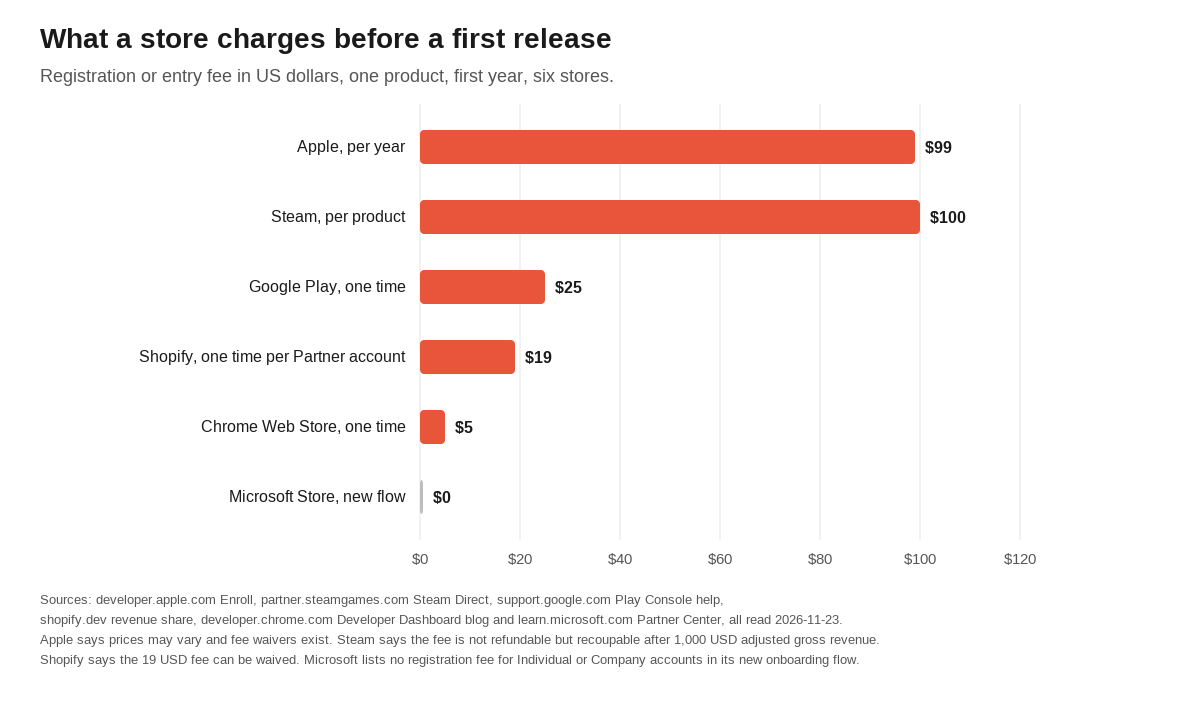
Notice that the numbers are not the same kind of number. Apple's is a subscription: it comes back every year, and one membership covers every app you ship. Google's is paid once, however many apps you publish. Steam's is per product, and so it behaves like a cost of goods for a game studio, not an account fee. Chrome's 5 dollars and Shopify's 19 dollars are one time, the first per developer account and the second per Partner account. Microsoft's is zero, with conditions we come to below.
Our second chart puts the same rules into one scenario, three products over three years from one account. Apple comes to 297 dollars, Google Play stays at 25, Steam reaches 300, Shopify stays at 19, Chrome at 5 and Microsoft at zero in the new flow.
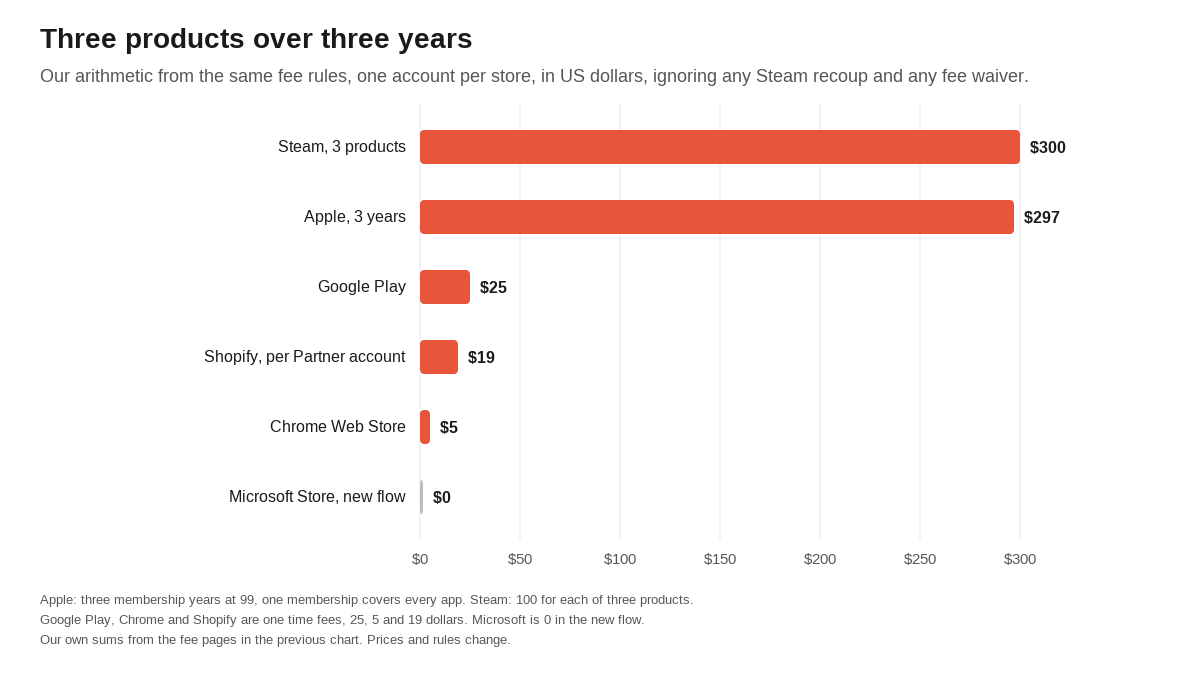
The sums are ours and deliberately simple. They ignore the Steam recoup and any fee waiver. The point is not the totals, which are all small next to a month of rent. It is the shape of each fee. A yearly fee, a one time fee and a per product fee grow differently as you ship more, so the right comparison depends on what you plan to ship and how often. The fee alone does not tell you which channel suits your product.
Google Play: the gate with a calendar
The Google Play registration page is short about money and longer about conditions. It says Google may require a valid government ID and a credit card, both issued under your legal name, and that if this information is invalid Google does not refund your registration fee. It also says personal account owners must verify access to an Android device using the Play Console mobile app before publishing apps.
The testing rule is the one that changes a schedule. According to Google's help page on testing requirements, developers with personal accounts created after November 13, 2023 must run a closed test for their app with a minimum of 12 testers who have been opted in continuously for at least 14 days. When they meet these criteria they can apply for production access on the Dashboard, and when they apply they answer questions about their app design, testing process and production readiness. The page says closed testing must happen before applying to publish to production.
Do the arithmetic backwards. If your target release is the first of the month, the earliest you can apply is 14 days after your twelfth tester joined and stayed in, and that assumes the twelve people are recruited on day one. A founder who starts recruiting testers a week before the release date has already missed it. After you apply, the same page says Google reviews the submission and that review usually takes seven days or less, but can occasionally take longer, and that you may have to keep running the closed test if you have fewer than 12 opted in testers or insufficient tester engagement. That is not a guarantee of timing, only a reason to leave room. The rule applies to personal accounts, so an organization account follows a different path, which is a good reason to read the page about choosing an account type before you pay anything.
Steam: a fee, then a wait
Steam's gate is a number of days, and it is stated plainly. Steam Direct lists a 21 day waiting period between when you paid the app fee and when you can release your game, and says this gives Steam time to review your information and confirm that it knows who it is doing business with. The same page lists other steps. Before your store page or build can go live there is a review that it says takes between 1 and 5 days, and you need a publicly visible coming soon page for at least two weeks. The page does not give a formula that adds these together, and some of them can run in parallel, so we do not add them up. The 100 dollar fee for each product is also a deposit you may get back: the page says it becomes recoupable in the payment made after your product has at least 1,000 USD of adjusted gross revenue for store sales and in app purchases.
For a small team the practical lesson is to pay the fee early and treat the 21 days, the coming soon page and the review as lead time that can overlap. The fee is paid once per product, so it is cheap to pay while the game is still a prototype, and it starts a clock before the work is finished. Paying it does not by itself make a game ready to release three weeks later.
Chrome Web Store: a range, not a date
The Chrome Web Store has no fixed waiting period, only a range. Its documentation says review times can vary and may fluctuate for a number of reasons. For most extensions, it says, review is completed within a few days, but it can take up to a few weeks, and if an extension is pending for more than three weeks you should contact developer support.
The same page lists what makes review slower. It says reviews may take longer for extensions that request broad host permissions or sensitive execution permissions, or that include a lot of code or hard to review code. Host permission patterns such as all URLs are called out. A range of a few days to a few weeks is hard to plan around, and the useful reading is that you control part of it: an extension that asks for narrow permissions and ships readable code is described as easier to review. Request only what the feature needs, and say so in the listing.
Microsoft Store: free, with a condition
Microsoft's page opens with good news: with the new onboarding experience there are no registration fees for either account type, so you can create a developer account and start publishing at no cost. The conditions are in the details. The page describes two account types and says which to choose by the use, not by the name on the account. Individual is for independent developers whose distribution of apps is not in relation to their business, trade or profession, small scale creators producing content for non commercial purposes, and people making digital content as a hobbyist, amateur, school or personal project. Company is for independent developers and freelancers whose distribution is in relation to their business, trade or profession, even under their own name, as well as businesses, organizations, and teams or groups within a company. A solo founder selling a commercial product therefore reads as a Company case, which is worth checking against the page before you pay anything. The page also says changing an account from Individual to Company is not supported, so to publish as a company you create a new Company account. For individuals the FAQ says the new flow is only for new individual developers creating their account for the first time, and that ID verification is required. The company steps say you start at storedeveloper.microsoft.com, the only supported entry point for company onboarding, verify the business with a DUNS number, which the page recommends for faster verification, or with official business documents, and use a work email on your company's domain. The page says other paths, such as going directly through Partner Center, Xbox or Visual Studio, show the legacy flow.
A zero fee can turn into a fee if you enter through the wrong door, so start at the supported address and read the account type comparison first.
Apple and Shopify: read the steps, not only the price
Apple's enrollment page, where the 99 dollar fee is stated, ties it to a sequence: your enrollment information is verified, you agree to the Apple Developer Program License Agreement and you complete the membership purchase. For organizations the page says a DUNS number is required, with government entities excluded, so that Apple can verify the organization's identity, legal entity status and address. We did not find a stated review time for apps on the pages we read, so we give none, and a founder planning a date should treat Apple review as an unknown to test with a real build early.
Shopify's distribution page says public distribution requires registering for the Shopify App Store, and its revenue share page gives the amount, 19 USD once per Partner account. It says registration is not required if you only develop custom apps for a single merchant, and that you must link all your associated developer accounts during registration. The distribution page also says you cannot change the distribution method after you select it, and advises selecting it on the production app if you have separate apps for development and production. That is a Shopify rule, not a Microsoft one, and it is easy to miss.
Planning backwards from a date
These steps follow from the pages above. They are suggestions, and the time each takes depends on your situation.
- Pick the date, then list the gates. For each store write down the fee, the identity check and any waiting period or testing rule, using the current page.
- Start the slowest clocks first. In this set that is the Google Play closed test with 12 testers for 14 days followed by the production access review, and for Steam the 21 day waiting period, the two week coming soon page and the 1 to 5 day review, which can overlap.
- Decide the account type before paying. Google separates personal and organization accounts, Microsoft separates Individual and Company accounts and the new and legacy flows, Apple asks organizations for a DUNS number and Shopify fixes the distribution method once chosen.
- Use the supported entry point. Microsoft names one address for its new onboarding, and the other paths show the legacy flow.
- Keep permissions narrow. For Chrome extensions, broad host permissions are named as a reason for slower review.
- Keep the receipts. Fees can be non refundable, as Steam says, and Google says it does not refund the fee if your identity information is invalid.
- Write the date of the last gate next to the launch date. Seeing both in one place shows how early the work has to begin.
Where this fits
The commission a store takes is a separate question from the fee to enter, and we covered it in our article on what the app stores take from a small app subscription. Cash timing after the first sale is in how long Stripe takes to pay a new small SaaS.
When your product is ready to be seen, you can submit it to RadarMakers for free, and you can browse the apps category and the browser extensions category to see how other small products present themselves.
Sources
All pages were fetched on 23 November 2026 and read as extracted text. That is our read date. Some pages show their own dates, noted below, and others show none we could read. The charts and the three year sums are our own arithmetic.
- Apple, Enroll, 99 USD per membership year, prices may vary by region, the enrollment and purchase steps and the DUNS number for organizations. The older compare memberships address now redirects to Apple's page about your developer account, and the amount is taken from Enroll.
- Google, Create a Play Console developer account, the US$25 one time fee, possible ID and card requirements under your legal name, no refund for invalid information, device verification for personal accounts; and App testing requirements for new personal developer accounts, the closed test with at least 12 testers for at least 14 days for accounts created after November 13, 2023, the production access review usually seven days or less, and possible continued testing.
- Valve, Steam Direct, the 100 USD fee for each product, not refundable, recoupable after 1,000 USD adjusted gross revenue, the 21 day waiting period, the coming soon page for at least two weeks and the review of 1 to 5 days.
- Google, Chrome Web Store registration, a one time registration fee, last updated 2 November 2026; Developer Dashboard roles blog post, published 28 April 2026, the 5 dollar registration fee; and review process, last updated 10 December 2021, review within a few days up to a few weeks, three weeks before contacting support, and the factors that slow review.
- Microsoft, Open a developer account, no registration fees in the new onboarding for Individual and Company accounts, the storedeveloper.microsoft.com entry point, the FAQ on new individual developers, the criteria for choosing Individual or Company by use, ID verification, the company verification steps and no change from Individual to Company; dated 29 October 2026.
- Shopify, App distribution, public distribution requires registering for the Shopify App Store and the distribution method cannot be changed once selected; and Revenue share, the one time fee of 19 USD per Partner account, possible waiver and linking associated developer accounts.
0 replies
Sign in to join the discussion
Log in