Which free hosting limit hits a small SaaS first?

Most advice about free hosting plans is a list of quotas: so many gigabytes, so many requests. For a small SaaS it can be worth reading something else first. A product with a modest number of users may never use up a monthly allowance, and what can hurt early, depending on the app, is behaviour: a database that pauses, a server that goes to sleep, a plan whose terms say it is not for commercial use. Those limits do not show up as a bar that fills. They show up as a customer waiting for a page, or a support email on a Monday.
This article reads the public pricing and documentation pages of five platforms that small teams commonly start on: Supabase, Neon, Render, Vercel and Cloudflare. We fetched the pages on 23 November 2026. Some of the pages show their own last updated date, such as Vercel's terms on 19 October 2026, the Vercel Hobby page on 12 November 2026, the Workers limits page on 19 November 2026, Neon's pricing page on 4 November 2026 and the D1 page on 30 October 2026, and others show none. Our read date and a page's own date are different things, and free plans change often, so treat every figure as the state of the page when we read it and check it again before you decide. We did not run a workload on any of them, so nothing here is a benchmark. The two charts and the arithmetic in the examples are ours, and we say where an assumption is ours.
Some limits are rules, not quotas
A quota is a number you can watch. A free plan also contains rules that fire without any usage at all, and those can surprise a founder who is busy building features.
Our chart below puts four of them on one axis. It is logarithmic, because the gap between the shortest and the longest is large: 5 minutes at one end, 30 days at the other.
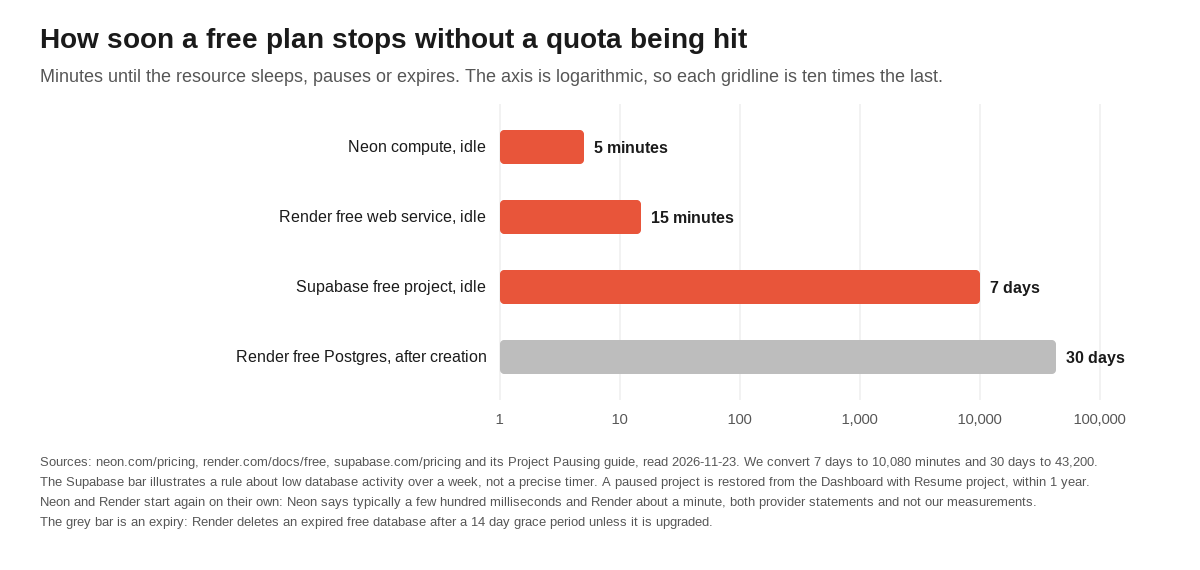
Three of the four bars are idle timeouts. Neon's pricing page says compute on the free plan scales to zero when idle and lists the trigger as after 5 minutes of inactivity. Render's documentation says it spins down a free web service that goes 15 minutes without inbound traffic, and that spinning back up takes about one minute while visitors see a loading page. Supabase's pricing page says free projects are paused after 1 week of inactivity, and its guide on pausing says the trigger is low activity over a 7 day period: typically a few user requests to the database each day over the previous week are enough to keep a project from being paused. Supabase says it emails a warning about a week before the pause and again when the project is paused, and that a paused project is restored from the Dashboard with Resume project, within 1 year. The fourth bar is different in kind. Render's free Postgres database expires 30 days after creation, and after a 14 day grace period Render deletes it with its data unless it is moved to a paid compute plan.
One practical point is the shape of your traffic, not only its size. A tool used mostly by businesses in one time zone can be quiet for long stretches every night, so a 5 or 15 minute timeout may be reached daily, and the first visitor after a quiet period may be the one who waits. The Supabase rule is about database activity, not signups. A product whose database sees a few queries a day may stay awake, while one that goes untouched for a week or more, for example a prototype left alone after a demo, is a candidate for a pause. The chart converts the week into minutes to put it on the same axis, as an illustration of the rule and not a precise timer for every project.
What a cold start costs you
The idle rules do not all end the same way, and two of the pages give a wake time. Render says about one minute for a free web service, and a loading page is shown meanwhile. A minute is a long wait for a visitor, and some may leave. Neon's pricing FAQ says a database starts again on the next query, typically within a few hundred milliseconds. That is the provider's own statement, not our measurement and not a guarantee. Supabase is different: a paused project does not start by itself on the next request, and the guide says you resume it from the Dashboard. We give no wake time for Supabase because its pages give none. If you rely on a free database that scales to zero, measure the first query after a quiet hour yourself and write the number down.
A second effect is easy to miss. Render's page says a free web service has an ephemeral filesystem. Files you upload, and a local SQLite database, are lost every time the service redeploys, restarts or spins down. That is a limit on where you may keep state, and it is separate from quota. The same page says free web services cannot send outbound traffic on ports 25, 465 or 587, the ports commonly used for SMTP. A signup flow that sends a confirmation email directly from the app will fail there, so email has to go through an HTTP API of a mail provider instead.
Storage is a number that only grows
Database size only goes up, so it is worth sizing early, although which limit a given app reaches first depends on its workload and we have no model that ranks them. The second chart compares the free database size on four platforms, counting 1 GB as 1,000 MB.
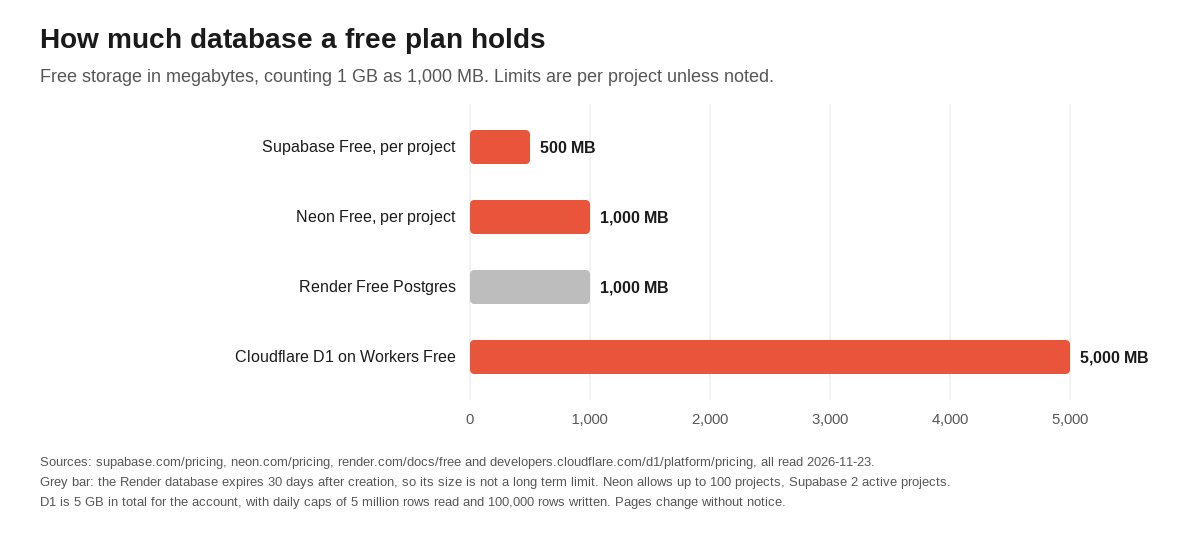
Supabase lists 500 MB of database size per project, with a limit of 2 active projects. Neon lists 1 GB of storage per project, with up to 100 projects. Render's free Postgres has a fixed 1 GB, only one can be active in a workspace, and it expires as described above, so its size tells you little. Cloudflare D1 on the Workers free plan allows 5 GB in total, but it is capped by the day as well: 5 million rows read and 100,000 rows written.
How many customers is 500 MB? Suppose, as our own assumption and not a measurement, that one account with its related rows and indexes takes about 5 KB. Then 500 MB holds around 100,000 accounts. For a product that stores only rows, that may be more than it has early on, though we cannot know your numbers, and storage may not be the first limit you meet. Files change the picture. If you store uploads, invoices or images in the database, 500 MB can go quickly, so consider keeping them in object storage and the database for rows. Neon's page lists 5 GB of object storage per project on its free plan, and Supabase lists 1 GB of file storage.
The limit that is a rule, not a number
A line worth reading on Vercel's side is not in the usage table. Vercel's terms of service say that on the Hobby plan you shall use the services only for personal or non commercial use. A SaaS that charges money is a commercial use. The Hobby plan page lists generous usage, including 1,000,000 function invocations, 1,000,000 CDN requests and 100 GB of fast data transfer a month. That headroom is real, and it does not change what the terms say about the intended use of the Hobby plan.
That is section 4, Hobby Plan, of the terms, last updated 19 October 2026. The same section says Vercel may shut down or remove projects on the Hobby plan without notice. A different part, section 3, Your Content, says that on a Hobby plan or a trial Pro plan you agree Vercel may use Your Content to train its AI and machine learning models and may share it with third parties for the purpose of developing and improving their products. It adds that on a paid Pro plan Model Training is not enabled by default and you may opt in, and that you may opt out of Model Training at any time by adjusting your Team account settings or by upgrading to an Enterprise plan. Read these sections before you put customer data on a free plan. We read the text and did not check how any particular database or customer data is processed, and the current text may differ from what we saw.
Vercel's limits page adds a smaller point for debugging. Runtime logs are stored for 1 hour on Hobby, 1 day on Pro and 3 days on Enterprise. If a customer reports an error from yesterday, there is nothing to read on the free plan.
Daily caps hit on your best day
Cloudflare's Workers free plan allows 100,000 requests a day, resetting at midnight UTC. The daily limit is on the pricing page, and the reset and the behaviour after the limit are on the limits page, which says that when a Worker exceeds the limit Cloudflare returns Error 1027. That page describes two route modes. Fail closed returns the 1027 error page, and fail open bypasses the Worker, so requests behave as if no Worker is configured. What a visitor sees therefore depends on how your route is set. A daily cap behaves differently from a monthly one. Multiply it by 30 and it looks like 3 million requests a month, which seems ample as an illustration, not a pool you can spend freely. The cap applies to each day separately, so a single good day, such as a launch or a mention in a newsletter, can break the product at the moment attention peaks.
A rough example, with an assumption that is ours: if a page view causes three requests to a Worker, one for the page and two for API calls, 100,000 requests is about 33,000 page views a day. Static assets are served under separate rules, so this counts Worker invocations only. That may be comfortable on a normal day and thin on a launch day that sends many visitors who each click around. D1 has the same shape, with 100,000 rows written a day. A signup that writes a handful of rows is fine, but a bulk import or a retry loop that fails and tries again can burn the daily write allowance in minutes.
Compute you do not see
Neon measures database compute in CU hours, and the free plan gives each project 100 CU hours a month. The page says that at 0.25 CU, the default size on the free plan, 100 CU hours covers about 400 hours of active compute, more than half the hours in a month. It also says a project that uses up its CU hours has its compute suspended until the next billing period, and that none of the limits delete data. For a product used during working hours that is comfortable. For one with a background job that keeps the database awake all night it is not, because a busy database does not scale to zero.
Render's free web services work on a different meter. Each workspace gets 750 free instance hours per calendar month. The page says a spun down service does not consume hours, and that if a workspace uses all of them, Render suspends the free web services until the next month. A single always on service fits, since even a 31 day month has 744 hours. A second always on service in the same workspace would not.
Backups and the restore question
A product is only as safe as its last good copy. The pricing pages are specific here and the answers are not good. Supabase lists automatic backups and point in time recovery as not included on the free plan, and says daily backups stored for 7 days start on the paid plans. Render's documentation says free Postgres databases do not support any form of backups. Neon's free plan has a restore window of up to 6 hours or 1 GB of data changes and one snapshot, according to its pricing table. That is a short undo rather than a backup you could rely on after a bad deploy discovered two days later.
If a paying customer's data lives on a free plan, you are responsible for a copy outside it. A scheduled dump to storage you control is a modest task, though the effort depends on your stack. Our article on restoring a backup for a small SaaS goes through why testing the restore matters as much as taking the dump.
A checklist before you pick a free plan
These steps follow from the pages above. They are suggestions, and how long each takes depends on your setup.
- Read the terms, not only the pricing table. Look for the words personal use, non commercial, and any statement about training on your content. For a Hobby plan that is the first line to check.
- List the idle rules. Write down the idle timeout, the pause rule and any expiry for each piece, then decide whether your visitors can tolerate the wake time.
- Find the daily caps. A daily request or row limit needs a margin of several times your normal day, because your best day is the one you care about.
- Keep state outside the free instance. Do not keep uploads or a local database on an ephemeral filesystem.
- Check outbound email. If ports 25, 465 and 587 are blocked, plan to send through an HTTP API.
- Take your own backup. Assume none exists on a free plan and schedule a copy elsewhere.
- Put the upgrade trigger in writing. Pick the event that moves you to a paid plan, such as the first paying customer, and write it next to the launch date.
Where this fits
Free plans are a good way to learn and to run a prototype, and several of them say plainly that they are not meant for production. Render's documentation says free instances are not for production applications. Treat that as a design input and not as a trick to get around. Cost belongs in the same plan as the rest of the money questions, so see our articles on what a domain name costs over five years and on how long Stripe takes to pay a new small SaaS.
When your product is ready to be seen, you can submit it to RadarMakers for free, and you can browse the developer tools category and the best developer tools to see how other small products present what they do.
Sources
All pages were fetched on 23 November 2026 and read as extracted text. That is our read date. Some pages show their own last updated date, noted below, and others show none. The charts, the 30 day conversions, the account size assumption and the page view example are our own arithmetic.
- Supabase, Project Pausing, pausing on low activity over a 7 day period, a few daily requests typically enough, warning and confirmation emails, Resume project, 1 year restore window.
- Supabase, Pricing, free plan limits: 500 MB database size per project, 2 active projects, projects paused after 1 week of inactivity, 1 GB file storage, no automatic backups or point in time recovery on free, daily backups stored for 7 days on the paid plan.
- Neon, Pricing, last updated 4 November 2026, free plan, and its FAQ on pausing and restarts, typically a few hundred milliseconds, a provider statement: 100 projects, 100 CU hours a month per project, 1 GB storage per project, compute scaling to zero after 5 minutes of inactivity, restore window of up to 6 hours or 1 GB of changes, 1 snapshot, 5 GB object storage per project, suspension on reaching the CU hour limit without deleting data.
- Render, Deploy for Free, free web services: spin down after 15 minutes without inbound traffic, about one minute to spin up, ephemeral filesystem, 750 free instance hours a month, blocked outbound SMTP ports; free Postgres: 1 GB, one per workspace, 30 day expiry with a 14 day grace period, no backups.
- Vercel, Hobby plan, included monthly usage, and Terms of Service, last updated 19 October 2026, section 4 on the Hobby plan and section 3 on Your Content with Model Training and its opt out; the Hobby page is dated 12 November 2026; Limits, dated 16 September 2026, runtime log retention of 1 hour on Hobby.
- Cloudflare, Workers pricing, dated 18 November 2026, the 100,000 requests a day limit on the free plan; Workers limits, dated 19 November 2026, Daily requests, the reset at midnight UTC, Error 1027 and the fail open and fail closed route modes; and D1 pricing, dated 30 October 2026, 5 GB total storage, 5 million rows read and 100,000 rows written a day on the free plan.
0 replies
Sign in to join the discussion
Log in