How long does Stripe take to pay a new small SaaS?

The first sale of a new product feels like cash, but for a while it is only a promise. The money has to move from the customer's bank to the payment processor, from the processor's pending balance to your available balance, and from there to your own bank account. Each step has its own clock, and the clocks are counted in different kinds of days. For a small SaaS with no savings that gap is worth planning, because rent, hosting and the next tool subscription do not wait for it.
This article works through the timing rules in Stripe's public documentation, which we use as one concrete example of how a processor describes them. We read the pages on 21 November 2026. The country table, the weekday counts and the cash examples below are either quoted from those pages or our own arithmetic on the rules they state, and we say which is which. Stripe shows no last updated date on these pages, so treat the rules as a snapshot and check your own dashboard before you rely on a number.
Two clocks, not one
Stripe's page on balances defines settlement time as the time between when a payment is made and when the funds become available in your Stripe balance. Its example is a 100 dollar card payment made on a Monday in the United States. The funds are pending first, and they are available in the balance on Wednesday, two business days later.
Available is not the same as paid out. A separate page on payouts describes how available funds travel to your bank. Payouts can be manual, daily, weekly or monthly. For daily payouts the page says Stripe automatically transfers your available funds every business day. For manual payouts it says they typically take 1 to 4 business days to arrive in your bank account after you start them.
There is a third rule that matters only once. The balances page says the initial settlement timing applies to your first payout, and the default timing applies to later payouts. The payouts page adds that after you receive your first live payment, Stripe typically schedules your initial payout within 7 to 14 days, depending on industry, country of operation and risk level. We do not try to reconcile this range with the 7 calendar days in the country table, because the two pages measure slightly different things and neither explains how they combine. For planning, use the longer one.
What a day means
The same page defines two kinds of days. Calendar days include every day, including weekends and holidays. Business days are working days, typically Monday to Friday, and exclude public holidays. The page gives one example of why this matters. A charge created on a Saturday has two different timings. With calendar days, Saturday is day 0. With business days, the next Monday is day 0.
We turned that rule into a table of waits. For each weekday of the charge we counted the calendar days until the funds are available, under rules of two, three and four business days, and next to them a flat seven calendar days. We ignore public holidays, which would add days.
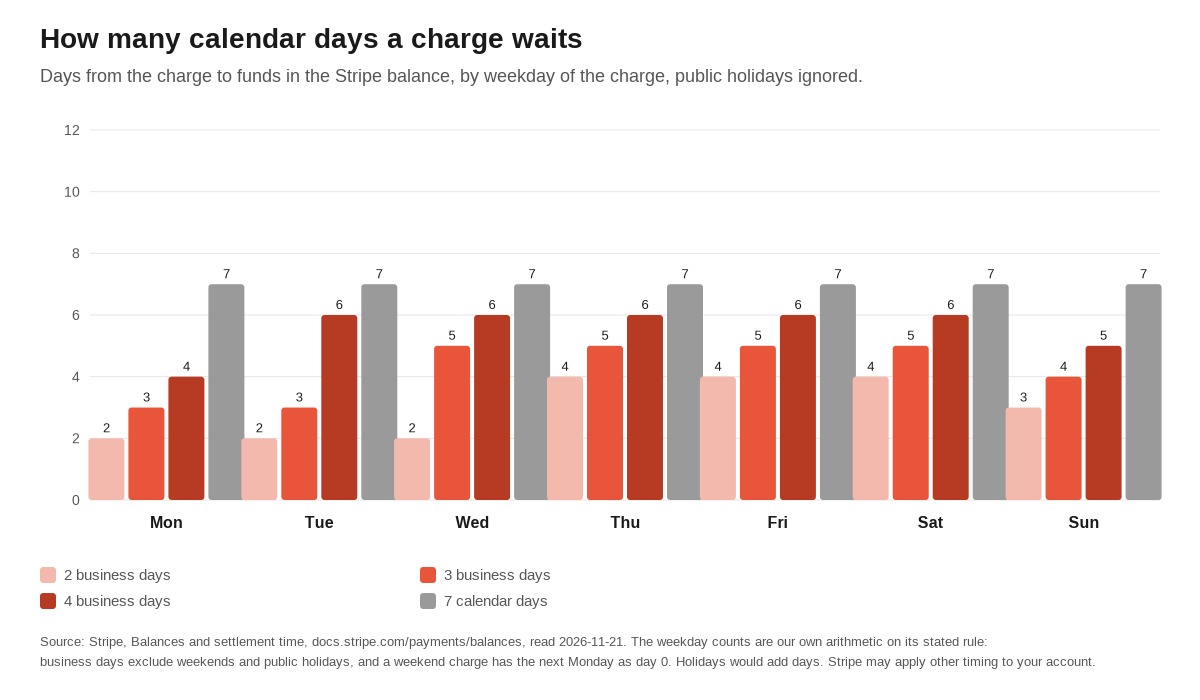
Three things stand out. First, a rule of three business days is not three days. It is three calendar days on a Monday or a Tuesday, five on a Wednesday through a Saturday, and four on a Sunday. Second, the weekend matters twice. A Saturday charge under two business days waits four calendar days, longer than a Monday charge, because Monday only becomes day 0. Third, the shortest and the longest wait under the same rule differ by two calendar days.
If charges arrive evenly across all seven days of the week, the average wait is 3.0 calendar days under two business days, 4.3 under three business days and 5.6 under four. That average is the number we use for the cash examples below. A product that sells mostly on weekdays, as many business tools do, will see slightly different averages.
What the country table says
The balances page lists 45 countries with an initial and a default settlement timing. We copied the table into a data file and grouped the countries by rule.
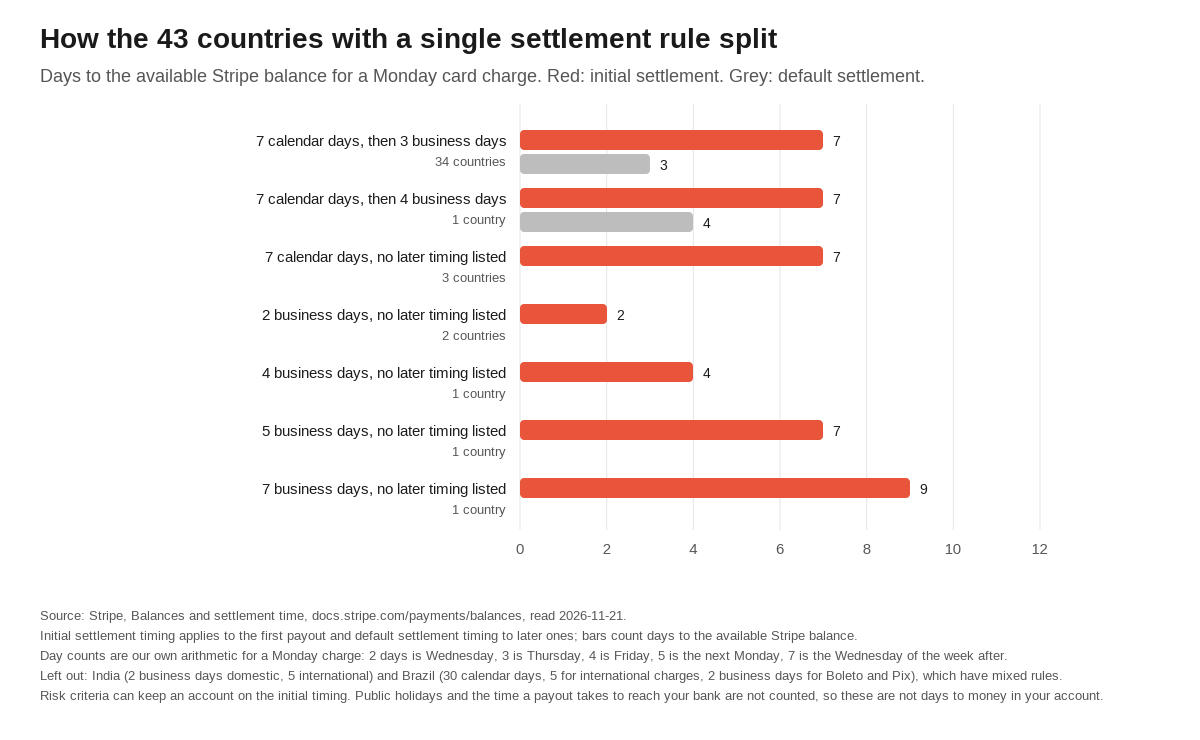
The biggest group has 34 countries, among them the United Kingdom, Canada, Mexico, Switzerland, Norway, Poland and most of the European Union. Their initial settlement timing is 7 calendar days and their default settlement timing is 3 business days. For a Monday charge that is 7 days, then 3, counted to the available Stripe balance and not to your bank account. Japan is the only country with 7 calendar days initially and 4 business days by default. Hong Kong, Malaysia and Singapore list 7 calendar days with no separate later timing.
The United States and Australia list 2 business days with no separate later timing. New Zealand lists 4 business days, the United Arab Emirates 5 and Thailand 7. India and Brazil have mixed rules that we kept out of the chart. India lists 2 business days for domestic charges and 5 for international ones. Brazil lists 30 calendar days, 5 calendar days for international charges and 2 business days for Boleto and Pix.
The practical reading is that a founder in a country of the large group waits longest at the start and gets faster later, while the table lists a single settlement timing for the United States and Australia. That is a reading of the table, not a promise that the first payout reaches your bank after that time. Where the table shows a dash for the default timing, we read it as no separate later timing, which is our interpretation, since the page does not define the dash. The page also warns that in some cases risk criteria might prevent your account from changing to the default settlement timing, so the faster rule is not guaranteed.
What the delay costs at three revenue levels
Settlement delay is money you earned and cannot use. We put numbers on it with a plain assumption: revenue arrives evenly across the month, 30 days to the month, and the delay is the exact average of 30 divided by 7 days for a three business day rule, shown as 4.3. We also show the first week of a new account on the 7 calendar day rule, where nothing has been released yet.
| Monthly sales | Per day | In transit in steady state, 4.3 days | Pending after the first 7 days |
|---|---|---|---|
| $1,000 | $33 | $143 | $233 |
| $5,000 | $167 | $714 | $1,167 |
| $20,000 | $667 | $2,857 | $4,667 |
The formula is monthly sales divided by 30, times the exact average of 30 divided by 7 days for the steady state, and times 7 for the first week. We keep the exact values and round to whole dollars only at the end, which is why the table shows $714 and $2,857. It models only the pending settlement and ignores refunds, fees and the payout step, so it is not the size of the cash buffer you need. It also shows a pattern that surprises people. In steady state the delay ties up about 14 percent of a month's sales, which is 4.3 days out of 30. In the first week of a new account the pending sum is about 23 percent of a month's sales, and none of it has reached you yet. The first payout is the moment a new product most needs patience, and the moment it is least likely to get it.
What can make the wait longer
The balances page names several things that hold money back. The first is a reserve balance. The page says Stripe might create one to cover expected refunds or disputes, and that funds in it cannot be paid out or transferred until the reserve hold period is complete. It does not state how long the hold lasts or what triggers it.
The second is the payment method. Bank payments settle more slowly than cards, because they carry a higher risk of returns or reversals. The page lists ACH Debit at 4 business days, SEPA Direct Debit at 6, Bacs Direct Debit at 4, Canadian pre authorized debit at 5, and USD bank transfers at 5. Australian and New Zealand direct debit are listed at 2. For eligible US businesses Stripe offers faster ACH, which reduces 4 business days to 2 from payment creation.
The third is your own setting. The page says you can set a minimum balance to cover refunds, disputes and fees that might lead to a negative balance, and that this helps you avoid paused payouts and automatic debits to your external accounts. A minimum balance also keeps part of your money in Stripe, so it is a trade, not a free option.
None of these is a surprise to someone who has read the pages, but a founder who has only read the marketing line about getting paid in two days will meet them on the first payout.
Instant payouts
Stripe also offers Instant Payouts, which move funds to a debit card or a supported bank account, usually within 30 minutes according to its page. The page lists 36 countries, and limits each account to 10 Instant Payouts a day. It says new Stripe users are not immediately eligible. It also says Stripe charges a fee on each Instant Payout, but the page gives no amount, so we cannot price it for you. The balances page says Instant Payouts give you access to funds immediately after a successful card charge, subject to eligibility. The Instant Payouts page says funds from bank debits wait until they settle.
For a new product the useful lesson is that the fastest option is not available at the moment the delay hurts most. Plan the first month on the standard rules.
Before your first sale
These are the steps that follow from the rules above. None needs more than an hour.
- Find your country in the table. Write down the initial and the default timing, and whether each is in business or calendar days.
- Convert to your weekday pattern. Use the weekday chart, or count it yourself, and note that a weekend charge starts on Monday under business days.
- Plan a buffer from your own rule. Use the expected deposit date shown in your Stripe Dashboard as the starting point and keep a margin beyond it. If you instead build an estimate from settlement timing, account for your payout schedule and bank processing time separately. As an example, for a country in the 7 calendar day group the payouts page quotes a typical 7 to 14 days for the initial payout, so a buffer of about two weeks plus bank time is a starting point, not a guarantee. Brazil lists 30 calendar days, and the range depends on your account.
- Check the payout schedule. The page lists manual, daily, weekly and monthly payouts. Brazil and India are always automatic and daily, and Japan has no daily payouts.
- Test in a sandbox, then watch a genuine sale. Check the integration in a Stripe sandbox. Stripe's testing page says not to test in live mode with real payment details, so do not charge your own card to start the clock, and do not assume a sandbox payment starts it. The payouts page ties the initial payout to your first live payment, so the first payout date is best observed on a genuine sale to a real customer, for example in a real pilot before launch.
- Decide on a minimum balance. Compare it with your expected refunds in the first month before you set one.
- Write the date into the plan. Put the first expected payout date in the same document as the launch date.
Where this fits
Timing is one input to cash planning, next to fees and tax. Our article on the merchant of record decision covers the fee side, and the one on app store commissions covers what a store keeps. More articles on pricing and payments are in Community.
When your product is ready to be seen, you can submit it to RadarMakers for free, and you can browse the fintech category and the best developer tools to see how other small products position themselves. A launch checklist is available as well.
Sources
All pages were read on 21 November 2026 through a web fetch agent. The country table was read verbatim from the raw markdown of the balances page. No page shows a last updated date. Every day count in the charts and the table, and the averages, are our own arithmetic on the stated rules, not figures Stripe publishes.
- Stripe, Balances and settlement time, definition of settlement time, the Monday example, calendar days and business days, the Saturday example, the table of 45 countries with initial and default settlement timing, timing by payment method, the reserve balance, the minimum balance and faster ACH.
- Stripe, Receive payouts, the 7 to 14 day wording for the initial payout, payout schedules, the restrictions for Brazil, India and Japan, and the 1 to 4 business days for manual payouts.
- Stripe, Testing, the guidance to test in a sandbox and not to use real payment details in live mode.
- Stripe, Instant Payouts, 36 listed countries, the limit of 10 a day, arrival usually within 30 minutes, new users not immediately eligible, and a fee with no amount stated on the page.
0 replies
Sign in to join the discussion
Log in