When does a merchant of record pay off against Stripe plus Stripe Tax for a small SaaS?

A merchant of record sells your product to the customer in its own name, so it takes on the sales tax, fraud and dispute work that a plain payment processor leaves with you. That convenience has a price, and for a small SaaS the useful question is not which platform lists the lowest rate. It is how large the extra fee is compared with doing the tax work yourself. This article does not settle that for you. It computes a partial fee threshold under stated assumptions: the fee premium of a merchant of record over a baseline of Stripe Payments plus Stripe Tax, and the number of sales a month at which that premium reaches an amount you choose for your own tax work. It is not a full cost comparison and it is not legal or tax advice.
Check this first: Lemon Squeezy is closed to new sellers
Lemon Squeezy was the default merchant of record for small makers, so a change there matters before any comparison. Its migration page says that it stopped accepting new users and new store sign ups on 16 November 2026 and will stop processing on 31 March 2027. The page recommends that existing sellers move to Stripe Managed Payments, which Stripe describes as its merchant of record solution for digital products such as SaaS. A new seller cannot choose Lemon Squeezy at all, so it is not in the charts below.
If you already sell through it, its published fee rules explain why your own number can be higher than the headline. The platform fee is calculated on the total order value, tax included. On top of 5% plus 50 cents there are extra charges of 1.5% for international transactions, 1.5% for PayPal and 0.5% for subscription payments, and payouts can carry a fee that depends on the method and the country. For products priced under 10 dollars the same page says to contact sales for custom pricing. Use your own statements for a real figure, and plan the move before the end of March 2027.
What this model covers and what it leaves out
The numbers below are deliberately narrow, so that each one can be checked against a page.
- One sale, one currency. A card sale in US dollars. The price is before tax. Where a platform charges its fee on the total including tax, as Lemon Squeezy and Creem describe, the real fee is a little higher than shown here.
- Base platform fees only. No tax itself, no payout or transfer costs, no currency conversion, no disputes, no refunds and no per transaction rounding. Creem's own explanation of payouts says that transfers and partner currency conversion can cost extra, and other platforms may incur similar costs.
- No surcharges. No international card fee, no PayPal fee and no subscription fee. Polar lists an extra 1.5% for cards from outside the US. Creem lists no international card fees. If most of your buyers are abroad or on subscriptions, redo the arithmetic with those lines.
- Fees are not total costs. A fee figure is never the full cost of selling. It leaves out your time, your accountant and the cost of a mistake.
- The Stripe baseline is conditional. Stripe lists Stripe Tax Basic at 0.5% per transaction where you are registered to collect taxes, so it is not a charge on every sale everywhere. The baseline assumes that all 100 sales in the example are in such places and that you use Tax Basic. Stripe Billing, which a subscription business may also need, is left out on both sides, for Managed Payments as well as for the baseline. Managed Payments includes indirect tax compliance, fraud prevention, dispute responses and support in its fee, while the baseline may need other products or work that are priced separately or not at all on a pricing page.
Everything in the charts is our own arithmetic on the rates below. Platforms publish rates, not these totals.
The rates, with one limit on Stripe
We read the public pages on 18 November 2026. In plain words:
- Paddle takes 5% plus 50 cents per transaction, with no monthly or migration fee on its listed plan. The page also lists custom pricing for high volume, low value transactions, so a very cheap product should ask before relying on the headline rate.
- Polar has a free Starter plan at 5% plus 50 cents, and paid plans that swap a monthly fee for a lower rate. Pro costs 20 dollars a month at 3.8% plus 40 cents. Its page lists a break even of about 1,379 dollars of monthly sales for Pro against Starter. By our arithmetic that matches an average sale near 40 dollars. At a 19 dollar price the monthly fee is covered after 61 sales, or about 1,159 dollars.
- Creem takes 3.9% plus 40 cents with no monthly or setup fee. Its blog adds extra percentages for affiliates, revenue splits and recovered carts.
- Gumroad lists 10% plus 50 cents for direct sales on its pricing page, but its fee help page says card processing of 2.9% plus 30 cents is not included in that. For a card sale the direct total is therefore 12.9% plus 80 cents. Sales that start in its Discover marketplace cost a flat 30% that includes processing, and its tax charge is added separately.
- Stripe. Stripe's US pricing page lists 2.9% plus 30 cents per successful domestic card transaction, which our reviewer confirmed on the US page. When we fetch the same address from this machine, we are served the Poland version, so we read two other Stripe pages directly. The Managed Payments page says it adds 3.5% per successful transaction to standard Stripe processing fees and includes global indirect tax, fraud prevention, dispute responses and transaction level support, with Billing and some payment methods optional and priced separately. The Stripe Tax page lists Tax Basic at 0.5% per transaction where you are registered to collect taxes. Gumroad's fee page and the Creem blog also state the 2.9% plus 30 cents rate. None of this proves that every business is eligible for these terms.
How much of a sale the base fee takes
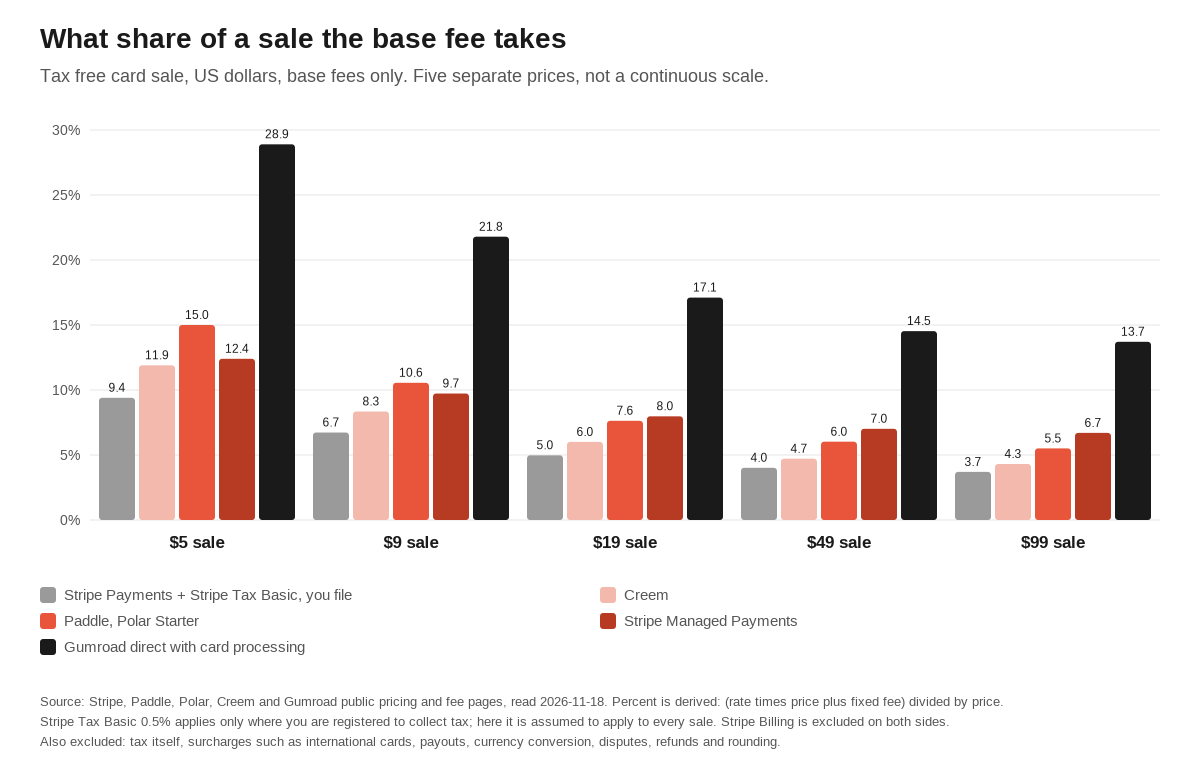
A fee made of a percentage and a fixed amount takes the largest share of small sales. The chart compares five prices as separate groups, because the prices are not evenly spaced, and a line through them would suggest a smooth scale that does not exist. The grey bar is the baseline: Stripe Payments plus Stripe Tax Basic, with you doing the filing.
Three things stand out.
- At five dollars every option is expensive. A 5% plus 50 cents rate takes 15.0% of the sale, and Gumroad's direct rate with card processing takes 28.9%. Even the baseline takes 9.4%.
- The turning point is not one price. The percentage part of a fee grows larger than the fixed part at a different price for each rate. For 5% plus 50 cents it happens at 10 dollars. For Creem it is about 10.26 dollars, for Polar Pro about 10.53, and for Stripe's 2.9% plus 30 cents about 10.34. With Stripe Tax added to the baseline it is about 8.82. For Stripe Managed Payments it is about 4.69, and for Gumroad with processing about 6.20. Most land near 10 dollars, but there is no single price after which the percentage rules.
- The ranking changes with the price. At 19 dollars Paddle takes 7.6% and Stripe Managed Payments takes 8.0%. At 5 dollars the order is the other way round, with Managed Payments at 12.4% and Paddle at 15.0%. A rate comparison done at one price does not carry to another.
The premium: what the merchant of record costs over doing it yourself
For each platform, subtract the baseline from its total fee. What is left is the extra fee you pay for the platform to carry the tax and dispute work, under the assumptions in the scope section: tax free price, all 100 sales in places where you are registered and use Stripe Tax Basic, and no Stripe Billing on either side. The chart does that for 100 card sales of 19 dollars in one month, with the 20 dollar monthly fee included for Polar Pro.
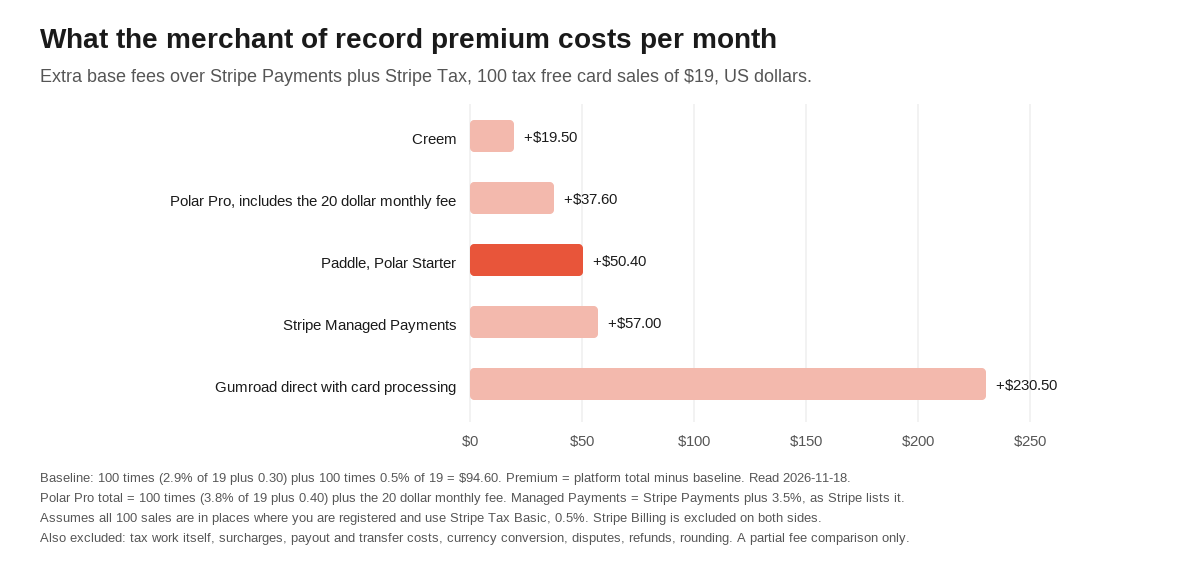
The baseline for 100 sales is 94.60 dollars. On top of it the premium is 19.50 dollars at Creem and 50.40 at Paddle or Polar Starter. Gumroad's direct rate with processing is 230.50 dollars above the baseline, which is more than twice the baseline itself. These are fees only, and they are a partial comparison. They do not include your time, an accountant, the cost of registering to collect tax in the places your buyers live, or the services that Managed Payments bundles and the baseline may need to buy separately.
How many sales before it pays
The extra fee per sale is the number to carry forward. At a 19 dollar price it is about 20 cents at Creem, 50 cents at Paddle or Polar Starter and 57 cents at Stripe Managed Payments. Whether that matters depends on one number you have to supply: what handling tax yourself costs you each month, which no pricing page states.
The table therefore uses three assumptions of our own, 50, 150 and 400 dollars a month. For each it shows the smallest whole number of sales a month at which the extra fee reaches that amount, found by dividing the amount by the extra fee per sale and rounding up. Below that number the extra fee is under your assumed cost. At or above it, the extra fee is at least as large. Whether that settles the decision also depends on the conditions listed above, so read it as a fee threshold and not as a verdict.
| Your monthly cost of handling tax | Creem | Paddle or Polar Starter | Stripe Managed Payments |
|---|---|---|---|
| 50 dollars | 257 sales | 100 sales | 88 sales |
| 150 dollars | 770 sales | 298 sales | 264 sales |
| 400 dollars | 2,052 sales | 794 sales | 702 sales |
Read the table with an example. If you assume that handling tax costs you about 150 dollars a month and you sell about 150 copies of a 19 dollar product, the extra fee at Paddle's rate is under 76 dollars, below that amount. If you sell 600 a month, the extra fee is about 300 dollars, above it. The break even moves with the price: a lower price shrinks the percentage part of the premium and leaves the fixed part, and a higher price grows it.
Two cautions. First, the table is built on base fees and a tax free price, so it understates the premium wherever a platform charges its fee on the total including tax. Second, the cost of handling tax is rarely smooth. A month with one registration costs little, and a month with three new jurisdictions costs a lot, so use your worst realistic month and not your average.
A routine for a small team
The steps are our own and follow from the numbers above.
- Write down your real prices. A fixed fee has a larger proportional effect on a small sale, so the lowest plan feels it most. Rankings can swap between prices, so compare each price on its own and do not apply one rule to all of them.
- Compute the premium per sale. Platform fee minus baseline fee, at each price you charge. It takes a minute in a spreadsheet.
- Estimate monthly sales and choose a busy month. Use the month you would be sorry to have mispriced, not the average one.
- Price your own tax work. Ask an accountant what registrations, filings and software would cost for the places your buyers live. That figure is the cost in the table.
- Compare, and check the conditions. If the extra fee at your volume is less than your tax cost, the merchant of record looks cheaper on this partial measure. If it is more, doing it yourself looks cheaper, provided you will really do it and qualify for the terms. Confirm the Stripe Tax and Billing assumptions for your case before you rely on either answer.
- Check the missing lines. International cards, PayPal, subscriptions, payout fees, currency conversion and refunds, on the pages of the platform you are leaning toward.
- Put a date in your calendar. Re run the numbers in six months and when your volume doubles, and if you sell through Lemon Squeezy, finish the move well before 31 March 2027.
If most of your buyers are in your own country and you sell at a low volume, the cost of handling tax may be small, and the baseline may win by a wide margin. If you sell worldwide and have no one to file for you, the premium may be the cheapest line on your bill.
Where this fits
The fee is one input to the price. If a product sells at five dollars and the fee takes 15% of it, raising the price to nine dollars can change the effective rate more than switching platform does. More pricing questions are in our other Community articles, and the launch checklist has a payments step that this comparison feeds into.
When your product is ready to be seen, you can submit it to RadarMakers for free, and you can browse the fintech category and the best developer tools to see how other small products position themselves.
Sources
The rates were read from public pages on 18 November 2026. Every figure in the charts and the table is our own arithmetic on those rates, not a number any platform publishes, and it excludes tax work, surcharges, Stripe Billing, payouts, currency conversion, disputes, refunds and rounding.
- Lemon Squeezy, migration notice, new sign ups closed on 16 November 2026, processing stops on 31 March 2027, Stripe Managed Payments recommended.
- Lemon Squeezy, fees, fee calculated on the total order value, extra 1.5% international, 1.5% PayPal and 0.5% subscriptions, payout fees, custom pricing under 10 dollars.
- Paddle, pricing, 5% plus 50 cents per transaction, custom pricing for high volume low value transactions.
- Polar, pricing, Starter, Pro, Growth and Scale plans, extra 1.5% for non US cards, Pro break even of about 1,379 dollars a month in sales.
- Creem, pricing and payment gateway comparison, 3.9% plus 40 cents, payouts on the 1st and 15th, extra charges for affiliates, splits and recovered carts, and payout transfer and partner currency conversion costs. The blog also repeats Stripe's 2.9% plus 30 cents.
- Gumroad, pricing and fees, 10% plus 50 cents direct, card processing of 2.9% plus 30 cents not included, 30% flat on Discover sales including processing.
- Stripe, pricing, 2.9% plus 30 cents per successful domestic card transaction on the US page, confirmed by the reviewer; from this machine the page is served in the Poland version. Stripe, Managed Payments, 3.5% per successful transaction in addition to standard processing fees, including indirect tax compliance, fraud prevention, dispute responses and transaction level support, with Billing priced separately. Stripe, Stripe Tax pricing, Tax Basic 0.5% per transaction where you are registered to collect taxes. Stripe, Managed Payments documentation, the Stripe merchant of record solution for digital products.
0 replies
Sign in to join the discussion
Log in