What does a domain name really cost a small SaaS over five years?

The first number you see when you search for a domain name is the price of year one. That is not always the number that matters for a product you plan to run for years, which is what you pay in year two, year three and every year after that. A domain registration is prepaid for a term, usually a year at a time, and when the term ends without a renewal the name can stop resolving and later be deleted. It is a recurring cost, and a missed renewal can take the product's address offline.
This article looks at what a domain costs over five years for eleven common extensions, using the public price list of one registrar read on 17 November 2026, for eleven extensions. We checked the registrar's own page for each of them, and none states a minimum term longer than one year. It then adds what ICANN's own policies say about expiry, recovery and transfers for generic extensions, and turns both into a short routine for a small team. The prices are one registrar's list prices on one day, so treat them as a way to compare extensions, not as a quote. Where a suggestion is our own and not from a source, it says so.
Why the first year price misleads
Registrars set their own prices, and some discount the first year to win a customer. That is our observation from this one list, not a claim about how often it happens across the market, and the price list itself does not say why prices differ. It does show cases where a name costs under two dollars in year one and over twenty in year two.
The chart below shows the first year price and the renewal price for eleven extensions at Porkbun, read from its public pricing endpoint on 17 November 2026. Coupons exist at this registrar and are not applied here. The registrar's own pages label the first year price as a sale for nine of the eleven, with a separate regular price that matches the renewal in the chart: for io, for example, 28.12 dollars is a first year sale and 51.80 is the regular registration, renewal and transfer price. For com and net the page shows a single everyday price. The extension ai is left out of the charts for a reason explained below.
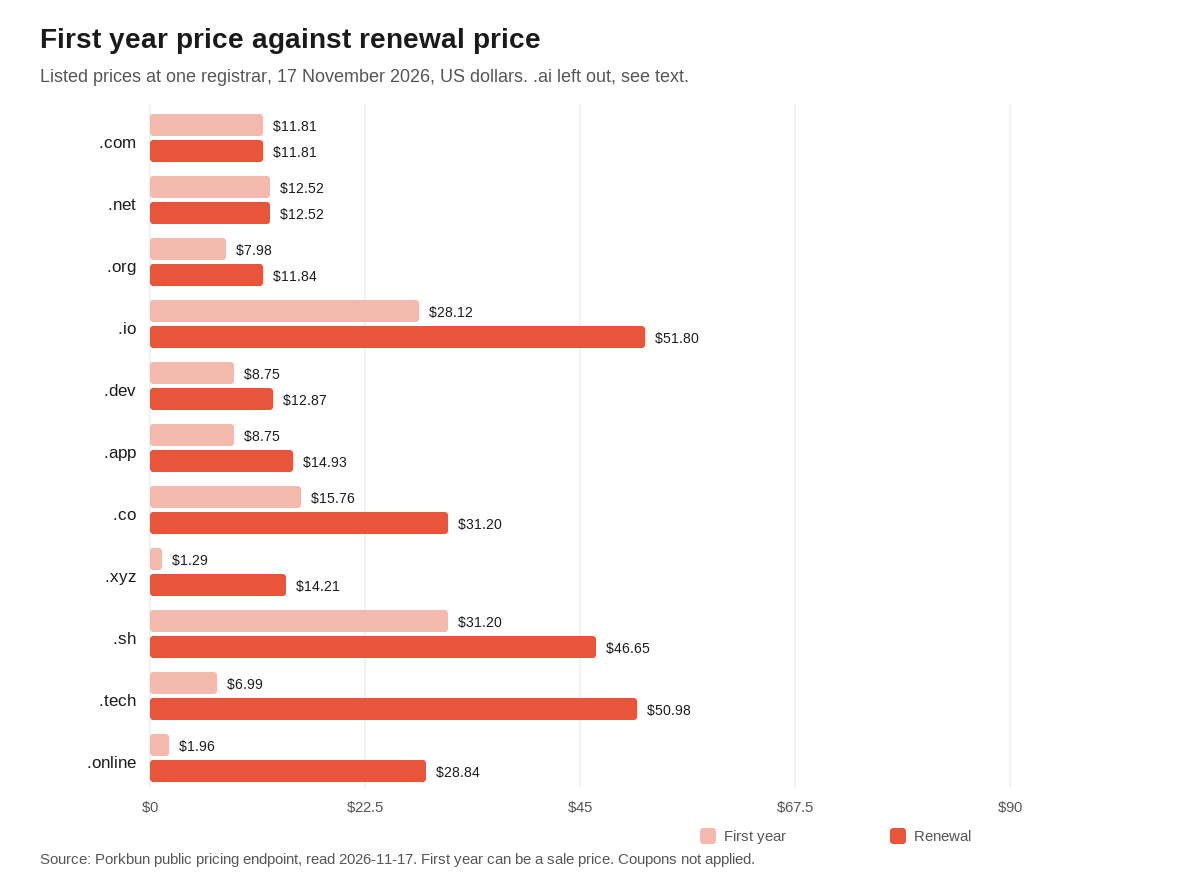
Three patterns stand out.
- Matching prices. For com and net the listed first year and renewal prices are the same in this snapshot, 11.81 dollars for com and 12.52 for net. That says nothing about future prices.
- A modest step up. For org, dev and app the renewal is higher than the first year by a few dollars. Org goes from 7.98 to 11.84, dev from 8.75 to 12.87 and app from 8.75 to 14.93.
- A large step up. For xyz, online and tech the first year is a teaser. Xyz goes from 1.29 to 14.21, online from 1.96 to 28.84 and tech from 6.99 to 50.98. Io almost doubles, from 28.12 to 51.80, and co doubles, from 15.76 to 31.20.
None of this means a cheap first year is a trap. It means the first year price tells you almost nothing about the cost of keeping the name.
What five years looks like
Because a product that works is likely to be around for a while, a simple comparison is the total over five years: the first year price plus four renewals at the listed renewal price. This is our own arithmetic on the list prices, not a figure any registrar publishes. It assumes prices stay where they are, which they may not, and that the listed registration price is a one year price. The list does not state the terms, so check the minimum term for the extension you want. The model does not fit ai: Porkbun's own page says .AI domains require a minimum term of 2 years for registration and renewals, and that transfers include a 2 year renewal. The list shows 82.70 dollars for registration and renewal and 165.09 for a transfer, but it does not say how those relate to the two year term, so we leave ai out of the charts and total instead of guessing.
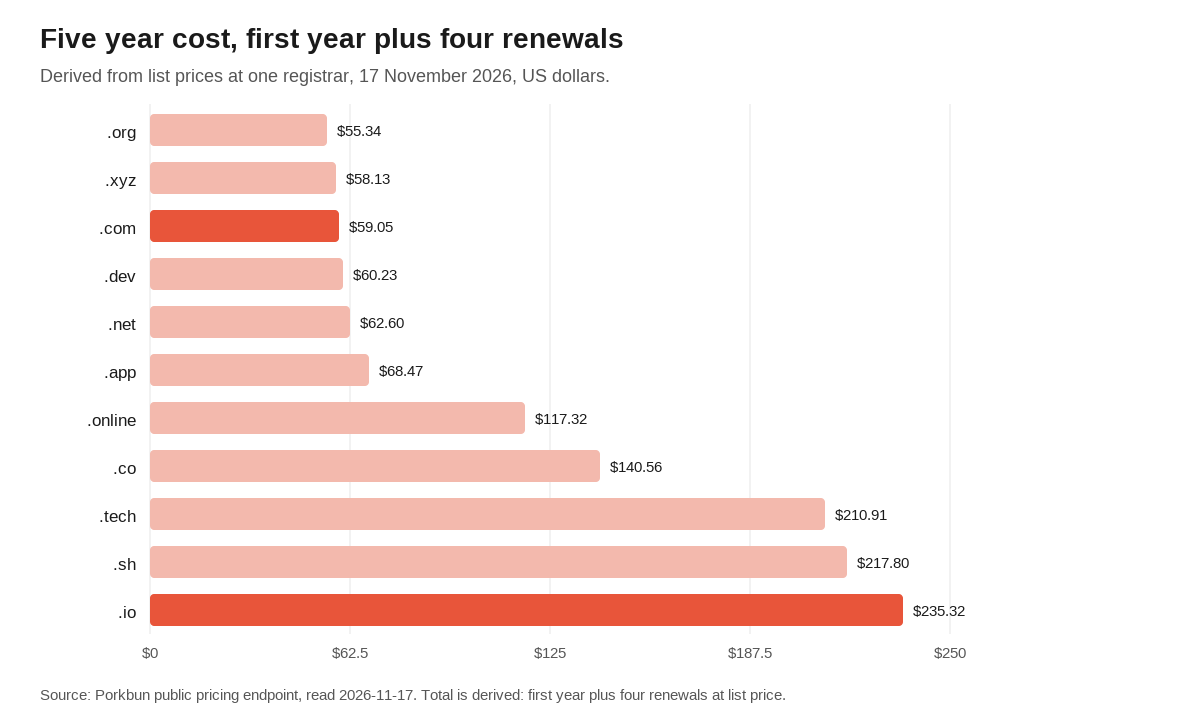
The cheapest first year is not the cheapest name. Xyz, with its 1.29 dollar first year, ends up at 58.13 dollars over five years, close to com at 59.05 and above org at 55.34. Tech starts at 6.99 and ends at 210.91, about three and a half times the cost of com. The difference between the cheapest group and the expensive group is large: com, org, dev, net and app sit between roughly 55 and 68 dollars, while io, sh and tech sit between roughly 210 and 235 dollars.
Whether an expensive extension is worth it depends on what it does for the product, not on the price alone. A short name on a well known extension can help people remember and type your address. A name on an unusual extension can look credible to a specific audience, or it can look unfamiliar to everyone else. Neither of those is something these price lists can show, so we leave the brand question to you and keep the arithmetic here.
Transfers are priced and limited separately
The same list also gives a transfer price. That is what this registrar charges to move a name in from another registrar, so it says what it costs to arrive here, not what it costs to leave another provider. For most extensions in the list it equals the renewal price. Ai differs, with a listed transfer price of 165.09 dollars against a renewal of 82.70, and the registrar's page says an ai transfer includes a two year renewal. The list does not say whether other transfers add time to the registration, so read the registrar's terms for the extension before you plan a move.
ICANN's Transfer Policy, which we read in its current version, applies to generic extensions and sets the rules for moves between registrars. It lists the specific instances in which the current registrar may deny a transfer request, and one of them is a request made within 60 days of the creation date shown in the registry record. This does not mean a young name can never move. It means the current registrar is allowed to refuse in that window, and a delay of about two months is something to expect. Country code extensions such as io, ai, co and sh are run under their own registry rules, which this article does not cover, so check those separately.
What ICANN says about expiry
Expiry is where a cheap or neglected domain turns into an outage, so it is worth knowing what the rules guarantee and what they do not.
ICANN's Expired Registration Recovery Policy covers generic top level domains such as com, net, org and many newer ones. We read the version published on 21 February 2024, which updated an earlier text to reflect the Registration Data Policy. We also read the earlier text and the clauses we use match. The policy requires registrars to notify the registered name holder of an upcoming expiry at least two times. One notice must be sent approximately one month before expiry and one approximately one week before. If the registration has neither been renewed by the registrant at expiration nor deleted by the registrar within five days after expiry, the registrar must send at least one additional notice with instructions for renewing.
After expiry, subject to applicable policies and its agreement with ICANN, a registrar may delete a registration at any time. The policy also describes the effect on the site: for names deleted within eight days of expiry, the registrar must interrupt the existing DNS resolution path from expiry until deletion, to the extent the registry permits. In plain terms, your site and your email can stop working soon after the date passes, before the name is gone. The registrant at expiration, meaning the holder who was eligible to renew just before expiry, must be allowed to renew from the moment of expiry through the DNS interruption period. For a name deleted eight or more days after expiry, that period covers at least the last eight consecutive days that the registration is still renewable, so do not assume you can renew right up to the deletion date.
After a name is deleted, the policy requires a Redemption Grace Period of 30 days from generic registries, with the exception of sponsored ones. During that window the deleted registration may be restored, at the request of the registrant at expiration, by the registrar that deleted it. Registrations deleted during a registry's add grace period, where one applies, should not be subject to this period. The policy also says the registry must disable DNS resolution and prohibit attempted transfers during that time, with an exception for ICANN approved bulk transfers and permitted partial bulk transfers. The policy does not set the price of a restore, and registrars often charge more for it than for a renewal, so check your registrar's terms before you rely on it.
Two limits are worth stating plainly. First, this policy covers generic extensions. Country code extensions such as io, ai, co and sh are run by their own registries under their own rules, and their grace periods and recovery options can differ. Second, a notice requirement is not a guarantee that you see the notice. The policy says notices must reach the holder in a manner, such as by email, that needs no affirmative action to receive, so the delivery method depends on your registrar. Check which contact and method yours uses, and keep a reachable contact that does not depend on the domain itself, because a notice sent to a mailbox on the expiring domain can stop being delivered once the name stops resolving.
A routine for a small team
The suggestions below are our own, built on the facts above.
- Check the renewal price before you buy. Look at the renewal and transfer columns, not just the first year. Add the first year and four renewals, or five renewals as a cautious estimate, and decide whether that number is acceptable for the product.
- Pick the registrar for the long run. A registrar may refuse a transfer in the first 60 days for generic extensions, and transfer prices can differ from renewal prices, so a move is slower and sometimes costlier than it looks.
- Register for several years or turn on auto renew. A multi year registration removes one yearly decision. Auto renew only works if the payment card on file is still valid, so put the card expiry in a calendar.
- Keep a contact that does not depend on the domain. Use a mailbox on another domain, which improves the chance that notices are delivered if the name stops resolving, though it does not guarantee that anyone reads them, and check how your registrar sends them.
- Lock the domain and protect the account. Turn on the registrar lock and two factor authentication for the registrar login. Losing the registrar account loses the domain.
- Write the renewal date down. Put it in a shared calendar, and add a second reminder a month earlier. Treat it like any other recurring cost, next to hosting and email.
- Do not let a name lapse by accident. If a name must be released, do it on purpose after you have moved DNS, email and links elsewhere.
This takes about an hour once and a few minutes a year. Compared with the cost of an unplanned outage, it is cheap.
Pricing is not the whole choice
Price is only one input to choosing an extension. Memorability, trust with your audience, the length of the name and whether the name is available matter at least as much, and none of them can be measured from a price list. If two options are close, compare the current renewal prices and check them again before each renewal, because a single list cannot show how stable a price will be.
Once you have a name and an address that will stay yours, you are closer to being ready to show the product to people. If you want one more place where makers and early customers can find it, you can submit it to RadarMakers for free. Our launch checklist covers the other tasks around a release, and the best developer tools page ranks developer tools that other makers have shared.
Sources
The price data was read on 17 November 2026 and covers one registrar. The list does not say whether a registration price is promotional or what minimum term applies, so we checked the registrar's pages for io and ai, which show a sale price for io and a two year minimum for ai. Prices change, coupons exist and other registrars price differently, so check the current figures before you decide. The five year totals and the routine are our own arithmetic and suggestions, not published by any registrar or by ICANN. The ICANN policies cover generic top level domains and may not apply to country code extensions.
- Porkbun, public pricing endpoint, registration, renewal and transfer list prices for the extensions, read on 17 November 2026 with an empty POST body. The registrar's pages for ai and io were read the same day. The response is saved with its retrieval time in the figures data folder.
- ICANN, Expired Registration Recovery Policy, version of 21 February 2024, expiry notices, DNS interruption after expiry and the 30 day Redemption Grace Period.
- ICANN, Transfer Policy, current version, reasons a registrar may deny a transfer, including a request within 60 days of the creation date.
0 replies
Sign in to join the discussion
Log in