How much of a subscription do the app stores let a small app keep?
A small app that sells a subscription through the App Store or Google Play does not receive the price on the screen. The store keeps a share, and the share is not one number. It changes with the month of paid service, with the size of your business, with the country of the buyer and, on Google Play, with a fee that sits on top of the percentage. The useful question is not whether the stores are expensive. It is how much of one subscriber you keep after two years, and how that compares with the other ways to take payment.
This article reads the current Apple and Google pages, turns them into one worked example and checks where the example stops being true. Every rate comes from a page we read on 21 November 2026. The price, the length of the stay and the web checkout fee are our own assumptions, and each chart footer says so. The result is a model for your own spreadsheet, not a quote for your app.
What Apple says
Apple's App Store Connect Help page on auto-renewable subscriptions sets two rates. During a subscriber's first year of service you receive 70% of the subscription price at each billing cycle, minus applicable taxes. After a subscriber accumulates one year of paid service in the same subscription group, your net revenue rises to 85% of the price, again minus taxes. Apple's subscriptions page is more exact about what counts. Days of paid service include subscription offers with paid pricing, whether pay as you go or pay up front, and exclude free trials and renewal extensions. So the threshold measures paid service, not every elapsed day of access.
Three details matter more than the percentages. The clock runs per subscriber, not per app, so a subscriber who joined last month starts at the lower rate however old your app is. It is specific to each subscription group, and upgrades, downgrades or crossgrades inside one group do not affect the days of paid service. And it stops when a subscription expires. The Help page says that if someone resubscribes or the subscription is recovered within 60 days, the days of paid service continue from the recovery date. If the subscription is recovered after 60 days, the rate reverts to 70% and the day count starts over. A billing grace period can keep access, and the count, running while Apple tries to recover a failed payment. Members of the Small Business Program receive 85% from the first day.
The Small Business Program is the second route. Apple describes a reduced commission of 15% on paid apps and on In-App Purchases. The threshold is 1 million USD in proceeds, where proceeds are your sales net of Apple's commission and certain taxes and adjustments. To qualify, you and your Associated Developer Accounts must have earned no more than 1 million USD in the current year and in the 12 fiscal months of the previous calendar year. If you pass the threshold during a calendar year, the standard rate applies to future sales. If your proceeds fall below it later, you can re-qualify the year after.
The program page does not state the standard commission percent. Apple sets rates by storefront and changes them, and the news posts show how. A post dated 29 October 2026 says that from 31 October the standard In-App Purchase rate on the Taiwan storefront is 26%, down from 30%. A post dated 12 March 2026 gives the China mainland storefront a standard rate of 25%, down from 30%, and 12% for qualifying Small Business Program transactions and for subscription renewals after the first year, down from 15%. So 30% is the standard rate those posts name as the previous one, and a table from one country is not a table for all of them. The same Apple subscriptions page says that default pricing in App Store Connect includes applicable taxes that Apple collects and remits, and that your revenue is the purchase price minus VAT and minus the commission. That is a real service, and we come back to it below.
On steering, the current App Review Guidelines, section 3.1.1 a, say that developers may apply for entitlements to include a link to a permitted destination for buying digital content, that approved destinations vary by region, and that these entitlements are not required for buttons, external links or other calls to action in apps on the United States storefront. Detailed steering rules are outside this article, and they change, so read the current guidelines for your storefronts before you build a flow around a link to your site.
What Google says
Google's Service fees page says there is no single fee. For users in Australia, the European Economic Area, Japan, the United Kingdom and the United States, the fee depends on whether the transacting user's install is new or existing, counted against a regional rollout date. The page gives 30 June 2026 for the EEA, the UK and the US, and 30 September 2026 for Australia and Japan. For auto-renewing subscriptions the page lists the same terms for new and existing installs: 10% plus a 5% billing fee.
The billing fee is the part people miss. Google says it applies when a user completes a purchase of an in app digital service or feature using Google Play Billing, or the initial purchase of a paid app or game. For a subscription that means 10% plus 5%, which is 15% of the price in total. Other transactions carry higher percentages that depend on the install type, and the page lists a lower rate for external web links in some of them. We do not use those rows because they do not apply to a plain subscription.
For all remaining markets, until the announced fees are rolled out globally, the page keeps the older structure, and there the subscription row is separate from the general tier. Auto-renewing subscriptions pay 15% regardless of the revenue the developer earns each year. The 15% tier, with 15% on the first 1 million USD earned each year and 30% above it, applies to the general row of the table, which covers purchases other than subscriptions. A second Google page says what enrolling in that tier takes: a payments profile, an account group that includes all of your Associated Developer Accounts, and acceptance of the 15% service fee terms in Play Console. It is titled as a 2021 change article, so it supports the general tier procedure and does not override the current subscription row. The 1 million USD in Google's tier is also measured differently from Apple's proceeds threshold, so the two are not one shared cliff for a subscription app.
Google also says that 97% of developers distribute their apps at no charge, and that 99% of those who do pay a service fee are eligible for 15% or less through its programs. That is Google's own statement about its developers. It says nothing about a subscription app, which is why we use the subscription rows only.
For a subscription, then, both stores land near 15% in the cases we read. Apple's 15% needs the Small Business Program or a subscriber past one year of paid service. Google's 15% is the percentage plus the billing fee in the named regions, and a flat 15% for subscriptions elsewhere.
One subscriber over 24 months
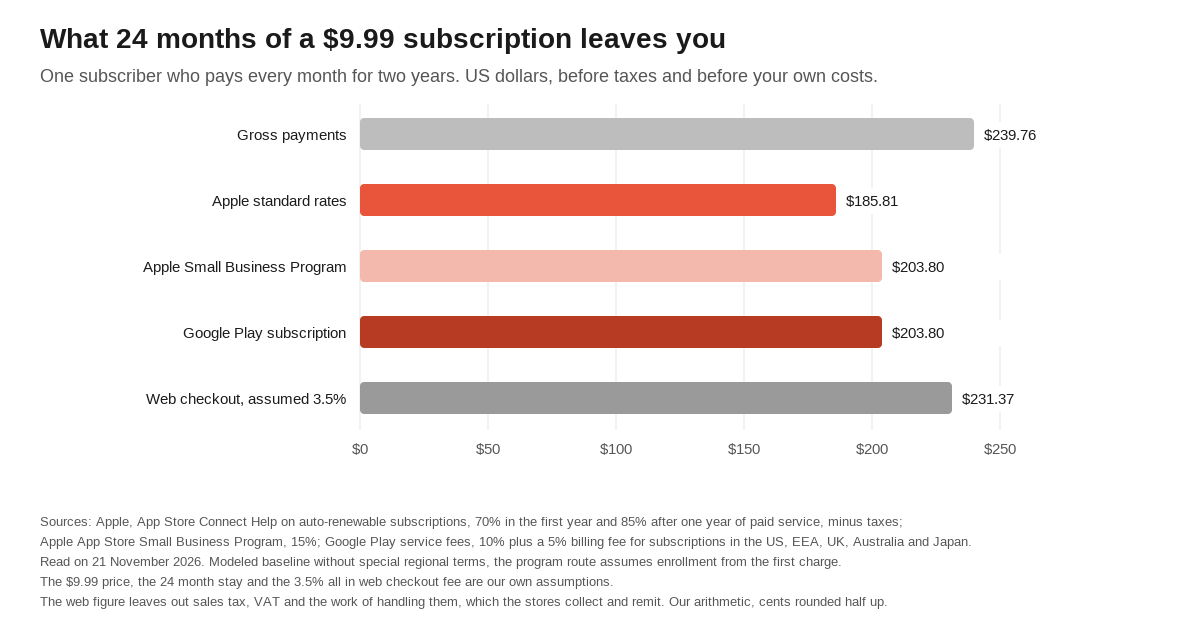
Take a subscription at 9.99 dollars a month and one subscriber who pays every month for two years. The gross payments are 239.76 dollars. The rest is arithmetic on the rates above, with cents rounded half up at the end.
| Route | Kept over 24 months | Share |
|---|---|---|
| Apple at standard rates | $185.81 | 77.5% |
| Apple Small Business Program | $203.80 | 85.0% |
| Google Play subscription | $203.80 | 85.0% |
| Web checkout at an assumed 3.5% | $231.37 | 96.5% |
Apple at standard rates keeps 6.993 dollars a month in year one and 8.4915 dollars a month in year two. Twelve of each add up to 83.92 and 101.90, which is 185.81 once the unrounded values are summed. The rows show the modeled baseline of Apple's 70% and 85% rates and the program's 15%, without special regional terms such as the China and Taiwan storefront rates above, and the program row assumes enrollment is already effective for the first charge. The Small Business Program is 85% from the first payment, so it keeps 17.98 dollars more of this one subscriber. Google's two routes give the same 203.80 dollars, which is a coincidence of the rates and not a rule, and it will change the moment the percentages do.
The web checkout line is where the assumptions are heaviest. We took 3.5% all in as a round number for a card processor plus a billing product. Stripe, for example, publishes different prices by country. The page we read was served with Poland prices, and it showed 1.5% plus 1.00 zloty for standard European Economic Area cards, 3.25% plus 1.00 zloty for international cards, an extra 2% when currency conversion is needed, and 0.7% of Billing volume. A fixed fee weighs more on a 9.99 price than on a 99 price, so your own rate can sit above or below 3.5%. The line also leaves out the thing the store does for the other three: sales tax and VAT. Someone has to calculate, collect and remit them, either you, a tax product or a merchant of record. Our article on when a merchant of record pays off works through that cost, and it is the missing piece before you compare 96.5% with 85%.
Why the first year weighs so much
The Apple standard route starts 15 points behind the others and catches up slowly. That is because the higher rate only applies to months after the first twelve, and the share we report is cumulative.
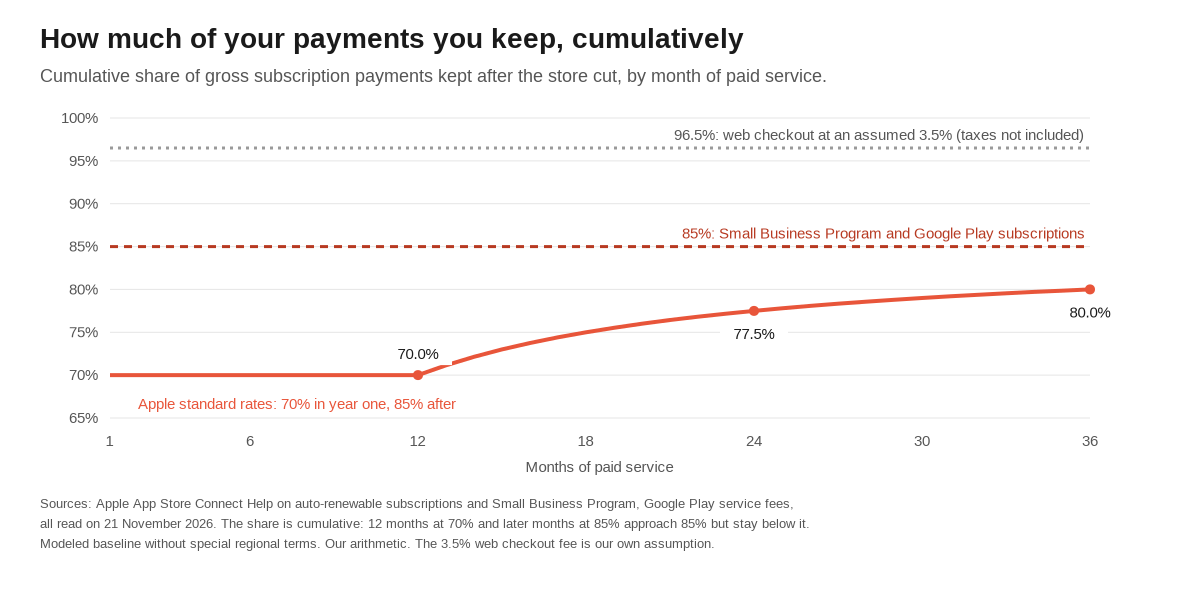
At month 12 the cumulative share is 70.0%. At month 18 it is 75.0%, at month 24 it is 77.5% and at month 36 it is 80.0%. It approaches 85% but never equals it at any finite month, because the first twelve months stay in the average forever. A subscriber would have to stay a very long time for the cumulative share to come close to the program's percentage, and under the churn model below most do not.
How long do they stay? In our article on lifetime deals we assumed a constant monthly churn of 6.1%. That is ChartMogul's median monthly customer churn for companies with an average revenue per account below 25 dollars a month, aggregated over November 2021 to January 2022 and excluding customers who joined and churned in the same month. It is a median company in a SaaS segment, not the churn of every individual customer paying under 25 dollars, and not a measured rate for small mobile apps. A constant rate is a model and not a measurement. Under that model the expected number of paid months is 1 divided by 0.061, which is 16.4. Running the Apple standard rates through the same model gives an expected retained revenue of 77.0% of expected gross revenue, where each subscriber pays a first month and then survives each later month with probability 0.939. That is a ratio of two expectations, not the average of each subscriber's own share. The practical reading is that under this assumption the year one rate is the rate you will mostly pay, and the 85% only shows up for the minority who stay past month 12, about 47% of those who start.
This also changes what a price rise or an annual plan does. Apple's rule counts paid service, and the first payment of an annual plan falls in the first year of service, so by our inference from that rule it is paid at the 70% rate unless you are in the Small Business Program. We found no separate quoted rule for annual plans, so check your own reports before you move many subscribers to yearly billing for the sake of the fee.
Where the model stops being true
Six limits are worth writing down before you copy the numbers.
- Taxes. Apple's revenue is net of VAT and the commission. Our chart is before taxes, so it overstates what reaches you in a country with a high VAT, and it hides the work you avoid.
- Currency and country. Apple sets rates by storefront and Google's fees depend on the region and the install date. We used the rates that the pages give for the named regions and for the rest of the world, and we did not model a mix of countries.
- New and existing installs. For subscriptions Google lists the same terms for both, so we ignored the split. For other purchases the split matters a lot.
- Refunds and chargebacks. Our model has none. Refunds change what you keep. Google's order management page says that when you issue a partial refund, the same percentage of the service fee is refunded to the user, so the fee follows the refund. Our article on handling the first refund requests covers what a refund costs when you take payment yourself.
- Billing fee scope. The 5% applies when Google Play Billing is used. If the rules in your region allow another billing system, the fee on that route is not what we show.
- Change. Google's table carries rollout dates in June and September 2026, Apple's news posts are dated 12 March and 29 October 2026 and lower rates on single storefronts, and the policy pages we read show no last updated date. A number that is correct today may be wrong next quarter.
A routine for the decision
- List where your buyers are. Count subscribers by store and by country. A rate table for the wrong country is worse than no table.
- Find your tier. Check whether you qualify for the Small Business Program, and remember that qualifying is not the same as being enrolled. On Google Play check whether your buyers are in a region on the new table or in the remaining markets, where subscriptions pay a flat 15%. If you also sell something other than subscriptions, read the general tier rules and the enrollment steps on the 2021 page.
- Compute your own 24 months. Use your price, your plan mix and your measured churn, not ours. Put the store cut for each month of paid service in a column, as the Apple rule requires.
- Add the tax cost to the web line. If you take payment yourself, put a number on tax collection and on the processor's fixed fee at your price. Compare the total, not the percentage.
- Check the rules for steering. Read the current guidelines before a screen mentions a cheaper price on your site. The rules are specific to each store and region and they have changed.
- Write the result next to the assumption. A price, a stay and a fee are three guesses. Mark them so that the next person who reads the sheet knows which one to replace first.
If your app is below the Apple program threshold, the difference between the two stores is small and the decision is usually not about the percentage. It is about where your buyers already are and how much work the web route adds. If you are close to 1 million USD in proceeds, Apple's standard rate becomes the number to model. Google's general 30% line applies to purchases other than subscriptions, so a subscription only app does not face it. That is the point to model both sides carefully.
Where this fits
Fees are one input to a pricing decision. Other Community articles cover free trials, price rises and annual billing. If you are listing an app, the apps category shows how other makers describe theirs, the launch checklist covers the work around a release, and you can submit your own product when it is ready.
Sources
We read the pages below on 21 November 2026. The 9.99 dollar price, the 24 month stay, the 3.5% web checkout fee and every dollar and share figure are our own arithmetic on the stated inputs. The policy pages show no last updated date, so we cannot say when a rate last changed. The Apple news posts and the ChartMogul post carry the publication dates given below.
- Apple, App Store Connect Help, Offer auto-renewable subscriptions, 70% of the subscription price in the first year of service and 85% after one year of paid service in the same subscription group, minus applicable taxes, the 60 day recovery rule and the 85% rate from the first day in the Small Business Program.
- Apple, App Store Small Business Program, reduced commission of 15%, threshold of 1 million USD in proceeds, eligibility over the current year and the previous 12 fiscal months, re-qualification the year after.
- Apple, Auto-renewable subscriptions, days of paid service include paid offers and exclude free trials and renewal extensions, the clock is specific to each subscription group, default prices include applicable taxes that Apple collects and remits.
- Apple, Adjustments to the Taiwan storefront of the App Store, 29 October 2026, standard commission 26% on that storefront from 31 October, previously 30%.
- Apple, Adjustments to the China storefront of the App Store, 12 March 2026, standard commission 25%, and 12% for qualifying Small Business Program transactions and for subscription renewals after the first year, previously 30% and 15%.
- Apple, App Review Guidelines, section 3.1.1 a, entitlements for links to other purchase methods, not required for external links in apps on the United States storefront.
- Google, Service fees, regional rollout dates of 30 June 2026 and 30 September 2026, 10% plus a 5% billing fee for auto-renewing subscriptions, 15% for subscriptions in the remaining markets regardless of revenue, the general 15% tier and 30% above 1 million USD, and Google's statement about 97% and 99% of developers.
- Google, Changes to Google Play's service fee in 2021, enrollment requirements for the general 15% tier. Titled as a 2021 article, it does not override the current subscription row.
- Google, Manage your app's orders and issue refunds, a partial refund also applies its percentage to the payout and the service fee.
- Stripe, Pricing, Poland, 1.5% plus 1.00 zloty for standard European Economic Area cards, 3.25% plus 1.00 zloty for international cards, plus 2% if currency conversion is required, 0.7% of Billing volume. Used only to show that card fees depend on the country and the card.
- ChartMogul, What Is a Good Customer Churn Rate, 23 February 2022, median monthly customer churn of 6.1% for companies with ARPA under 25 dollars a month, aggregated over November 2021 to January 2022, read for our article on lifetime deals on 20 November 2026 and not re-read for this one.
0 replies
Sign in to join the discussion
Log in