How to handle the first refund requests
The first refund email is small. The expensive mistake is treating every unhappy message as the same kind of money movement. A refund you issue, a dispute the cardholder files with the bank, and a legal right to withdraw from a distance contract are three different events. They have different clocks, different fees, and different rules about paying someone twice.
Public reports will not tell you whether this particular buyer deserves the money back. They can show which reasons appear in contested chargebacks, the amounts disputed in software subscriptions, and where a refund and a dispute can overlap. They do not measure how many complaints bypassed your inbox. Use them to design the first ten replies, while measuring your own requests separately.
Name the request before you move money
A refund, in Stripe's documentation, is money you send back to the original payment method after a successful charge. You can refund part of a charge or all of it. You cannot refund more than the original charge. Stripe says its processing fee on the original charge is not returned. The customer usually sees a card credit about 5 to 10 business days later, depending on the bank. A refund issued very soon after the charge can instead appear as a reversal: the original charge drops off the statement and no separate credit is issued.
A dispute is the cardholder asking their bank to contest the payment. Stripe debits the disputed amount plus a dispute fee from your balance when the dispute opens. While that dispute is open, Stripe says you cannot issue a refund outside the dispute process. The bank, not the processor, decides the outcome. Stripe describes a typical cardholder window of 120 days from the original payment, with more time in some cases, and a response window for you of usually 7 to 21 days. The full path can take 2 to 3 months. Accepting closes the dispute as lost in your Stripe account and cannot be undone. It does not remove the received fee or guarantee when the issuer credits the customer.
A withdrawal right is neither of those. Under the EU Consumer Rights Directive, a consumer has 14 days to withdraw from a distance contract without giving a reason, unless an exception applies. The European Commission guidance on that directive treats digital services and online digital content differently. This article is not legal advice. If you sell to people in the European Union, read the guidance against your own contract before you answer the first email with a policy sentence you copied from another product.
Write the type on the request before you touch the balance. "Please refund last month" can be a voluntary refund, a claim that cancellation already happened, or the start of a bank dispute. The reply and the ledger entry depend on which one it is.
What contested chargebacks have been about
Justt's 2026 Chargeback Benchmark Report is built from contested chargebacks processed on its platform from July 2024 through June 2026. It excludes chargebacks a merchant chose not to contest. Its methodology uses a fixed group of 165 merchants, each with at least 50 contested chargebacks in both comparison periods, to check growth and mix trends. That is a recovery book, not a census of every card payment or a representative sample of new indie products. The report treats Q2 2026 volume and mix as reportable, but marks that quarter's outcomes provisional because only 68 percent had been decided.
Inside that book, the reason mix moved. Fraud was 74.6 percent of contested chargebacks in the second quarter of 2025 and 60.4 percent in the second quarter of 2026. Product not received rose from 7.1 percent to 13.3 percent. Cancelled recurring rose from 5.9 percent to 10.8 percent. An arithmetic check of the last two categories gives 13.0 percent in the earlier quarter and 24.1 percent in the later one, matching the report's combined figures. These are sums of published shares, not extra observations.
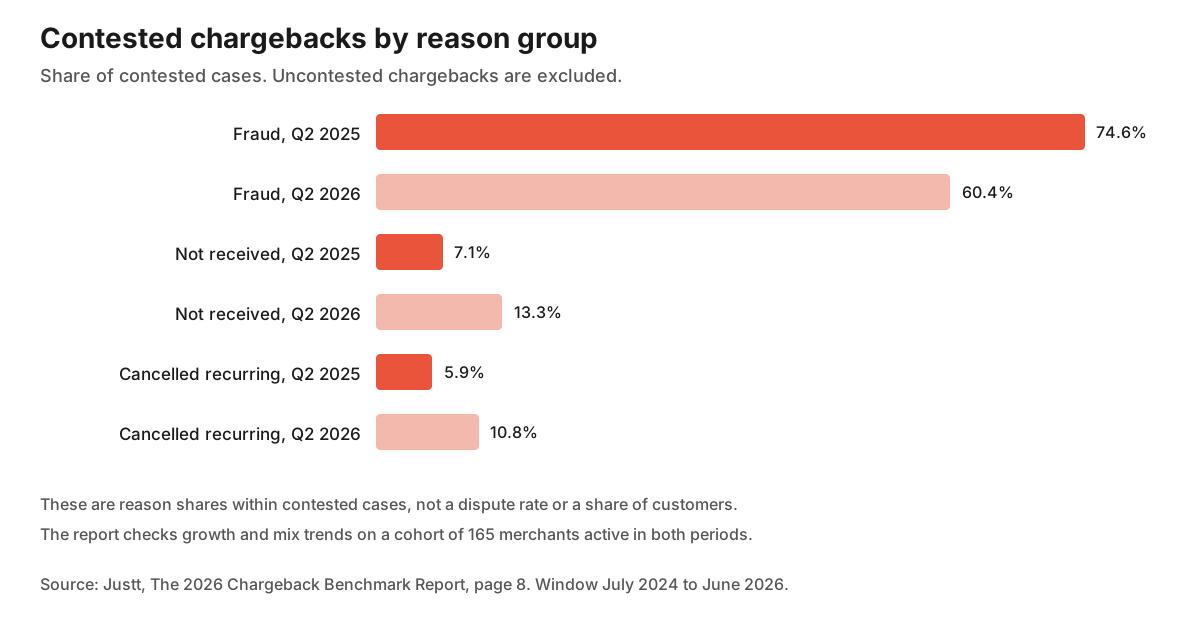
The chart is those six shares and nothing else. It is not your dispute rate, and it is not the share of customers who ask you for a refund. These bars count reason categories within contested disputes. They say nothing about the share of all payments disputed. A product with almost no disputes can still belong to an industry where contested disputes are growing in someone else's book.
The same report says contested chargeback counts at the median merchant in the 165 merchant group grew 13 percent year over year, and that the top quarter grew 68 percent or more. Software subscriptions are called out separately: same merchant volume more than tripled, up 222 percent, while the median software merchant grew 51 percent. The median line is the useful one for a small product. A tripling of a pooled total can be a few large merchants. A 51 percent rise at the median merchant is broader, and it is still one platform's contested book.
The authors interpret the shift as shoppers taking delivery and subscription complaints to their banks. Reason codes alone do not establish whether those shoppers first contacted the merchant, or why a particular cancellation failed. Plan for requests that arrive through either support or the processor, and investigate the individual case before assigning a cause.
What small software disputes can cost
In the software subscription cut of the same report, fraud was still 58 percent of contested chargebacks in the second quarter of 2026. Cancelled recurring is described as the defining category in that industry, covering nearly a fifth of all disputes there. The report does not print a more exact percentage than "nearly a fifth," so this guide does not invent one. It also says that category is the hardest major category to win, and it does not print the win rate. Treat "hardest" as the authors' judgment about their contested cases.
The dollar amounts are printed exactly.
| Software subscriptions | Q2 2025 | Q2 2026 |
|---|---|---|
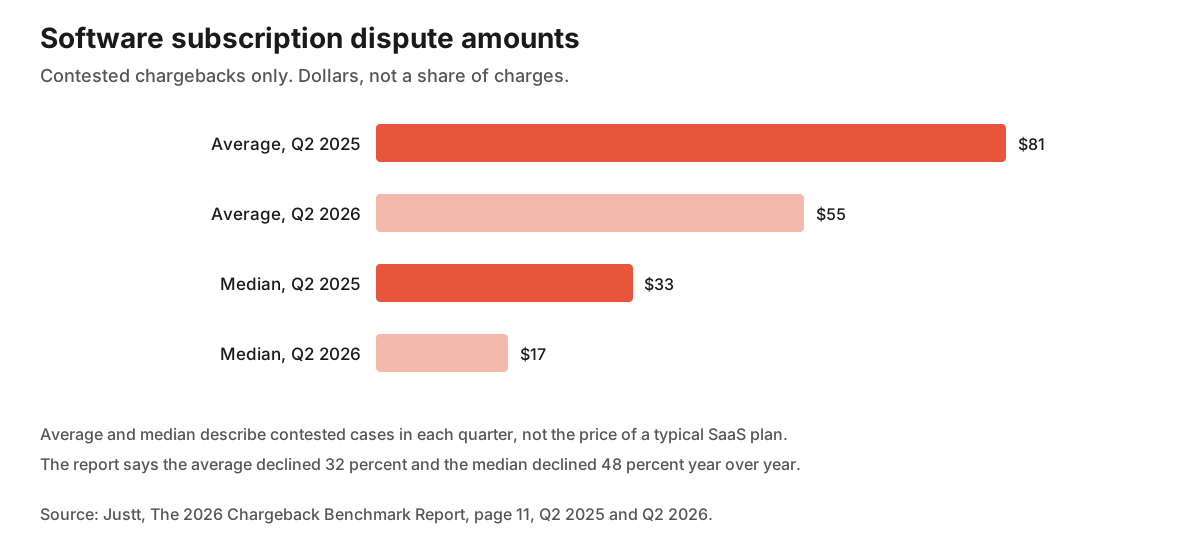
| Average contested chargeback | 81 dollars | 55 dollars |
| Median contested chargeback | 33 dollars | 17 dollars |
The report says the average declined 32 percent and the median declined 48 percent year over year. 81 minus 55 is 26, and 26 divided by 81 is about 32 percent. 33 minus 17 is 16, and 16 divided by 33 is about 48 percent. The sentences and the table agree. The report also says these are the smallest chargeback amounts of the seven industries it covers.
Put Stripe's US fee schedule next to the 17 dollar median as an illustrative cost sketch, not a prediction about your next dispute. Stripe's June 2025 pricing note lists a United States dispute received fee of 15 dollars and a dispute countered fee of 15 dollars. The counter fee applies when you counter disputes initiated after June 17, 2025. The standard received fee is not returned outside Mexico unless your contract says otherwise. The counter fee is returned for a full win, but the pricing note says it is retained for a partial win. It does not apply in Mexico or Japan, and the note waives it for disputes countered through Smart Disputes. Check your actual pricing and country before using the example.
For a US account on those standard fees, assume a 17 dollar dispute with no earlier refund, fee waiver or special contract. If you accept, Stripe does not restore the 17 dollars and retains the 15 dollar received fee. The issuer controls when the customer receives the money. If you manually counter and fully win, Stripe restores the 17 dollars and returns the counter fee, but retains the received fee. If you counter and fully lose, the 17 dollars and both 15 dollar fees remain debited. That is 17 plus 15 plus 15, or 47 dollars. These totals are editorial arithmetic relative to the original sale proceeds, excluding original processing fees, tax and evidence work. They are not measured losses at indie products.
Stripe's own dispute guide says accepting a dispute still incurs the dispute fee, and that networks count disputes received, not disputes won or lost. Winning is not a way to erase the event from the rate. For a median this close to the fee, gathering a long evidence file can cost more than the amount in dispute. That is a reason to decide in advance which disputes you will accept. It is not a reason to ignore the email that could have stayed a refund.
Reply to the person, then the balance
The practical sequence for a message that arrives before any dispute is short.
Confirm the charge. Match the request to a payment id, a date, an amount, and the last four digits if needed. A buyer may write from a different email address, so a failed email match is a reason to investigate rather than deny the request. Do not ask them to send a full card number.
Decide full or partial, and write the reason in the same place you issue the refund. Stripe's Dashboard asks for a reason. If you choose Other, it requires a note. The note is for you later, when a second message arrives about the same charge. Stripe says a customer cannot dispute a fully refunded payment, while a partially refunded payment can still be disputed for the full original amount under card network rules. Treat that as the normal rule once a full refund has completed, rather than a promise about a pending refund or a bank processing error. Keep proof of any credit. If the whole original amount is disputed after a partial refund, Stripe's evidence guide says to include the amount and date of that refund in your response.
Send the refund to the original payment method. Stripe says refunds can only go back to that method. A closed or expired card is handled by the issuer, which usually credits a replacement card. Stripe also describes a fraud pattern in which someone overpays, then asks for the difference by wire or check because the card is "closed." The original cardholder can still dispute the charge, leaving you exposed to that dispute and the separate transfer. Start with the original method. If a refund fails, returning its funds to Stripe can take up to 30 days from the refund post date. Verify the failed status and any dispute before arranging another payment. Stripe specifically recommends handling a dispute instead of another refund when the failure reason is a dispute on a pending refund.
Tell the person what will change on the statement. A reversal may remove the charge instead of adding a credit. A normal refund can take 5 to 10 business days to show as a credit. Stripe says an acquirer reference number can take up to 7 business days to become available, and that a reversal does not get one. Give the reference when you have it. Give the timing when you do not.
Confirm separately whether future billing should stop and when access should end. Stripe's subscription cancellation flow lets you choose the end date and separately choose a refund. Record both decisions, and honor the access and data retrieval rights that apply. If you are refunding because the product failed, say so in one sentence. If you are refunding unused time after a cancellation, say the end date. The product description examples can help you compare the promise on the sales page with what the buyer says they received.
The launch checklist already asks you to state the price, the billing period, what a trial requires, and how cancellation works, before signup. That cancellation sentence is part of refund handling. Justt's software section says clear statement descriptors and a painless cancellation flow beat fighting cancelled recurring disputes. The report is talking about contested chargebacks on its platform. It is still the right order of work for a product that has not had a dispute yet: make the descriptor recognizable, and make cancel findable, before you practice evidence templates.
If the buyer is still choosing between a free plan and a paid plan, the freemium pricing examples show how other makers describe what is free. Settle that boundary in public. A refund desk that redefines the free limit one customer at a time will not match the next charge.
Two credits is the failure mode
Justt reports that 0.5 percent of contested chargebacks in its study involved a refund issued before the dispute was filed. It also says every Ethoca or Verifi alert in the study that later became a chargeback had already been refunded. Read the second sentence narrowly. It is about alerts on that platform that escalated, not about every alert in the card system. The operational lesson is still blunt. A refund and a later dispute can describe the same charge.
Stripe states the same collision from the processor side. While a dispute is open, you cannot refund outside that process. If the disputed amount is genuinely still owed to the buyer and no earlier credit needs reconciling, Stripe recommends accepting rather than asking them to withdraw it for an ordinary refund. Accepting cannot be undone. If a refund was already issued, preserve that evidence and check the disputed amount before accepting another debit. A withdrawn dispute still counts toward the dispute rate and still needs an evidence response. Stripe does not allow a normal refund until the issuer decides in your favor. Sending a separate payment while the case is unresolved risks compensating the same charge twice.
Bank debit methods add another version of the same mistake. Stripe's refund guide says that for SEPA, Bacs, ACH, and the other bank debit methods it lists, a proactive refund while the bank also disputes the payment can credit the customer twice. Card refunds and debit refunds do not share one safe habit. Look up the method on the charge before you press refund.
Inquiries are an earlier stage on networks that use them. Stripe says American Express and Discover use them most often, while Mastercard and Visa generally no longer do. Its documentation notes an exception for domestic Mexican charges across card brands. During an inquiry you can provide evidence or a full refund, potentially resolving it without a dispute fee. A partial refund can still escalate. An unanswered inquiry can become a chargeback that is difficult to win. Read the actual deadline in the dashboard, and handle the processor response alongside the customer email.
A fraud warning is not a refund request
Early fraud warnings are a third inbox. Stripe describes them as issuer reports, including Visa TC40 and Mastercard SAFE, flagging a payment that might be fraud. They do not require a response. Stripe says that if you do not refund, about 40 percent of Visa and Mastercard early fraud warnings become fraud disputes, and that the rate varies by network and amount. Automatically refunding every warning will refund payments that would never have become disputes.
The same page gives a cost guideline from Stripe's analysis. All else equal, it favors refunding warnings on charges roughly less than or equal to the dispute fee. Refunding warnings on charges more than 35 percent above that fee is described as likely not worthwhile. For an illustrative US received fee of 15 dollars, 35 percent above 15 is 20.25 dollars. The 17 dollar software median sits between those two stated thresholds. The page does not supply a firm decision for every amount in that interval. The 55 dollar average is above the higher threshold. These comparisons are editorial arithmetic, not measurements of which choice worked for software makers.
This guideline concerns early fraud warnings, not cancellation complaints. Stripe also notes that concern about the effect of a dispute on your account can justify refunding more aggressively. The reported 40 percent is not a promise about your own warnings. Refunding normally does not remove the fraud warning itself. Stripe says a refund can prevent the fraud report only when processed as a reversal, which usually happens within 2 hours of capture. A later refund may still be appropriate for the customer without preventing that report.
Use the warning as a prompt to look at the charge and any existing dispute before moving money. Product usage does not prove that the cardholder authorized the payment. Consider the amount, the evidence and the consequences of another dispute, rather than treating a single fee threshold as an automatic rule. Record why you chose to refund or wait.
The 14 day clock is a different refund
Article 9 of the Consumer Rights Directive generally gives consumers 14 days to withdraw from a distance contract without giving a reason, where no exception applies. A consumer here is someone buying outside their trade or profession, not every business customer of a SaaS product. For services and online digital content, the ordinary period starts when the contract is concluded. Missing the required withdrawal information can extend that period under Article 10.
The Commission's 2021 guidance explains the distinction between testing a digital service and starting a digital download. Beginning a paid service does not generally remove the right to withdraw. Under Article 14, a consumer who expressly requested an early start may owe a proportionate amount for service already supplied, subject to the required information having been provided. Article 16 point a has a separate exception after full performance, with prior express consent and acknowledgement of losing the right when a paid service is fully performed. Those conditions are not interchangeable with a generic "no refunds" checkbox.
Online digital content has a different exception in Article 16 point m. For paid content not supplied on a tangible medium, performance must have begun, the consumer must have expressly consented to starting during the withdrawal period and acknowledged losing the right, and the trader must have provided the required contract confirmation. A product's delivery format and contract matter. In PE Digital, discussed in the guidance, the Court of Justice held that generating a personality report within a dating subscription did not qualify as supplying digital content for that exception. A hosted service should not simply copy the waiver used by a download shop.
For this November 2026 guide, there is also a newer provision to check. Article 11a adds an online withdrawal function for distance contracts concluded through an online interface. It is available during the applicable withdrawal period. Directive 2023/2673 required national measures applying from 19 June 2026. This concerns exercising a statutory right, rather than creating an unlimited subscription cancellation right. An email procedure alone is not a complete account of the current EU framework.
There is a second remedy to keep separate. Directive 2019/770 covers digital content or services that do not conform to the contract. Article 14 provides for bringing them into conformity, a proportionate price reduction or termination, under stated conditions. Those conditions include situations where a fix is impossible, fails or is too late, or the problem is serious enough to justify an immediate remedy. For paid supply, termination requires a problem that is not minor. A bug does not automatically entitle every buyer to an immediate full refund.
When the consumer is entitled to terminate, Article 16 generally requires reimbursement. For continuous supply that conformed during part of the period, it instead provides for the proportionate price of the nonconforming period plus advance payments for future supply. Article 18 sets reimbursement timing, including a 14 day outer limit after notification of the relevant decision. That legal deadline is a different question from how long a card credit takes to appear.
These paragraphs summarize public EU texts, not legal advice or a classification of your product. National implementing law, the buyer's status, the contract and the facts all matter. Published terms cannot remove mandatory consumer rights. Have the applicable position checked before using a template response to deny a statutory claim.
Keep a ledger the next reply can trust
The sources do not give you a script for the email. They do rule out a few habits. Here is an editorial ledger for the first ten refund events. It is not a finding from Justt or Stripe.
- Date of the charge, amount, currency, and payment method.
- Date the person asked, and the words they used for the problem.
- Whether you classified it as a voluntary refund, a withdrawal, a defect reimbursement, an inquiry, or a dispute.
- Full or partial, and the amount.
- Destination. Use the original method first; investigate a confirmed failure and any dispute before another payment.
- Date you sent it, whether it was a reversal, and the reference number once it exists.
- Whether a dispute or an early fraud warning appeared later on the same charge.
- The fee, if a dispute was received, and whether you accepted or countered.
Ten rows can reveal a repeated complaint to investigate, but they do not establish a stable refund rate or its cause. As an illustrative example, if three people say they could not find cancel, test that path and compare their accounts with the billing record. For repeated fraud warnings, review how you apply the processor guidance rather than assuming every warning needs the same response. If a row shows a refund and then a dispute, reconcile the two before moving money again. The 0.5 percent figure is a share of Justt's contested cases, not your quota or the share that ultimately suffered a double loss.
Review the ledger when you change the price, the trial, or the descriptor. You can still count refunds. You cannot tell which change produced them if all three moved in the same week. Hold the public promise steady for a short stretch of charges, then read the rows.
A short checklist
Answer these before you send the first refund, and again when the first dispute arrives.
- Is this a refund you chose, a withdrawal or defect rule, an inquiry, or an open dispute?
- Does the amount match one charge, and are you refunding all of it or a stated part?
- Will the money return to the original payment method?
- If a dispute is already open, are you accepting or countering inside that dispute, rather than sending a second credit?
- Does the statement descriptor match the product name the buyer saw?
- Can a new buyer find the price, the period, and the cancel path before paying?
- For a European consumer, have you checked the 14 day position against the public guidance instead of a slogan?
- Does the ledger have the charge, the request, the amount, and any later dispute on the same row?
A refund is a normal possibility when selling a subscription. A later dispute does not by itself prove that your team made an error, but it does call for reconciliation. The software amounts in the report show why the fee can rival the disputed payment. Keep the customer informed, check the processor status before another transfer, and leave a record the next person can follow.
Sources
Pages were opened before this was written. Charts use only figures printed in the Justt report. Fee totals on a 17 dollar dispute are 17 and 15 added as shown in the text. They are not extra measurements. The ledger and checklist are editorial.
- Justt, The 2026 Chargeback Benchmark Report and full report PDF, covering July 2024 through June 2026. Page 8 gives the reason shares, page 11 the amount table, page 13 the software subscription analysis, page 16 the refunded disputes, and page 19 the methodology. Uncontested cases are excluded. Growth and mix trends are checked against 165 merchants with at least 50 contested cases in each period. Q2 2026 outcomes are provisional; volume and mix are reportable. These are contested cases on one recovery platform.
- Stripe, Refund and cancel payments, documentation current when opened on 12 November 2026. Refunds return to the original payment method. The original processing fee is not returned. Multiple partial refunds cannot exceed the charge. Card credits are described as about 5 to 10 business days. Failed refunds can return to the balance for up to 30 days. Early refunds may be reversals. Bank debit methods can double credit if you refund while a dispute is also opened.
- Stripe, How disputes work, opened 12 November 2026. Card dispute timing, fees, inquiries and early fraud warnings. Typical cardholder window 120 days, response usually 7 to 21 days, and full lifecycle 2 to 3 months. About 40 percent of unrefunded Visa and Mastercard warnings become fraud disputes, with variation by network and amount. Its cost guideline distinguishes charges roughly at or below the dispute fee from charges more than 35 percent above it. Reversals, usually within 2 hours of capture, can prevent the fraud report; ordinary refunds do not remove the warning.
- Stripe, June 2025 pricing updates for disputes, opened 12 November 2026. United States row: received fee 15 dollars and countered fee 15 dollars. Counter fee applies to disputes initiated after June 17, 2025 and is returned for a full win, retained for a partial win, and waived for Smart Disputes. Country and contract exceptions matter.
- Stripe, Common types of online fraud, opened 12 November 2026. A customer cannot dispute a fully refunded payment. A partially refunded payment can still be disputed, including for the full amount. Refunds should use the original method.
- Stripe, Dispute evidence best practices, Dispute withdrawals and Accepting disputes FAQ, opened 12 November 2026. Evidence of earlier refunds, accepting when funds remain owed, irreversibility and the distinction between closing a case and the issuer crediting the buyer.
- Stripe, Cancel subscriptions, opened 12 November 2026. Cancellation timing and refund choices are separate settings. A disputed subscription can continue billing unless cancellation is handled.
- European Commission, Commission Notice on the interpretation of the Consumer Rights Directive, 2021/C 525/01, and Directive 2011/83/EU, consolidated 27 September 2026. Articles 9, 10, 11a, 14 and 16 cover withdrawal periods, missing information, the online function, service compensation and exceptions. The guidance discusses the PE Digital judgment. Directive 2023/2673, Article 2, sets 19 June 2026 for application of national measures. These texts do not classify an individual product.
- European Parliament and Council, Directive 2019/770, Articles 14, 16 and 18. Conditions for defect remedies, reimbursement after termination, proportionate reimbursement for continuous supply, and reimbursement timing.
0 replies
Sign in to join the discussion
Log in