Your two thousand word page gets read as four hundred
generalNielsen Norman Group have been measuring this for twenty years and the answer hasn't moved. On an average page visit, people have time to read at most 28 percent of the words. Twenty percent is the likelier figure.
Which means your two thousand word landing page gets read as four hundred words. About twenty seven sentences. You don't get to choose which twenty seven.
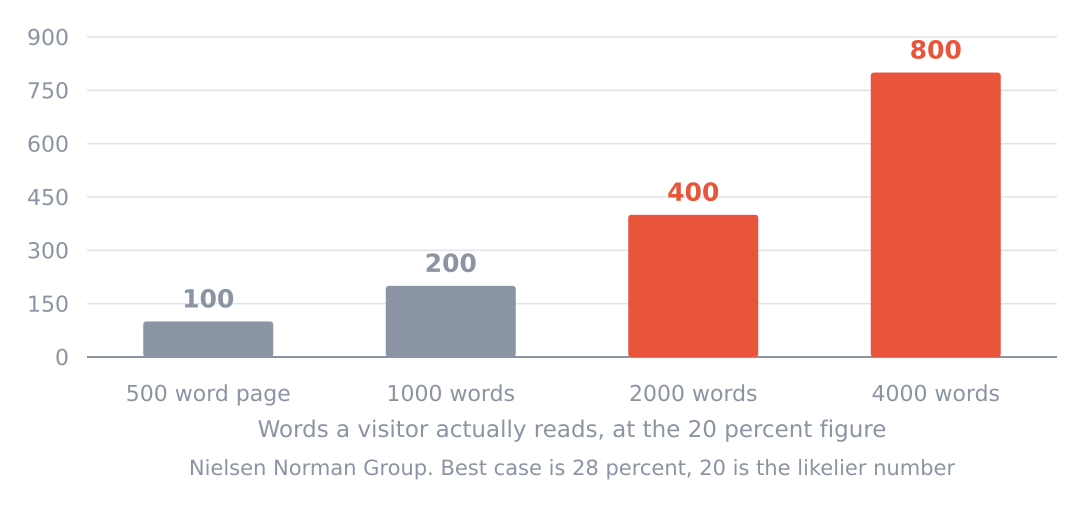
At the 20 percent figure. Writing more doesn't get more read, it just changes the denominator.
Where those twenty seven sentences come from
They aren't spread evenly. Eye tracking with 232 participants produced the F pattern, and it has survived two decades of attempted debunking.
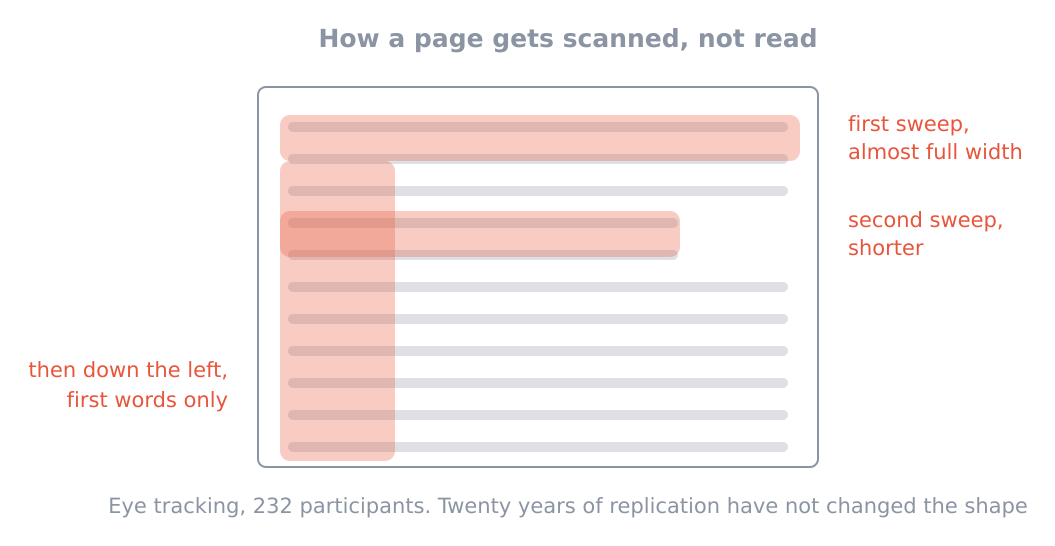
A near complete first line, a shorter second sweep, then the left edge only.
People read across the top nearly completely. Then a second, shorter horizontal sweep further down. Then they go down the left hand edge, picking up the first two or three words of each line and nothing else.
| Slot | How much gets read | What most people put there |
|---|---|---|
| First line | Nearly all of it | A greeting, or the company name |
| Start of each paragraph | First two or three words | It, This, With that in mind |
| Headings | All of them, they're short | A label like Our approach |
| Middle of paragraphs | Almost none | The number, the proof, the argument |
That gives you three things to work with, and they aren't the three things most people optimise.
Your first line gets read properly. Almost all of it. This is the only sentence you can rely on.
The start of every paragraph gets read. The first two or three words, in the vertical sweep. The rest of the paragraph is decoration unless something pulls them back in.
Headings get read because they sit in the left column and they're short. A heading that says Our approach is a wasted slot. A heading that says You can lose 69 percent of your customers is doing the work of a paragraph.
What this changes about how you write
Front load every paragraph. Put the claim in the first four words and the support after it. This is the opposite of how most people write, where the paragraph builds towards its point, and it means the scanning reader gets the conclusion rather than the setup.
Never bury a number. A number is the most scannable thing on a page because it's short and visually distinct. If you have one, it belongs at the start of a line, not in the middle of the third sentence.
Use headings as sentences, not as labels. Labels are for people who've already committed to reading. Sentences are for people deciding whether to.
Stop writing transitions. Phrases like it's also worth noting that and with that in mind occupy the left edge, which is your most valuable space, and communicate nothing. Every one of them is a slot spent on connective tissue that a scanner never reads.
The honest counter argument
This is where I'd push back on how the finding usually gets used.
Twenty percent is an average across page visits, and a large share of those visits are people who bounced in four seconds. Somebody who has decided your page is about their problem reads much more of it, and the NN/g work says so.
So the correct conclusion isn't that people don't read, therefore write less. It's that the first thirty seconds are scanned, and if you survive them a real reader emerges. You're writing two documents at once. A scannable one for the first thirty seconds and a proper one for whoever gets through.
The way you do both is structure, not brevity. Same content, arranged so that the first words of each block carry the argument. A reader who scans gets the argument. A reader who commits gets the argument and the evidence.
The test
Read only your first line, then only the first three words of every paragraph and heading, in order.
Does that sequence make the case on its own? If it reads as a list of throat clearing, that's what most of your visitors are getting, and no amount of quality in the parts they skip will change it.
I run this on anything I expect to be read by strangers. It usually takes ten minutes and it usually finds two paragraphs that begin with the word This.
0 replies
Sign in to join the discussion
Log in