The decoy effect mostly did not replicate
generalThe decoy effect is the most confidently repeated idea in SaaS pricing advice, and the evidence for it's much weaker than anybody tells you.
What the claim is
Add a third option that's clearly worse than one of your existing two, and it pushes people towards the option that dominates it.
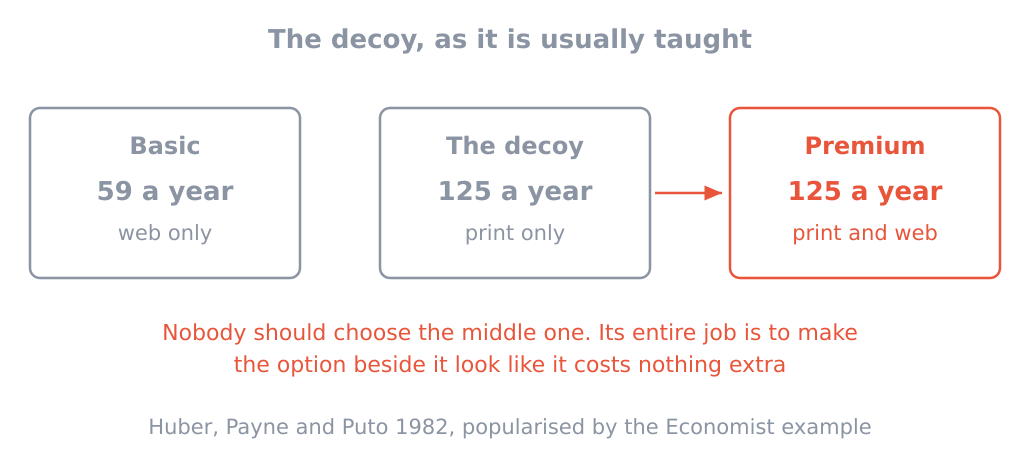
The middle tier exists to make the right hand one look free.
The canonical illustration is the Economist subscription example popularised by Dan Ariely. Web only at 59. Print only at 125. Print and web at 125. Nobody should take print only, and its job is to make the bundle look like a gift.
The underlying research is Huber, Payne and Puto in 1982, on asymmetric dominance.
What happened when people tried to reproduce it
In 2014 two substantial replication efforts found the effect largely disappeared once the stimuli were realistic. Not reduced. Mostly gone.
The original experiments used abstract, tightly controlled options where the dominance relationship was unmistakable and the attributes were directly comparable. Real pricing pages aren't like that. They have brand, familiarity, feature lists of different lengths, and buyers who arrive with a rough idea of what they need.
That gap between laboratory stimuli and real choices is where the effect went.
What does survive
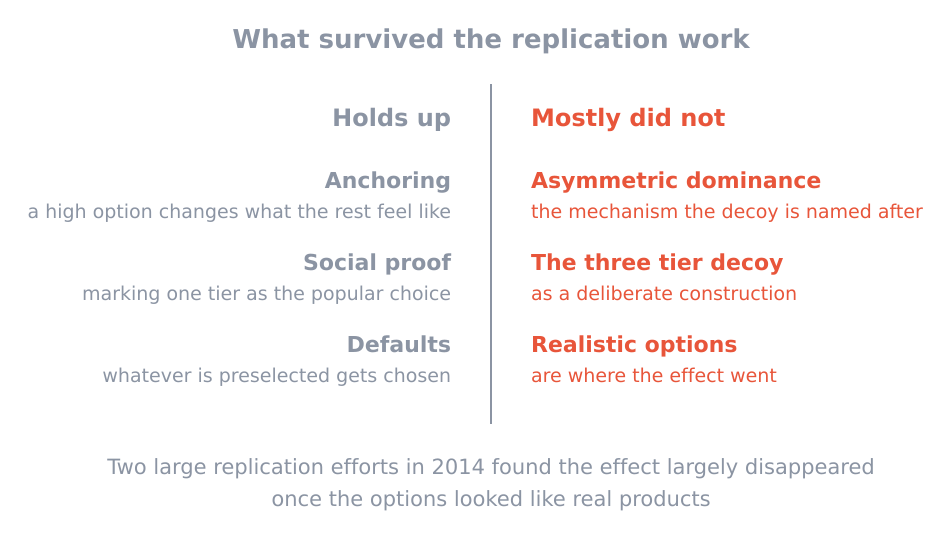
The replication problem doesn't mean pricing page structure is irrelevant. It means the credit went to the wrong mechanism.
| Effect | Evidence | What it means on a page |
|---|---|---|
| Anchoring | Good | Show a high tier even if nobody buys it |
| Social proof | Good | Mark the tier that genuinely is most popular |
| Defaults | Good, and largest of the three | Whatever is preselected or listed first wins |
| Asymmetric dominance | Mostly failed to replicate | Don't build a tier designed to be rejected |
This is the useful part, because the replication problem doesn't mean pricing page structure is irrelevant. It means the credit was assigned to the wrong mechanism.
Three things have better empirical support and probably do most of the work people attribute to the decoy.
Anchoring. Showing an expensive option changes what the other numbers feel like. This is robust, it isn't the same as asymmetric dominance, and it doesn't need a deliberately bad tier to work.
Social proof. Marking a tier as the most popular one moves choice. It also has an honesty requirement, since if it isn't the most popular you're lying on your pricing page for a couple of percent.
Defaults. Whatever is preselected, preexpanded, or first in the reading order gets chosen more. This is the largest and least discussed of the three, and it costs nothing.
Why the decoy story spread anyway
It's a very good story. It has a villain, a twist, and a number, and it makes the person telling it sound like they know something about psychology.
It's also unfalsifiable in practice. Nobody running a three tier pricing page has a control. If the middle tier sells badly, that was the plan. If it sells well, the tier is earning its place. There's no outcome that counts as the decoy failing, which is precisely the property that lets an idea survive without evidence.
I've believed and repeated a fair amount of this kind of thing. The tell, in hindsight, is that the advice arrives with an anecdote rather than an effect size, and the anecdote is always the same one.
What I'd actually do with a pricing page
Three tiers, because comparison needs a shape. Not for the decoy, but because a single price gives the reader nothing to reason about and five gives them a research project.
Make the middle tier the one you want sold, and make it genuinely the best value. That way the social proof label is true and the anchoring works in your favour without you having to construct anything deliberately bad.
Put your highest tier on the page even if almost nobody buys it. That's the anchoring effect, it has decent support, and it's the honest version of what the decoy was trying to do.
Don't build a tier whose purpose is to be rejected. Beyond the evidence problem, somebody eventually buys it, and now you're supporting a product you designed to be worse.
The general point
Pricing psychology is full of results from the 1980s that were run on undergraduates choosing between abstract options, and a lot of it didn't survive contact with the replication crisis.
That doesn't mean psychology is useless for pricing. It means the confident specific tactics are the weakest part of it, and the boring general findings are the strong part. People prefer round numbers less than they prefer clarity. People choose defaults. People anchor. People won't read your fourth tier.
None of those make a good conference talk. All of them replicate.
0 replies
Sign in to join the discussion
Log in