A fifth of the customers you lose never decided to leave
generalSomewhere between a fifth and two fifths of the customers you lose never decided to leave. Their card failed.
The average subscription business loses about 9 percent of monthly recurring revenue to failed payments. Median recovery across the market is around 12.7 percent of the attempts. Good practice recovers 70 to 85.
That gap is the cheapest revenue available to a small product and it needs no new customers, no feature and no marketing.
What the layers do
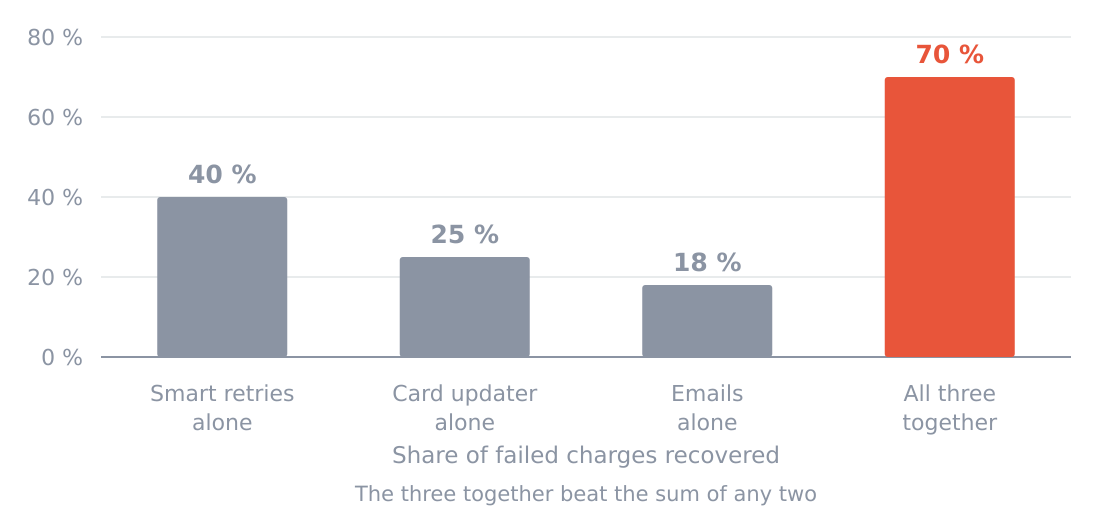
The three together beat the sum of any two.
| Approach | Recovers |
|---|---|
| Smart retries alone | 40 percent |
| Card updater alone | 25 percent |
| Emails alone | 15 to 20 percent |
| All three | 70 percent |
The reason the combination outperforms is that the three cover different failure modes. Retries fix a temporary decline, an insufficient balance on the 28th that clears on the 2nd. A card updater fixes an expiry, where the number has changed and nobody told you. Emails fix everything else, which is the customer needing to do something.
Run only one and you're solving one third of a problem while the other two thirds churn quietly.
What it's worth
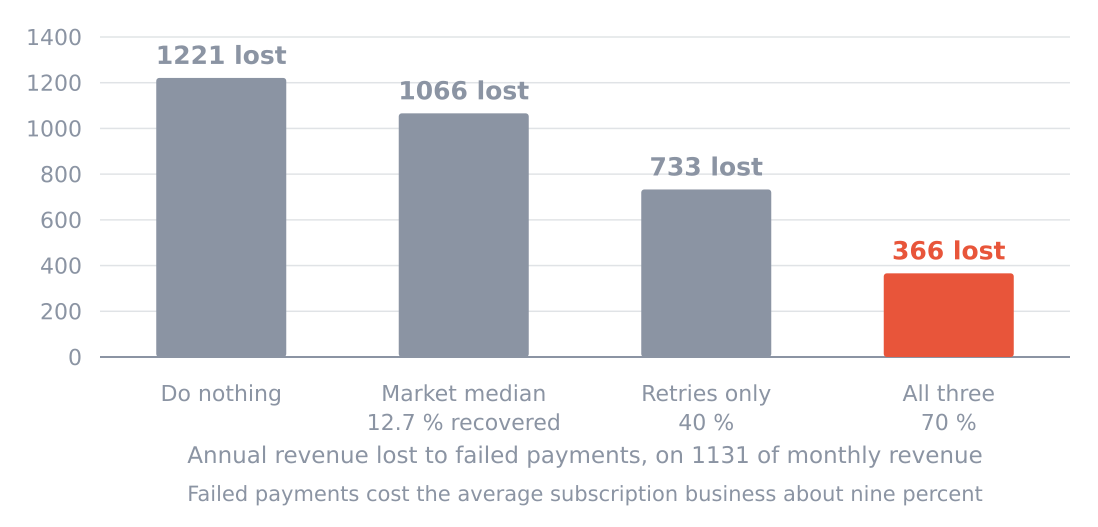
On 1131 of monthly recurring revenue.
At that revenue, 9 percent is roughly 1221 a year at risk. Doing nothing loses all of it. Sitting at the market median recovers 155. Getting to 70 percent recovers 855.
Seven hundred pounds a year, for a couple of days of work, on a business that size. There's no feature you could build in two days with that return, and unlike a feature you already know it works, because the people involved never wanted to leave.
The messaging, which is the part you control
I took the emails away from my payment provider and wrote them myself. Three changes mattered.
From my address, in plain text, no logo and no button. The provider default looks like every automated notice, and automated notices are exactly what a busy person deletes. A plain message from a person gets read.
To the account owner as well as the billing contact. This alone accounted for a large share of my improvement. For several of my accounts the billing address was an accountant who'd set the thing up once and had no idea what the message referred to. The person who can fix it's frequently not the person your provider is emailing.
A line inside the product, on a screen they actually use. Not a modal that blocks them. A line at the top. Most people who fixed it fixed it from there rather than from any email.
The end of the sequence is a real decision
At some point recovery fails and you have to decide what happens.
The provider default is usually to cancel, which for me would eventually have led to data being cleaned up. That's a harsh outcome for somebody whose bank replaced their card while they were on holiday.
What I do is pause at day 21. Access stops, data stays indefinitely, one final plain email says exactly that. Three people have come back after more than two months and just updated a card. Keeping paused accounts costs a few pounds of storage a year and I have no argument for ever deleting them.
The line I try not to cross
There's an aggressive version of this. Daily emails, an interface that won't let you do anything until you pay, escalating language. It probably recovers a few more.
I send four emails over three weeks and one of them is the final notice. If somebody doesn't want to fix it, the answer is no, and chasing a person over 29 a month isn't the relationship I want with somebody whose account I can see by name.
The plain language matters for the same reason. A dunning email written to create alarm works on some people, and the people it works on are the ones already anxious about money. I would rather recover one fewer.
Do this first, before anything on your roadmap
Take last quarter's cancellations and mark each one as decided or mechanical. Your payment provider can usually tell you, since a failed payment cancellation looks different from a customer initiated one.
If mechanical is over about a tenth, you have a two day job in front of you with a better return than anything you were planning, and with none of the uncertainty, because these people were never trying to leave.
0 replies
Sign in to join the discussion
Log in