The customer story nobody skips starts with a Tuesday
generalMost customer stories are unreadable, and the fix isn't better writing. It's putting the good part where people still are.
Where people still are
Assume each section of a piece loses some share of the readers who started it. Then after n sections you still have (1 - r)^n of them.
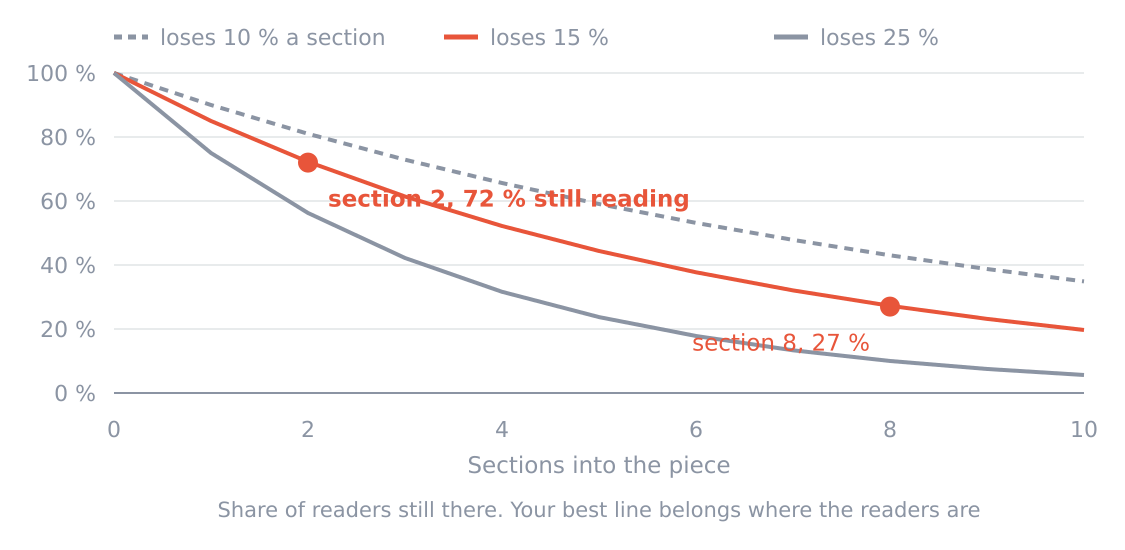
Nothing dramatic happens. It just compounds.
| Section | Loses 10 % each | Loses 15 % | Loses 25 % |
|---|---|---|---|
| 2 | 81 percent | 72 percent | 56 percent |
| 4 | 66 | 52 | 32 |
| 6 | 53 | 38 | 18 |
| 8 | 43 | 27 | 10 |
| 10 | 35 | 20 | 6 |
At a fairly ordinary 15 percent, your closing line reaches 20 percent of the people who started. The same line in section two reaches 72 percent. Nearly four times the audience, same words, different position.
Now look at where the average customer story puts its best material. The number is at the bottom. The specific detail that would make somebody recognise themselves is in paragraph nine, after the company background. The whole thing is built as a reveal, and a reveal is a format that only pays if people stay for it.
So the structure inverts
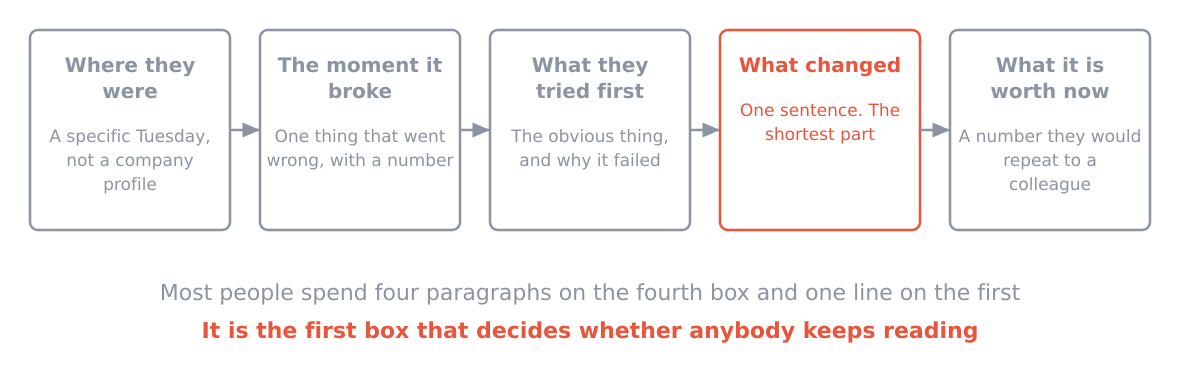
The last box is the one people write first. The first box decides whether anybody reads the rest.
Where they were. The moment it broke. What they tried first. What changed. What it's worth now.
Each part exists to buy you the next one. Nobody owes you section four.
Part one is a Tuesday, not a company
The opening most people write describes the customer. Founded in 2019, a team of twelve, clients across three countries.
Nobody has ever read that and felt anything. It's the information you'd need to raise an invoice, not the information a reader needs to recognise their own situation.
What works is one specific occasion. A person, at a particular moment, doing a particular thing that went wrong.
| Opening that fails | Opening that works |
|---|---|
| A twelve person accountancy firm in Leeds | It was the last Friday of the quarter and the two figures were 4 pence apart |
| They were looking for a better workflow | She had been staring at the same spreadsheet since half past seven |
| The team had outgrown their old process | Nobody could tell him which of the four versions was the real one |
The right hand column isn't more dramatic. It's more specific, and specificity is what makes a stranger recognise themselves. Somebody who's never been to Leeds and doesn't work in a twelve person firm has absolutely been 4 pence apart at the end of a quarter.
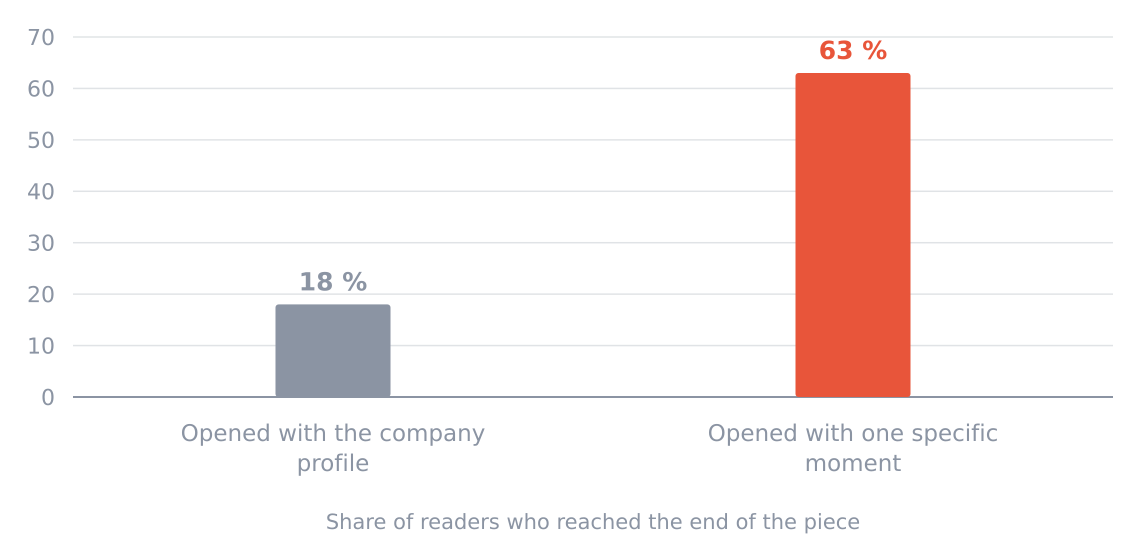
Two versions of the same story, same length, different first paragraph.
Part two needs a number, and small beats large
The moment it broke has to be concrete enough to argue with.
Four pence. Three hours. Eleven versions of one file. Two people cross checking the same numbers every month for a year.
Small numbers work better than big ones, which surprises people. Saved 40 percent of finance time is a claim about a category. Four pence is a thing that happened. The reader extrapolates on your behalf and they'll be more generous about it than you'd have dared to be.
Part three is the one everybody deletes
What they tried first. The obvious thing, the free thing, the thing your reader is doing right now.
This section gets cut for length and it's the most important one for anybody not yet convinced. Your reader is currently doing the obvious thing. If your story jumps from problem to product, you've skipped the objection they're actually holding, which is that they could probably just be a bit more careful.
Say what they tried. Say why it nearly worked. Be fair to it, because if you're unfair the reader stops trusting everything else.
Part four should be one sentence
People write four paragraphs here and it needs one line.
Your product is the least interesting thing in the story to the reader. They don't want to know about it. They want to know whether their Tuesday stops happening. Everything you add is detail they haven't asked for, and it reads as relief on your part, which it usually is.
Part five is a number they'd repeat
End with something a person could say out loud to a colleague without feeling silly.
Two hours a month back is repeatable. A 34 percent improvement in reconciliation efficiency isn't, because nobody talks like that, and a number nobody repeats does no work once the page is closed.
My test is whether I can imagine it being said in a corridor. If it needs a chart to make sense, it belongs in the middle, not at the end.
Getting the material
You can't write this from a form. The specific Tuesday never appears in a testimonial request, because when you ask somebody what they think of your product they'll say it's great and reliable.
Ask what they were doing on the day they went looking. Then be quiet. The story is in the answer to that question and almost nowhere else.
Two follow ups that reliably produce the good detail. What did you try before this. And what would you have done if you hadn't found anything. The second one produces the emotional content without you asking for it, and people answer honestly because it's hypothetical.
What to leave out
Adjectives about your own product. Each one is a claim the reader has to evaluate, and they cost more in trust than they earn in persuasion.
Quotes that say nothing. A quote should carry something that would sound wrong in your voice. A customer calling your tool intuitive and easy to use is a quote you wrote and they approved, and everyone can tell.
And yourself. Your story about deciding to build this is a different piece. Putting it here is the commonest way these turn from a story into a brochure.
The test at the end
Read it and ask whether it would still be worth reading if the product in it were a competitor's.
If yes, it's working, because the value is in the situation and the reader gets something either way. If no, you've written an advert with a person in it, and readers file those alongside everything else that's trying to sell them something.
0 replies
Sign in to join the discussion
Log in