We killed our free tier and revenue went up
generalA free tier is a bet with a number attached, and you can work out the number in about a minute. Almost nobody does, which is why so many of them run for years while quietly losing money.
The bet pays off when the revenue from the few who convert covers the cost of serving everybody who doesn't. Written out:
required conversion = monthly cost per free account x 12 / LTVLTV is what a paying customer is worth over their life. Mine was 29 a month with an average life of about eighteen months, so 522.
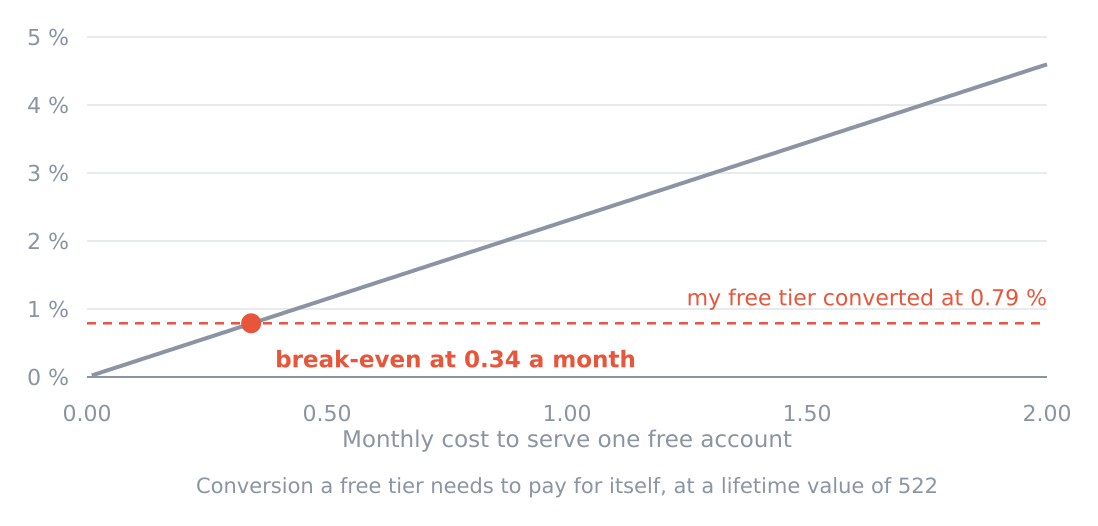
Straight line, no cleverness. Where you sit on it decides whether your free tier is marketing or charity.
| Cost per free account | Conversion you need |
|---|---|
| 0.05 a month | 0.11 percent |
| 0.10 | 0.23 percent |
| 0.25 | 0.57 percent |
| 0.50 | 1.15 percent |
| 1.00 | 2.30 percent |
| 2.00 | 4.60 percent |
Mine converted at 0.79 percent. Eleven paying customers out of 1400 free accounts over eleven months.
Run it backwards and 0.79 percent means I could afford to spend 34 pence per free account per month. My actual cost was well over that once I counted storage, the background jobs those accounts queued, and the third of my support volume they generated. So the free tier wasn't a slow funnel. It was a subsidy, and I'd been paying it for eleven months while reading the signup count and feeling fine.
The cost line is where people fool themselves
Everybody underestimates cost per free account, and it's always the same three omissions.
Support is a cost and it's the big one. Free users were about a third of my tickets. If support is worth anything as an hourly rate, that dwarfs the hosting, and hosting is the only thing most people count.
Free accounts are not free to keep. They were 84 percent of my database rows and a similar share of my job queue. Everything you build afterwards runs against that data. Every migration is slower, every backup is bigger, every query needs an index it wouldn't otherwise need.
Your attention is the real one and it isn't on the line at all. A free tier means a second set of edge cases, a second billing state, and a second answer to every design question. I don't know how to put a number on that. I know it's not zero, and it's the one you'll feel most.
Count support and you'll usually find you're above a pound a month per account, which needs 2.3 percent conversion. Very few free tiers convert at 2.3 percent.
Why mine was never going to work
There's a structural test that would have saved me eleven months, and it has nothing to do with the arithmetic.
Does using your product more make somebody need the paid plan?
If yes, the free tier is a genuine funnel. Storage, seats, messages sent, anything where success generates more of the thing you charge for. The upgrade becomes a consequence rather than a decision, and you're not persuading anyone, you're just present when they outgrow it.
If no, you haven't built a funnel. You've built the product and given it away.
Mine did a fixed job for one person. Doing it perfectly for a year made them love it and brought them no closer to paying, because somebody reconciling two accounts a month is not a smaller version of somebody reconciling two hundred. Different person. They will never need the paid plan and my free tier served them beautifully, permanently, for nothing.
The number I should have watched
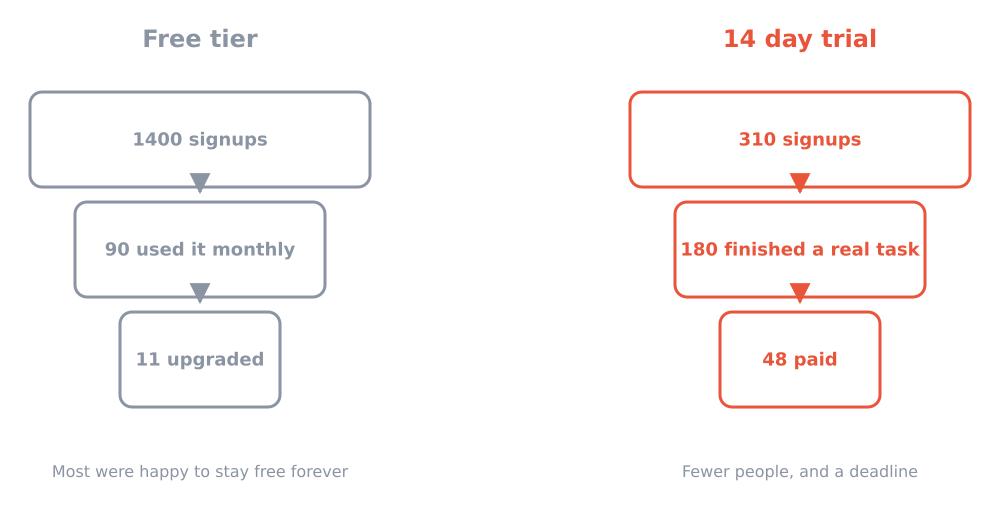
The middle box is the one I never measured.
Of 1400 free accounts, about 90 used the product in a given month. The other 1310 had signed up, poked at it, and stopped.
Because they were free, they never cancelled. So my headline number climbed all year while the thing underneath it didn't move at all.
That's the quiet damage a free tier does. A cancelled subscription is a signal. An abandoned free account is silence, and silence reads as fine. I had a retention problem for a year and my dashboard was constitutionally unable to show it to me.
If you run a free tier, go and count how many free accounts did something real last month. Not how many exist. If that number is flat while the total grows, you already know.
What the trial changed
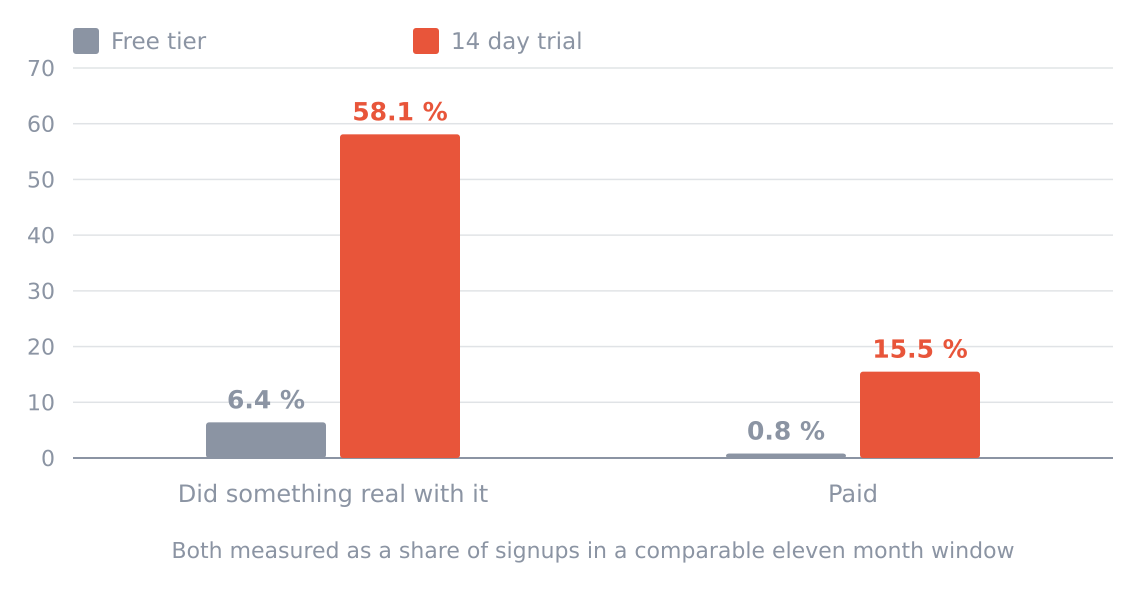
Same length window either side. Fewer people at the top, four times as many at the bottom.
| Free tier | 14 day trial | |
|---|---|---|
| Signups | 1400 | 310 |
| Did something real | 90 a month | 180 |
| Paid | 11 | 48 |
| Share of support volume | About a third | About a tenth |
| Told me when they left | No | Yes, by not converting |
The support row surprised me. I'd assumed free users would be undemanding because they were paying nothing. The opposite happened, and the reason is obvious in hindsight. A free user has no sunk cost, so when something confuses them they ask instead of working it out. A trial user has a deadline, works it out, and then asks a much better question.
Two things I got wrong in the switch
I started the clock at signup. People signed up on a Friday, forgot, and burned their trial over a holiday. Starting it at first real use lifted conversion about six points and cost nothing, since somebody who never starts was never going to buy.
And my first version cut access dead at day fifteen. Terrible moment to pick a fight with somebody who's just uploaded their real data. Now the account pauses, the data stays, and it's exportable forever. Three people have come back after more than six months precisely because their data was still there.
The 1400
Everyone on the free tier kept it. No migration, no countdown, none of the email everybody sends about how we've made some changes to our plans.
There are about 1600 of them now. It costs me roughly 40 a month and a couple of hours of support, and I carry that deliberately, because I never had to be the person who took away something that was promised. New signups get the trial. The old tier is closed rather than cancelled, and it isn't advertised anywhere.
Before you launch one
Work out your cost per free account with support included, divide by your LTV, and see what conversion you'd need. Then ask whether a delighted free user gets closer to needing the paid plan or further away.
If the honest answer is further away, no conversion rate will save it, and the arithmetic above is just telling you how fast you'll lose.
0 replies
Sign in to join the discussion
Log in