We cut the welcome sequence from seven emails to two
generalOur welcome sequence was seven emails. It's two now, and more people do the thing the emails were asking for.
The reason is in one number. The first two emails carried 44 percent of all the attention that sequence ever received.
Where the attention actually was
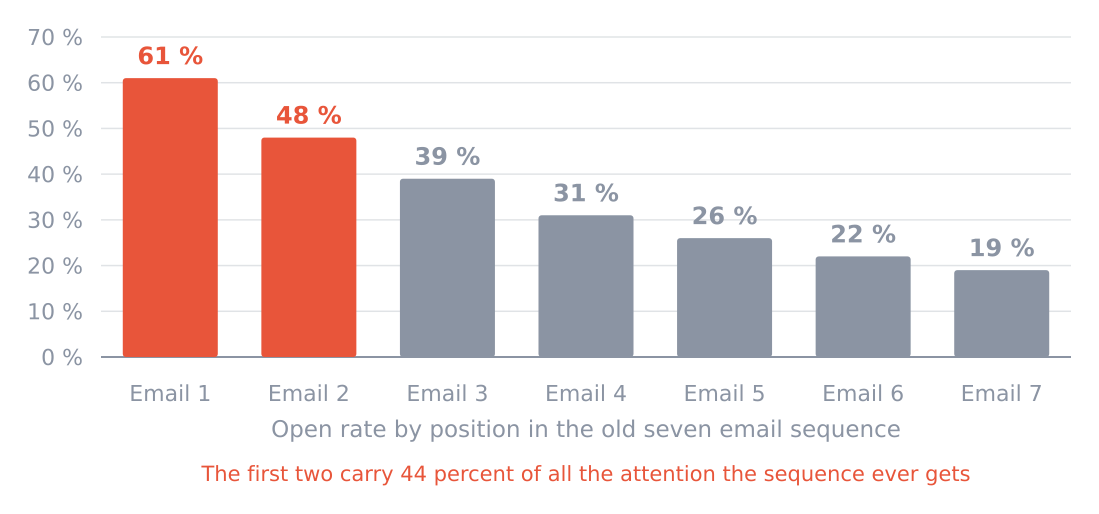
Add the opens up and the first two are nearly half of everything.
Opens by position went 61, 48, 39, 31, 26, 22, 19. Sum that and you get 246 points of attention across the whole sequence. Emails one and two account for 109 of it.
So five sixths of the emails, and more than half of the writing, were competing for the remaining 56 percent, in ever thinner slices, with a reader who was steadily less interested each time.
And every send costs you something
Attention isn't the only thing that decays. Each email carries some chance that a person unsubscribes, and it compounds the same way.
list remaining = (1 - p)^n| Emails | p = 0.5 % | p = 1 % | p = 2 % |
|---|---|---|---|
| 2 | 99.0 percent | 98.0 percent | 96.0 percent |
| 4 | 98.0 | 96.1 | 92.2 |
| 7 | 96.6 | 93.2 | 86.8 |
| 10 | 95.1 | 90.4 | 81.7 |
At a modest one percent, seven emails costs 6.8 percent of your list against 2.0 for two. Those five extra emails, which between them carried 56 percent of a rapidly shrinking attention pool, cost me nearly five percent of everyone who ever signed up.
That's the trade written out. You're spending list to buy attention, and the exchange rate gets worse with every send.
What was wrong with them
Each email was individually fine. Nothing spammy, nothing badly written. The problem was that they had no job.
Emails two through seven existed because a sequence should have several emails. When I went back and asked, for each one, what do I want this person to do differently after reading this, four of them had no answer. They were content, sent on a schedule, to somebody who hadn't asked for content.
The case studies were the worst. Somebody who signed up three days ago and hasn't imported their own data doesn't want to read about another company succeeding. They want their file in. Sending them somebody else's story at that moment isn't encouragement, it's evidence that you aren't paying attention to where they are.
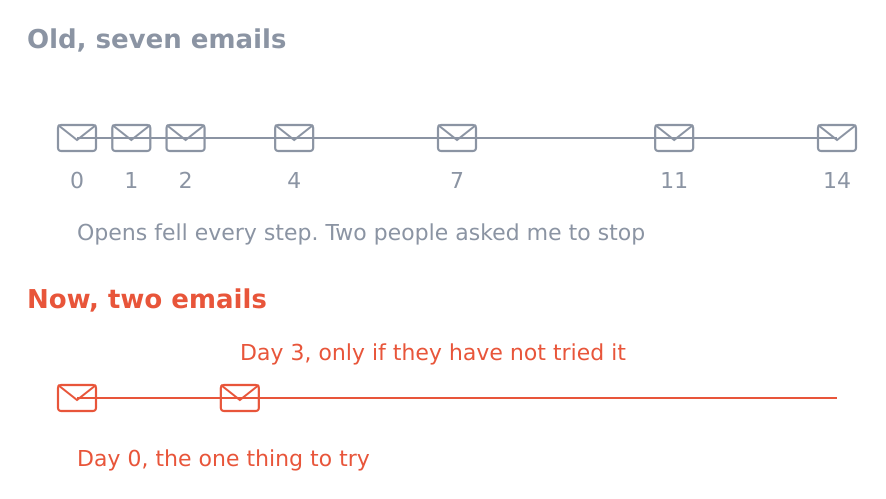
Both sequences have the same job. One of them says it once.
What the two do
Day zero. One thing to try, which is importing a single file, with the exact steps. Nothing else. No tour, no feature list, no case study.
Day three, and only if they haven't imported anything. One line asking what they got stuck on, from my address, no formatting, no images.
That condition is the important part. Anybody who's already done the thing gets nothing at all, because the correct number of emails to send a person who's doing fine is zero.
| Seven emails | Two emails | |
|---|---|---|
| Opens, first | 61 percent | 64 percent |
| Opens, last | 19 percent | 47 percent |
| Unsubscribed during | 7 percent | 2 percent |
| Replied with a question | 4 people | 11 people |
| Did the task in week one | 31 percent | 44 percent |
| Asked me to stop emailing | 2 people | 0 |
Replies are the real result
Eleven people replied to the day three email in one quarter, against four across all seven of the old ones.
It looks like a message from a person, asks one question, and lands at a moment when they genuinely are stuck. Those eleven replies are where the merged header cell problem came from, and that turned out to be the single largest cause of people giving up in their first fortnight.
A sequence producing replies is doing something a sequence producing opens isn't. Opens tell you the subject line worked. Replies tell you what's wrong with your product.
What I kept, but moved
The day fourteen email, the how is it going one, had a low open rate but the people who opened it wrote back with unusually good detail. Too late to help them, but useful.
I didn't put it back in the sequence. I moved it out of onboarding entirely and made it something I send by hand to accounts active for a month. Same words, different moment, no longer automated. Better response, and it's now a research tool rather than an onboarding one.
Which is the tidy version of the lesson. Onboarding email helps a person do one specific thing. Research email asks somebody who's already done it what happened. Mixing them produces emails that do neither.
If you're cutting one down
For each email, finish this sentence. After reading this, the person will go and do X.
Any email where you can't name X isn't a weaker version of a good email. It's content you're sending because you built a schedule, and it costs you a slice of goodwill and a slice of your list every time.
Then check whether it should go to somebody who's already done X. Mine went to everybody, including people who imported on day one, which meant my most engaged new users were receiving the most irrelevant mail I sent.
0 replies
Sign in to join the discussion
Log in