My first ten customers came from seven places, none of which scale
generalThree of my first ten customers came from one forum answer. One came from a cold email. For about eight months I treated that as a three to one result and put my time accordingly.
It isn't a result. Here's what three out of ten actually tells you.
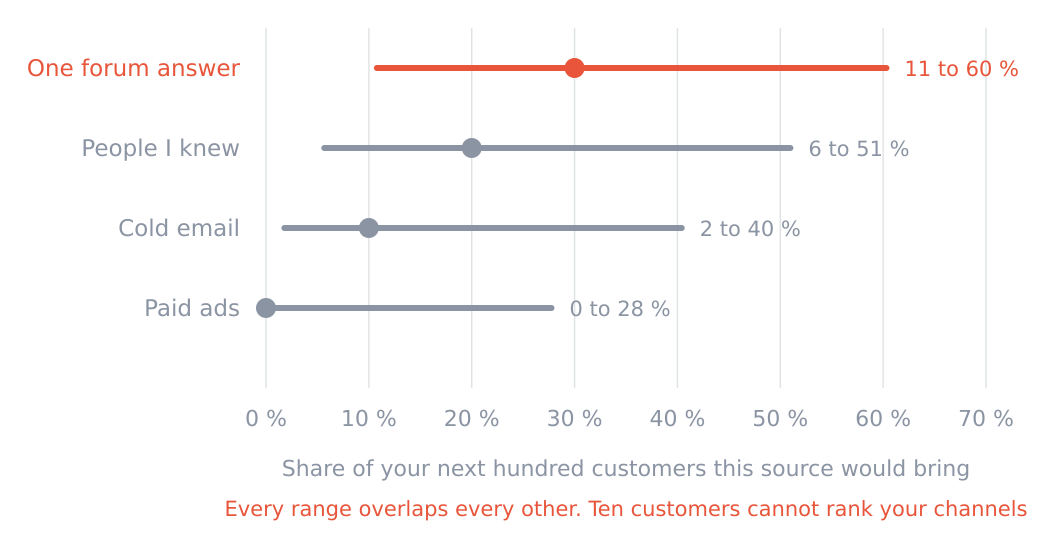
The dot is what I measured. The line is what the measurement is compatible with.
| Source | Of my ten | What the data supports |
|---|---|---|
| One forum answer | 3 | Somewhere between 11 and 60 percent |
| People I already knew | 2 | Between 6 and 51 percent |
| Cold email | 1 | Between 2 and 40 percent |
| Paid ads | 0 | Between 0 and 28 percent |
Those are Wilson intervals, which is the standard way to put a range around a proportion when your sample is small. Every one of them overlaps every other one. The forum range runs from 11 to 60. The cold email range runs from 2 to 40. They share almost their entire span, which means my three to one result is entirely consistent with cold email being the better channel.
Even the ads, which produced nothing, could plausibly be a channel worth up to twenty eight percent of my customers. Zero out of ten does not mean zero.
Why this bites so hard
Small samples are much noisier than they feel, and proportions from small samples are the worst offenders because your brain reads them as ratios rather than counts.
Three out of ten sounds like a measurement. It's three events. Move one customer from the forum column to the cold email column, which could easily have happened, and it's two to two.
I know all this in the abstract. I still spent eight months acting on it, because at the time it wasn't a statistic to me, it was a story about how the forum was working.
What I did with those eight months
Wrote twenty more forum answers, which produced two signups because most were thin. Asked for introductions from the friends who'd referred people, which produced one awkward conversation. Found nine more podcasts and left comments on them, which produced nothing and which I'd rather not discuss.
What I didn't do was talk to the ten customers I already had.
The thing worth measuring at ten
Here's what saves this. You don't need statistics to learn from ten customers, you just need to ask them a question that isn't about channels.
Seven of my ten were doing the same specific job, badly, in a spreadsheet, and had gone looking for something better within the previous month. Seven out of ten with a Wilson interval of 40 to 89 percent, which is still wide but is nowhere near a coin flip, and more importantly it's a claim about who they are rather than where they came from.
That's the difference. Channel data at n equals ten is unusable. Pattern data at n equals ten is often obvious, because you're not estimating a rate, you're noticing that the same sentence keeps coming up.
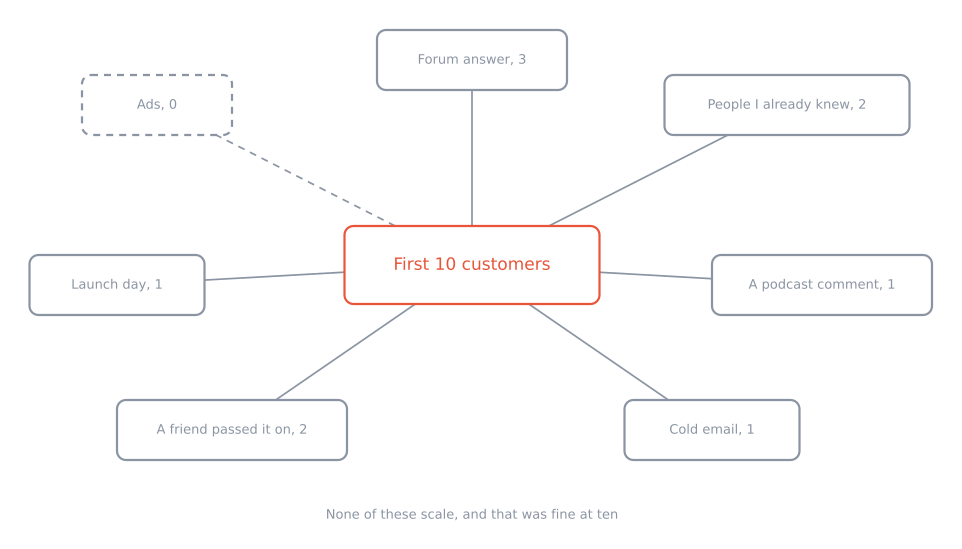
Seven sources for ten people. I spent months studying this diagram when the useful information was in the customers, not the arrows.
Roughly when channel numbers start meaning something
Depends what you want to tell apart. To separate a channel producing thirty percent of your customers from one producing fifteen, with the usual confidence, you need somewhere around a hundred and twenty customers total. To tell thirty from twenty five, you need over a thousand.
So for most of us the answer is that you will never have enough customers to rank your channels statistically, and that's fine, because by the time you would, you'll have something better. You'll have cost per customer and time per customer, and those are measured per attempt rather than per success, which means they accumulate data far faster.
That's the practical move. Stop asking which channel produced the most customers, because that's the rare event. Start asking what an attempt costs and how many attempts each channel needs, because attempts are common and you can count them from week one.
What I'd tell somebody at three customers
Don't build the channel spreadsheet. There's nothing in it yet and it will send you hunting for dials that don't exist.
Talk to all three. Ask what they were doing on the day they went looking. Write down their exact words. When two of them use the same phrase, that phrase is your first docs page, your first forum answer, and probably your headline.
And treat any early source you can't describe as a person with a problem as an accident. My podcast comment was somebody being curious. The forum answers were people who were stuck. Only one of those has ever repeated.
The one number that was real
Paid ads: thirty one email addresses, zero customers.
The interval on nought out of ten technically goes up to twenty eight percent. But this is the one case where I'll go past the statistics, because I have more than the ten customers here. I have 31 addresses, several hundred impressions, and a full funnel of people who arrived and did nothing. That's a much bigger sample of the attempt, and it's uniformly bad at every step.
Which is the lesson underneath all of this. When the successes are too few to count, count the attempts instead.
0 replies
Sign in to join the discussion
Log in