Show HN launch planning in 2026: lessons from 28,270 posts in 2025

A Show HN post gives a maker a place to share something people can try and discuss. That opportunity is worth preparing for, but it does not come with a promised audience. A quiet thread needs to be part of your launch plan.
For a launch planned in November 2026, we looked back at a completed year. Our saved snapshot from the public HN Search API by Algolia contains 28,270 posts tagged Show HN and created in 2025. Points and comments were recorded on November 10, 2026. The median post had 2 points, 61.6 percent had no recorded comments, and 742 posts, 2.6 percent, had at least 100 points. This is a 2025 baseline, not a measurement of current 2026 launch traffic.
Use those rates to set expectations, not to calculate a personal probability of success. The snapshot measures points and comment counts, not visits, signups, sales or the quality of a product. The useful question is how to prepare a worthwhile post without making your launch depend on an unusually large response.
What a typical Show HN gets
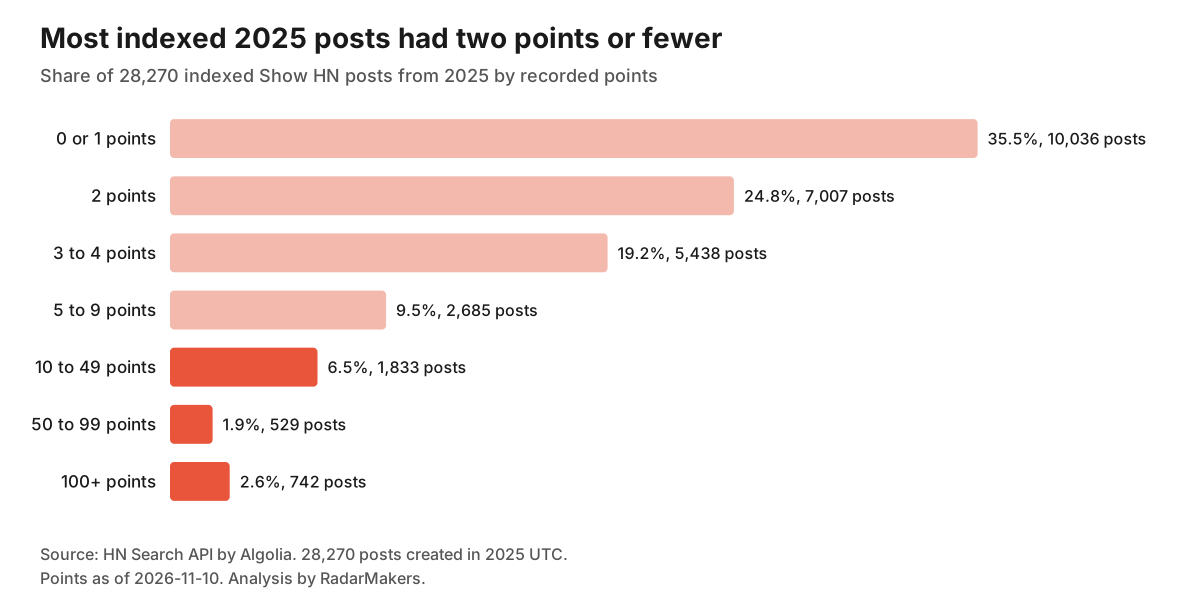
Here is the whole year in one distribution. 35.5 percent of posts had 0 or 1 point. Another 24.8 percent had exactly 2. Add the 19.2 percent that got 3 or 4, and about four out of five posts had no more than 4 points.
The top of the list looks very different. 3,104 posts, 11.0 percent, had at least 10 points. 1,271 posts, 4.5 percent, reached 50. 742 had at least 100, 328 had at least 200 and 73 had at least 500. The highest scoring post in this cohort had 3,346 points.
Recorded points were concentrated at the top. The highest scoring 1 percent of posts accounted for 38.7 percent of the cohort's recorded points, and the highest scoring 5 percent accounted for 72.5 percent. That describes an uneven score distribution. It does not tell us how many people viewed or tried each project.
Comment counts also varied with the score threshold. Among posts that had at least 10 points, the median post had 14 comments. Among posts that reached 100, the median had 65. Below 10 points, a thread is often empty. Comments can bring useful questions and product feedback, but a count does not tell you whether the commenter tried the product. Read the thread before treating it as user research.
More posts, a lower share above the threshold
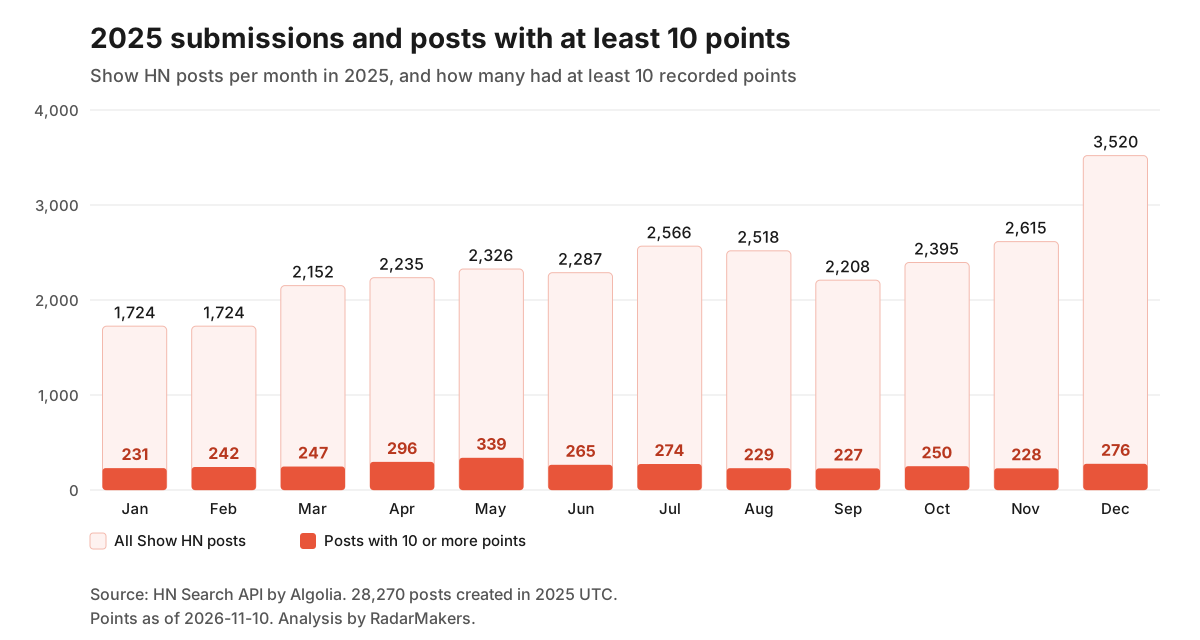
The year also shows why a percentage needs its denominator. Submission volume grew faster than the count of posts above our attention threshold.
In January 2025 there were 1,724 Show HN posts. In December there were 3,520, about twice as many. Over the same months, the number of posts that had at least 10 points stayed in a narrow band: 231 in January, a high of 339 in May, 228 in November and 276 in December. The December count above the threshold was higher than January's, but it did not grow as fast as the total post count. The monthly results were not constant.
So the share above the threshold fell. In January, 13.4 percent of posts had at least 10 points. In December it was 7.8 percent. The share that had at least 100 points fell from 3.71 percent to 1.53 percent.
These are observed counts, not a fixed supply of launch slots. We did not measure how many readers were available, how long posts stayed visible or how much attention each one received. More submissions competing for attention is one possible explanation for the lower share, but this data cannot establish the cause.
It also contains no measure of effort, product quality or AI use. The numbers cannot tell you whether easier building caused the rise in posts, or how hard work changes the outcome of one project. They show that copying an earlier month's rate would give a different baseline, even before you consider whether your project fits the audience.
Why posting again is not a plan
A common reaction to a flat launch is to try again. The math looks tempting at first. If each attempt has a chance p, the chance of at least one success in k attempts is
P = 1 - (1 - p)^k
Using the exact 2025 fraction behind the rounded 11.0 percent rate, this hypothetical model gives 29.5 percent for three attempts and 44.1 percent for five. It takes six attempts to exceed even odds. Using the exact fraction behind the 2.6 percent rate for 100 points, five attempts give 12.5 percent and it takes 27 attempts to reach at least even odds. These are model calculations, not measured outcomes of makers posting repeatedly.
There are two problems with that plan. First, the formula assumes each try is independent, and a repost of the same thing to the same audience cannot simply be assumed to satisfy that condition. Second, the FAQ does not permit an unlimited reposting strategy. Its FAQ says that a small number of reposts is fine only if a story "has not had significant attention in the last year or so", that duplicates are otherwise buried, and that you should not delete and repost the same story.
The formula does not show that repetition will improve a real launch. It assumes the same probability on every attempt, while the audience, project and moderation history can change. The FAQ also describes ranking factors beyond points and age, including flags and moderator action. Prepare something useful to try and discuss; do not turn the equation into a repost schedule.
Does the hour matter
The snapshot has differences by posting hour. Those differences are descriptive, not evidence of an optimal time for your next launch.
We grouped posts by creation hour in UTC and calculated the share with at least 10 points. We also calculated 95 percent Wilson score intervals using the method in the NIST statistics handbook. These are binomial model intervals: they assume independent posts with the same underlying probability within each group. They do not establish a causal timing effect or uncertainty about the already observed counts.
The highest observed hourly share was at 17:00 UTC, with 14.0 percent of 1,817 posts reaching 10 points, interval 12.5 to 15.6 percent. The weakest was 07:00 UTC, with 7.3 percent of 885 posts, interval 5.8 to 9.3 percent. Those hours were selected after comparing all 24 groups. The intervals are not adjusted for that selection, and the analysis does not account for repeated posters. Their separation is not proof of a best posting hour.
Grouped into blocks, posts created between 13:00 and 18:59 UTC had at least 10 points 12.6 percent of the time, 1,465 of 11,669. Posts created between 04:00 and 10:59 UTC did so 8.3 percent of the time, 477 of 5,763. These blocks were also chosen after looking at the hourly data. The snapshot does not identify readers' locations or time zones.
The observed weekday range was narrower: 10.1 percent on Saturday to 11.3 percent on Sunday. That comparison is also observational.
People posting at 17:00 UTC may differ from people posting at 07:00 UTC in ways unrelated to the clock. Product type, audience and other unrecorded differences could explain the gap. Pick a time when you can be available to discuss the project. Treat the hourly rates as exploratory context, not a free improvement you can apply to your own probability of success.
One more small result. Records with a URL had at least 10 points 11.0 percent of the time, compared with 9.9 percent for records without one. The median was 2 points for both. This measures whether the API had a URL, not the effect of changing the format of the same project. Choose a format that lets readers understand and try the work.
Prepare the post using the current guidelines
The dataset does not measure which preparation steps improve a post. The current Show HN guidelines, checked in November 2026, explain what belongs there. They need not describe every entry in this historical cohort, which was not screened for eligibility.
Make it tryable. Show HN is for work readers can use and discuss. The guidelines ask for access "ideally without barriers such as signups or emails." If accounts are necessary, consider a demo account or a sandbox. The current guidance also rejects quickly generated one off projects and asks you to explain work that is personally interesting to you.
Show something real. Blog posts, sign up pages, newsletters, lists, landing pages and fundraisers are not suitable Show HN submissions. There are specific exceptions: a hardware project can use a video or detailed article, and a book can use a sample chapter. Minor version updates normally do not qualify, while a major overhaul may. If the work is not ready to try, wait.
Be there. You must have worked on the project personally and be available to discuss it. As a practical plan, reserve time after posting to answer substantive questions, explain tradeoffs and learn from criticism. A thread can be useful without becoming a large one.
Do not game it. The guidelines say plainly that asking friends to upvote or comment is not ok. Apart from the rules, it also breaks the one thing you are there to learn, which is whether strangers care.
Plan for the median, hope for the tail
Put the numbers together and a sensible plan looks like this.
First, budget for a quiet response. The median score was 2 and 61.6 percent of posts had zero recorded comments. Those are separate measures; they do not mean most posts had exactly 2 points and no comments. Do not make a front page result necessary for the launch to be worthwhile.
Second, make your one try count. Spend the time on a demo that works without sign up, a first sentence that says what the product does, and a short note on why you built it. Our guide to writing a tagline and description that works covers that first sentence.
Third, choose a time when you can be present. The 13:00 to 18:59 UTC block is an exploratory pattern in this 2025 cohort, not a proven scheduling rule. Do not hold a finished project for days waiting for a supposedly perfect hour.
Fourth, spread the plan across appropriate channels. Only 2.6 percent of posts in this cohort had at least 100 points; that is not your personal probability, but it is a reason to avoid depending on a large thread. Relevant communities where sharing is welcome and suitable directories give you other places to explain the product and seek feedback. Our list of places to launch a SaaS and the launch checklist help you plan the rest.
Fifth, measure what each channel actually sent you. Use a separate tagged link for every place you post with the UTM link builder, so a quiet Show HN and a busy forum reply do not blur together in your analytics.
When you are ready, you can also submit your product to RadarMakers as one of those channels.
How we measured
The collection script uses the HN Search API endpoint search_by_date, the show_hn tag and consecutive three day windows from January 1, 2025 inclusive to January 1, 2026 exclusive, UTC. It deduplicates by object ID. The saved snapshot contains 28,270 records, with at most 430 in a window, below the requested 1,000 results per page. A review recheck matched all 12 monthly totals to current API queries and checked representative item records. This supports coverage of the indexed tag, not a complete archive of every submission ever made.
Points and comment counts are the snapshot recorded on November 10, 2026, not guaranteed final values or votes necessarily cast during 2025. Missing and unindexed posts may be absent. The saved fields do not retain a killed or deleted status, and we did not screen projects for current Show HN eligibility. Missing points or comment values were normalized to zero by the collection script. We did not measure page position, traffic, buyers or effort. Hours, weekdays and months use UTC.
The companion chart script calculates its arrays and the article statistics directly from that saved file. It checks the snapshot hash, offers a read only check of generated figures and does not refresh the raw data. For the top 1 and 5 percent shares, the number of ranked posts is rounded down to whole posts: 282 and 1,413. Percentages and model probabilities use unrounded fractions before display rounding.
The thresholds of 10 and 100 points are our choices, picked to mark a post that got some attention and a post that got a lot. The guidelines say a Show HN appears on the Show page once it clears "a small points threshold", but they do not publish the number, so 10 points is not a claim about that threshold.
Sources
- HN Search API by Algolia, API documentation and its first party documentation source: the search_by_date endpoint, show_hn tag and numeric timestamp filters. The documentation page needs JavaScript; the source and live endpoints were checked directly.
- Hacker News, Show HN Guidelines: what counts as a Show HN, trying without sign ups, quickly generated one offs, being around to discuss, the Show page threshold and the rule on asking for votes.
- Hacker News, FAQ: the rule on reposts and deleting and reposting.
- NIST, Confidence intervals for a proportion: the Wilson score calculation used for the hourly descriptive model intervals.
Historical counts and percentages come from our analysis of the saved 2025 cohort. Retry probabilities are hypothetical calculations under an independence assumption, not observed repeat launch results. The preparation checklist is editorial advice informed by the current HN rules, not a causal finding from the dataset.
0 replies
Sign in to join the discussion
Log in