How Long Should a Free Trial Be
A free trial is a deadline you invented. The product does not care whether that deadline is 7 days or 30. The person using it cares whether they can finish one real job before you ask for money.
That is the starting question, and public numbers will not settle it for you. RevenueCat's study of more than 17,000 apps puts the highest monthly trial to paid rate in the 10 to 16 day group. Whop's digital seller study puts 30 days first, at 56 percent against 15 percent for 14 days. Those are different populations, not competing forecasts for your product. Copy either result onto your pricing page and you have copied someone else's market.
Use the numbers to see what was measured. Then time your own first useful result and test two lengths on the same plan.
What "converted" means before you trust a chart
A trial conversion rate is not a quality score. It is a fraction, and the denominator changes the story.
In the RevenueCat count below, trial to paid is the share of trial users who pay. First renewal is a second question, asked only of people who already paid: what share of those payers pay again. A long trial can look strong on the second number because the people who lasted until the charge were already the ones who wanted the product. RevenueCat says this outright. Someone still in the trial on day 25 of a 30 day window is more likely to pay than someone who leaves on day two. That is a pattern in the data, not proof that adding days caused the payment.
Whop's seller study mixes a third idea into the same conversation. It reports both the conversion rate and the share of signups that landed on each length. A rare 3 day offer can convert well and still bring almost nobody. A popular 30 day offer might attract a different audience or come from different kinds of products. The page does not establish which explanation accounts for the gap. The page does not say the lengths were assigned at random.
If your analytics tool uses one word for all three ideas, split them before you change the calendar.
What the app numbers say
RevenueCat published the breakdown in How long should your free trial be? The window is August 2025 through July 2026. The rates are medians of apps, not one pooled crowd of users. An app segment needed more than 100 eligible trials for conversion, or more than 100 subscriptions reaching a first renewal for retention. Conversion uses trial starts in that window; retention uses renewal dates, which can include trials that began earlier. Groups with fewer than 20 apps are treated as directional. Trials longer than 32 days are left out of the conversion figures. The set is more than 17,000 apps on the App Store and Google Play.
The same article cites their State of Subscription Apps 2026 report for a headline: a 42.5 percent median conversion rate for trials of 17 days or more, against 25.5 percent for trials of four days or less. That is about 67 percent higher. The headline does not separate billing plans. The useful cut is by weekly, monthly, and annual billing, because a week of access and a year of commitment are not the same purchase.
On monthly plans, trial to paid rises from the shortest group and then slips:
| Trial length | Trial to paid | First renewal among payers |
|---|---|---|
| 4 days or less | 39.6 percent | 54.2 percent |
| 5 to 9 days | 45.9 percent | 62.8 percent |
| 10 to 16 days | 46.6 percent | 72.0 percent |
| 17 to 32 days | 43.7 percent | 77.5 percent |
Their own chart rounds the conversion column to 40, 46, 47, and 44. The sentences in the article are the unrounded figures above. The 72.0 percent renewal on 10 to 16 day trials is the figure they set next to 62.8 percent, which is the 5 to 9 day group, not the shortest group. The shortest group's renewal is 54.2 percent, from the same table.
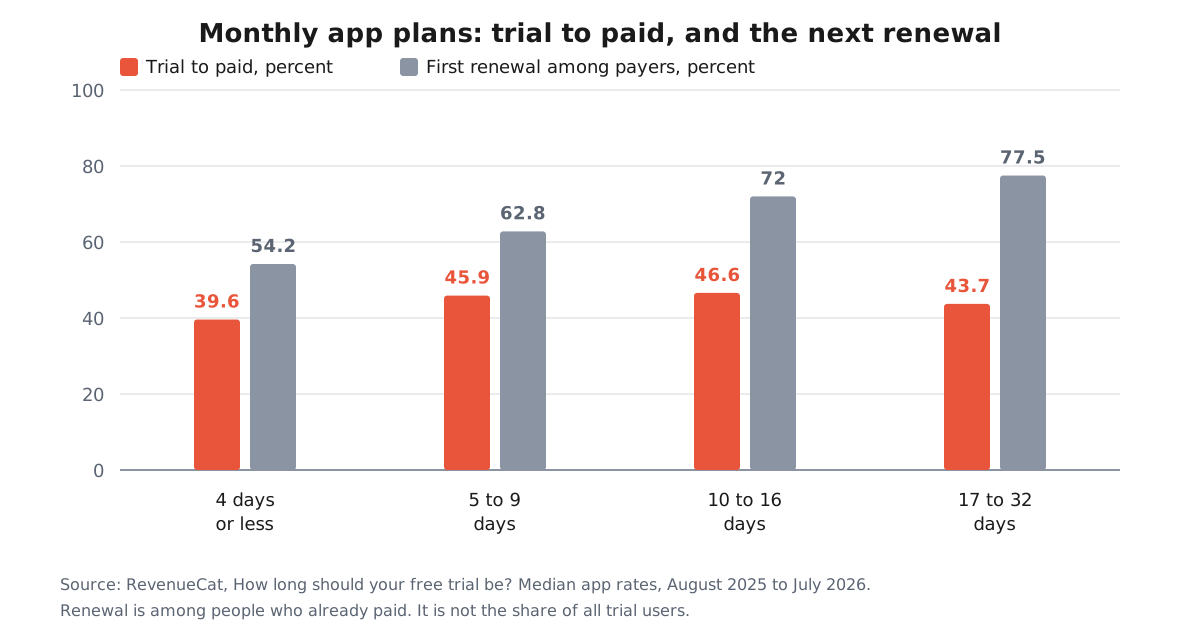
Read the two columns as different jobs. Conversion peaks in the 10 to 16 day group, and the longest group is a little worse. Renewal among people who paid keeps climbing through the longest group. The longest group had lower conversion than either middle group, while more of its paying subscribers renewed. That describes different groups of apps; it does not show what adding days would do inside your product.
Weekly plans, where the comparison is only safe for the two short groups, move less. Trials of 5 to 9 days convert 24.3 percent of trial users, against 22.3 percent for four days or less. Among those payers, 65.9 percent renew after the longer of those two, against 57.9 percent after the shorter. There were not enough apps with weekly trials past nine days to extend the line.
Annual plans show larger differences. RevenueCat suggests that annual buyers may need more time to evaluate a larger commitment. From trials of four days or less to trials of 17 to 32 days, conversion rises from 24 percent to 44.6 percent, and first renewal among payers rises from 18.3 percent to 47.5 percent. A longer look before a yearly bill is not the same decision as a longer look before a monthly bill. The people willing to consider a year may already be the people less likely to cancel, and the trial mostly gave them time to be sure. RevenueCat says that too. Do not treat the annual slope as a reason to add a month onto a cheap monthly tool.
When extra days stop helping
The monthly pattern is not "longer is better" even inside this one count. Conversion's best group is 10 to 16 days. The longest group gives the best renewal and a weaker conversion rate. If your cost is near zero, that trade can be fine. If every session spends money, the long tail is a bill.
AI apps in the same article make the cost obvious. On monthly AI plans, trials of 5 to 9 days and 10 to 16 days convert almost the same, 38.2 percent and 38.5 percent. First renewal is higher in the 10 to 16 day group, 64.2 percent against 57.4 percent. Stretch to 17 to 32 days and renewal stays flat, at 64.1 percent, while conversion falls to 31.8 percent. In this cut, the longest monthly AI trials are not a better benchmark than 10 to 16 days. For an app with generation costs, that is a reason to test whether extra access pays for itself. It does not prove that extending your own trial would lower conversion.
Annual AI plans still show a gain from 5 to 9 days to 10 to 16 days: conversion 23.3 percent to 33.8 percent, first renewal 19.6 percent to 29.4 percent. Weekly AI plans barely move on conversion, 22.3 percent to 23.1 percent, with first renewal 57.9 percent to 62.5 percent. The plan you sell changes which extra days are worth buying.
High volume apps do not follow the longer trial groups. Among the 100 apps with the most trial starts in each category, short trials dominate. On weekly plans, 81 to 100 of those apps use trials of four days or less, depending on the category. That describes what is common among apps with many trial starts. It does not identify the best performing duration. RevenueCat separates the two on purpose. Popularity is not a performance test. A default you copied from a famous app is a default, including when the famous app is in your category.
Category cuts in the same piece show why a single winner is a bad goal. On monthly plans, Media and Entertainment leads on both conversion and first renewal in the 10 to 16 day group, at 58.9 percent and 79.4 percent, and neither rate is higher in the longest group. Utilities convert best at 10 to 16 days, 47.4 percent, against 44.0 percent in the 17 to 32 day group, while renewal is highest in the longest group, 77.9 percent, against 55 percent for trials of four days or less. Health and Fitness converts better at 5 to 9 days than at 10 to 16 days, 46.8 percent against 40.4 percent, while renewal rises from 51.5 percent on the shortest trials to 77.1 percent on the longest. A streaming app, a one task utility, and a workout log are asking the extra days to do different work. These are questions to test: does another evening help a viewer find useful content, does a second task make a utility worth keeping, and do extra days support repeated use of a workout log? The category data do not measure those mechanisms.
A seller study that points the other way
Whop's page Optimal free trial length for digital products, dated 30 July 2024, looks at trials of 3, 7, 14, and 30 days among digital product sellers. It is not the app store count, and it should not be averaged with it.
The page gives these conversion rates. A 3 day trial converted 35 percent, a 7 day trial 20 percent, a 14 day trial 15 percent, and a 30 day trial 56 percent. The same paragraphs give the share of users on each offer: 22 percent on 7 days, 9 percent on 14 days, and 32 percent on 30 days. The 3 day offer is described as uncommon, and the table's signup share for that row is 2 percent. Among the four lengths shown, the second highest conversion rate came with the smallest signup share. The highest conversion rate came with the largest share. The page does not explain the denominator or provide a complete breakdown of all signup types, so those shares cannot tell you how much demand changing a trial would create.
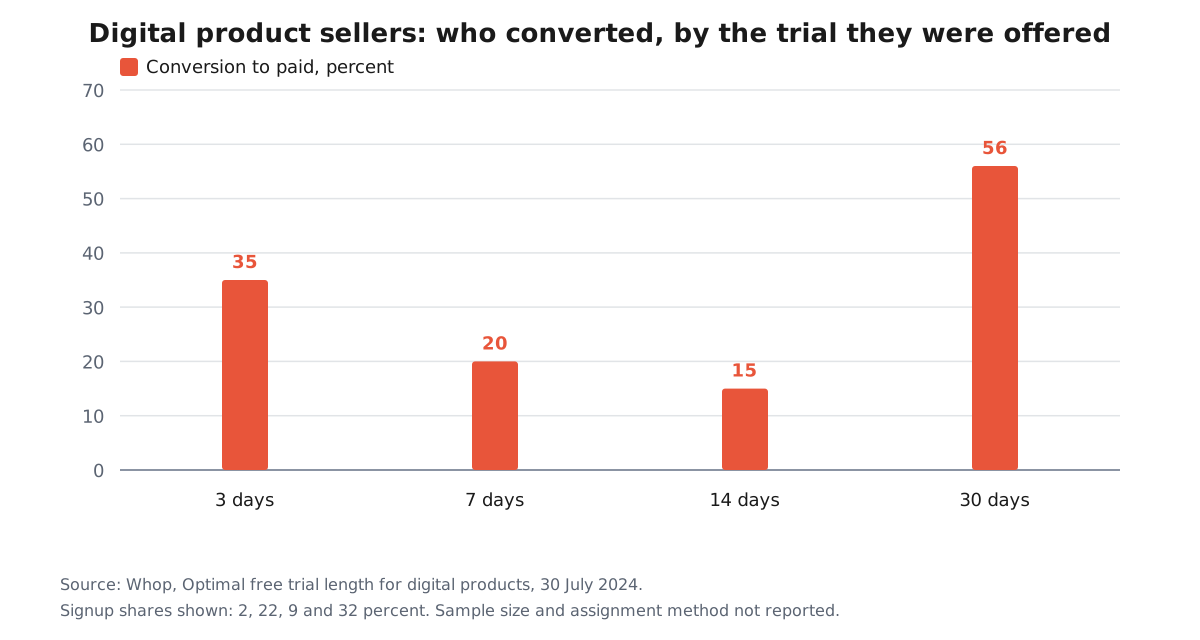
The page recommends 30 days over the other lengths. That is the strongest result in its table, but not in the monthly app medians, where 17 to 32 days was not the conversion peak. Both pages can accurately describe their samples without telling you what caused the differences. Compare their products, billing plans and audiences with your own before treating either as a useful starting point. Neither table is your forecast.
Keep the access model separate from this experiment. A permanent free plan and a timed trial answer different questions. If you are still choosing between them, the freemium pricing examples and products labeled freemium show how makers describe their free allowances. Settle that choice before testing trial duration.
How to choose a length without a data team
You do not need 17,000 apps to explore a starting length. For a small usability check, invite five people who match the buyer and time their first useful result. Five is a practical starting point for observing problems, not a sample size that can establish the best conversion rate. The following is a working test plan, not a result from either study.
Ask each person to do the one job your homepage promises. Not a tour. The job. If the promise is "turn a bank export into a monthly summary," the job ends when they have a summary they would send. Write down the minutes. Imagine four of the five finish in a single sitting. That makes a shorter trial worth testing, but first ask whether they need another project or a teammate to evaluate the product properly. If the job requires a full month of their own data, a 7 day trial may end before that job is possible. These are hypothetical observations, not findings from the benchmark studies.
Choose an available trial length that gives users time for that evaluation, rather than copying a round number from a blog. A job that takes two evenings does not automatically need a month. A job that takes a month of waiting on a client's books will not fit in a week, no matter how high a 7 day conversion rate looks in an app chart.
Then change only the length. Same price, same plan, same page, same way of asking for a card. Changing the price at the same time makes a result harder to interpret. Where possible, randomly assign eligible new users to the two lengths during the same enrollment period. Comparing one month with a different month can mix the effect of length with changes in traffic or demand.
Write down the enrollment window, success measure and followup rule before you begin. Plan the sample around your baseline conversion and the smallest improvement worth acting on. Do not stop as soon as one version looks better. If traffic is too low for a reliable comparison, report the uncertainty and use the usability observations to choose a provisional length.
Let both groups mature. Every trial counted for conversion must have had time to finish its assigned length and the same payment followup window. Every payer counted for renewal must have reached the first scheduled renewal date, including people who canceled before that date. Annual renewal needs much longer followup than weekly renewal. Do not count a payment that is not due yet as a failed renewal, or claim that an early conversion result has established retention.
Count three numbers, not one.
- Trials started.
- Trials that paid.
- Payers who paid the next bill.
Trial to paid divides trials that paid by eligible trial starts. First renewal divides payers who paid again by payers whose first renewal date has passed. These are different denominators, just as they are in the chart. A length that wins the first and loses the second can still be wrong if those payers leave immediately. A length that loses the first and wins the second can still be wrong if you cannot afford the free use. Write both down before you declare a winner.
If each free session costs you money, track actual usage costs for both paying and nonpaying trial accounts. The monthly AI benchmark is a warning to investigate, not a cost calculation for your app. Compare collected revenue over the same followup window with the costs of serving each group, including trial usage and paid usage. Include refunds and payment costs. A conversion improvement is not enough if the extra service costs consume the margin.
Do not stack the trial test on top of a new onboarding, a new price, and a new homepage. You will get a story and no cause. The product launch checklist already asks you to state what a trial requires, and to complete the first useful task from a fresh account, before you invite a crowd. Do that pass first. A trial clock on a product nobody can finish is a shorter way to the same failure.
What the trial screen has to say
The trial screen needs the same care as the calendar. Clear billing information helps users understand the choice they are making.
Say the date the charge happens, in calendar language, not "at the end of your trial." Say whether a card is required today. Say what they keep if they do not pay, and what they lose. Say how to cancel, in the same view as the price, not in a help article they will not open. If the charge is automatic, say automatic. Whop's description of a trial treats the move from free to paid as automatic. Many app trials work the same way. If yours does not, do not borrow wording from a product that does.
Match the length you show to the job you show. For example, if the trial is 14 days and the task shown takes ten minutes, explain what users can evaluate during the rest of the trial. A second project, a teammate, a full week of their real data. If you cannot name that use, question the extra days. A lower conversion rate in the longest benchmark group is not proof that your own users would behave the same way.
Keep the card requirement fixed during this test. Comparing a short trial without a card with a longer trial that requires one mixes two changes. This guide tests duration; choosing a card requirement is a separate decision.
A short checklist
Before you ship a trial, answer these in writing.
- What is the one job, and what did your exploratory usability check show about the time it takes?
- Does the trial end after that job, with a little slack, rather than on a default of 7, 14, or 30?
- Are price, plan, and card rule the same in any test of two lengths?
- Can you report trials started, trials that paid, and payers who paid again, using groups with enough followup?
- Have you included the service costs of both paying and nonpaying trial accounts?
- Does the trial screen name the charge date, what is kept, and how to cancel?
- Were assignment, enrollment window and success criteria chosen before the test?
Public medians are a reason to question your default. Neither the monthly app peak nor the seller study's 30 day peak chooses a duration for your product. Start with the job your buyer came to finish, then test how much time helps them evaluate it.
Sources
Both pages were opened before this guide was written. Figures in the charts are the figures on those pages. Where a page rounded a chart and also printed a more exact sentence, the sentence is the one used here.
- RevenueCat, How long should your free trial be?: more than 17,000 apps, August 2025 to July 2026, median app rates. Monthly trial to paid of 39.6, 45.9, 46.6, and 43.7 percent. Monthly first renewal among payers of 54.2, 62.8, 72.0, and 77.5 percent. The 42.5 and 25.5 percent headline is this article citing the State of Subscription Apps 2026 report. Weekly, annual, AI, and category figures are from the same page. The page states that the pattern is correlational.
- Whop, Optimal free trial length for digital products, 30 July 2024: conversion of 35, 20, 15, and 56 percent for 3, 7, 14, and 30 day trials, with signup shares of 2, 22, 9, and 32 percent. The page does not report the sample size or assignment method, or explain the full denominator behind its signup shares.
The usability check and testing checklist are editorial recommendations. The examples of tasks and five users are hypothetical, not measured customer results.
0 replies
Sign in to join the discussion
Log in