I tracked my hours for six weeks before hiring anybody
generalDelegation has a break-even point and it isn't where people think. It sits at the handover overhead, not at the hourly rate, and if you don't know your number you'll either hire too late or give up six weeks in.
The sum
weekly gain = (hours freed x (1 - overhead)) x your hourly value - what you payTen hours a week at 25 an hour, when your own time is worth 40.
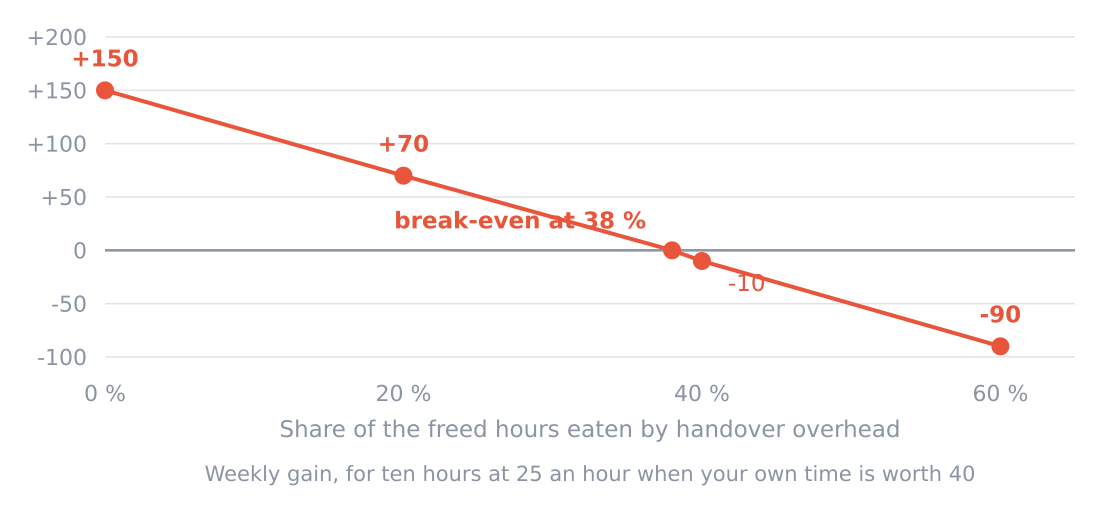
The line crosses zero at 38 percent. Everything past that is you paying somebody to make you busier.
| Overhead | Hours you actually get back | Weekly gain |
|---|---|---|
| 0 percent | 10.0 | plus 150 |
| 20 percent | 8.0 | plus 70 |
| 38 percent | 6.2 | zero |
| 60 percent | 4.0 | minus 90 |
Two things fall out of this that I wish I'd known in advance.
The gap between your value and their rate has to be wide, not just positive. At 40 against 25 you can absorb 38 percent overhead. If your time is worth 30 you can only absorb 17, and almost no first handover comes in under 17 percent.
And the first six weeks are always past the line. Every ticket comes back to you as a question, so you're answering the same tickets with an extra step in front. That's not a sign it isn't working. It's the shape of the thing, and knowing the break-even is what stops you quitting during the part where you're underwater by design.
Track before you decide who to hire
I was certain I needed a developer, because I'm a developer and building is the work I could imagine needing help with.
Six weeks of tracking, in half hour blocks, said building was already the smallest part of my week.
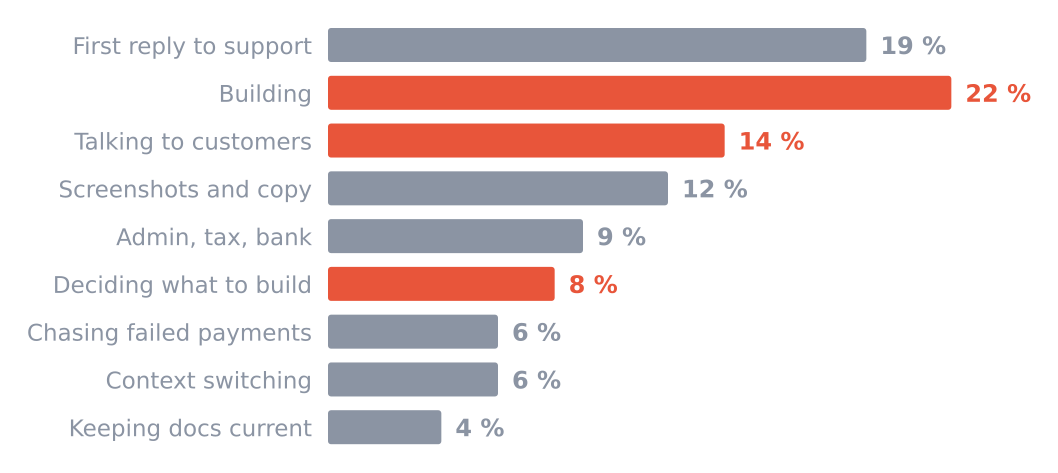
Building was 22 percent. Hiring a second developer would have solved a problem I didn't have.
| What | Share | Needs my judgement |
|---|---|---|
| First reply to support | 19 percent | No |
| Building | 22 percent | Yes |
| Talking to customers | 14 percent | Yes |
| Screenshots and marketing copy | 12 percent | No |
| Admin, tax, bank | 9 percent | Nobody else can sign |
| Deciding what to build | 8 percent | Yes |
| Chasing failed payments | 6 percent | No |
| Context switching | 6 percent | No |
| Keeping docs current | 4 percent | No |
The no rows add up to 41 percent, and none of them were things I was good at or enjoyed.
The rule that decides what goes
Hand over what doesn't need your judgement. Not what you dislike.
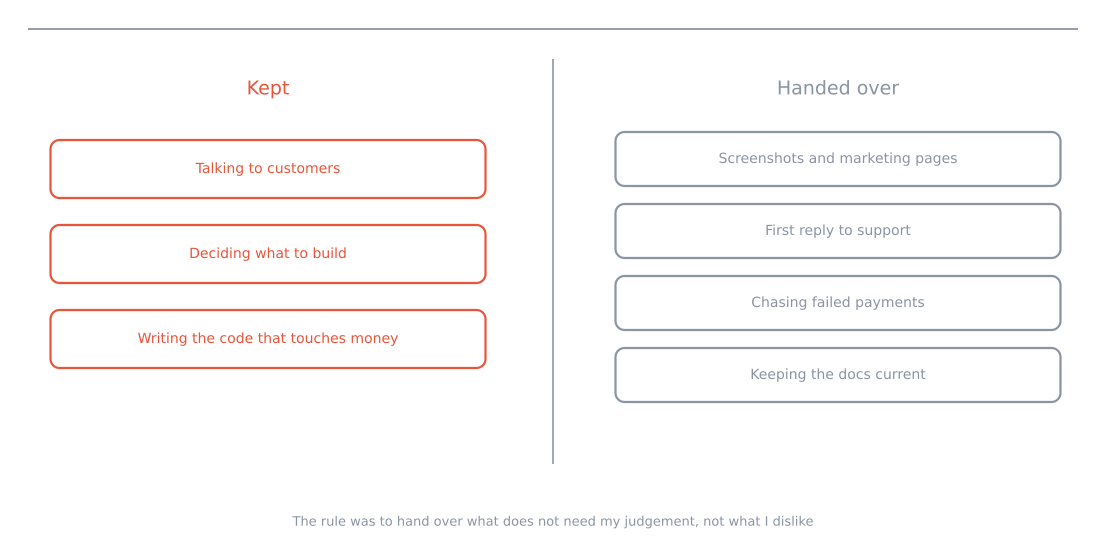
The line is judgement, not preference.
Those two sets overlap but they aren't the same, and confusing them is how people hand over the wrong things. I dislike doing my accounts, but the decisions in there are mine and the consequences land on me. I quite like writing documentation, and there's no judgement at all in updating a screenshot after a screen changed.
What actually reduced the overhead
Not training. Writing down the twelve most common answers, which I'd never done because I carried them in my head.
Once those existed the questions dropped by most of the way, and the twelve answers became the first version of the documentation that now brings more traffic than everything else I have.
That pattern is worth noticing on its own. Handing something over forces you to make explicit what was implicit, and the artefact you produce doing it is often worth more than the hours you saved.
What I got wrong
I handed over first line support and kept anything complicated. Sounds sensible. It created a problem I didn't see coming.
I stopped reading the easy tickets. Within two months I'd lost my feel for what people were struggling with, because the boring repetitive tickets are exactly the ones that tell you where the friction is, and I'd made them somebody else's job.
The fix was to read every ticket without answering it. Ten minutes a day. No replies, no intervention unless something's wrong. That keeps the signal without taking the work back.
What I got right by accident
I didn't hand over anything I hadn't done myself for at least six months.
That wasn't a principle, just the order things happened, and it mattered more than any of my actual decisions. I could describe each task precisely, I knew where the edge cases were, and I could tell within a week whether it was being done well. The one thing I tried to delegate that I'd never done properly myself was advertising, and it was money wasted for both of us because I had no way to evaluate the work.
The arithmetic in the end
Ten hours a week cost me a bit under a fifth of revenue at the time. It bought back about twelve hours, because handover overhead is permanent rather than a startup cost. That puts my steady state overhead somewhere around 20 percent, comfortably inside the 38 percent line.
Twelve hours a week of building and customer conversations for a fifth of revenue. I'd have said yes to that trade two years earlier if I'd known the shape of my week, and the only reason I didn't is that I'd never looked.
Six weeks of tracking is dull and I nearly stopped twice. It remains the highest value administrative thing I've ever done, entirely because the answer contradicted what I was certain of.
0 replies
Sign in to join the discussion
Log in