40 cold emails, 3 replies, and what the other 37 taught me
generalI sent 40 cold emails over two weeks. Three replied, one became a customer who's still paying 14 months later.
That reads like a win. Work out what the customer cost and it stops reading like one, and the arithmetic is the reason I now send four emails a month instead of forty.
What one customer actually costs
My second batch, the one that worked, ran roughly like this. Twenty minutes researching each company. About half discarded because I found nothing worth writing about. Fifteen percent reply rate on what I sent, and about one reply in three becomes a customer.
emails per customer      =  1 / (0.15 x 0.33)        =  20
companies to research    =  20 / 0.5                 =  40
hours per customer       =  40 x 20 minutes          =  13.3
Thirteen hours per customer. Now the only number that matters, which is what your time is worth.
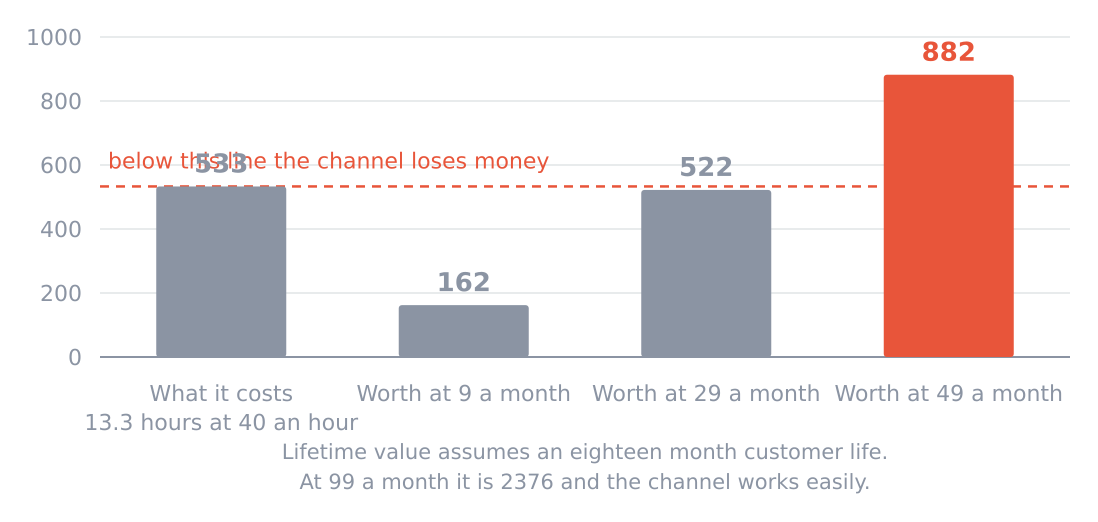
Cost is 13.3 hours at 40 an hour. Lifetime value assumes an eighteen month life.
| Your hourly rate | Cost to win one customer |
|---|---|
| 20 | 267 |
| 40 | 533 |
| 60 | 800 |
At 29 a month over eighteen months, a customer is worth 522. At an hourly rate of 40, they cost 533.
Cold email was losing me money and I couldn't see it, because the cost was denominated in hours I wasn't billing anybody for.
Which changes what the channel is for
That single comparison reframes everything. Cold email isn't good or bad. It's a function of your price.
At 9 a month it's absurd. You'd need to give away thirteen hours to win 162, and no amount of better copy closes a gap like that.
At 29 it's marginal and depends entirely on what else you could be doing with the afternoon.
At 99 it's obvious. Lifetime value around 2376, cost around 533, and you should be doing far more of it than you are.
So the correct question isn't does cold email work. It's whether it works at your price, and mine only became defensible after I raised it. I did those two things eighteen months apart and never connected them until I sat down with this sum.
The one thing that moves the arithmetic
Look at where the hours go. Forty companies researched to send twenty emails. Better copy doesn't touch that. What touches it is the discard rate.
If you can find something worth writing about in eighty percent of companies rather than fifty, you research 25 instead of 40 and the cost per customer drops by nearly forty percent. That's a far bigger lever than anything you can do to the email itself.
Which means the highest value work is choosing a narrower list, not writing a better message. Pick companies where the problem you fix is visible from outside, and the discard rate is a property of your list rather than your luck.
What the first twenty looked like
Short, polite, personalised in the way everyone means when they say personalised. I mentioned their funding round, noted they were hiring for operations, asked for fifteen minutes.
Zero replies. Not one.
The funding round is the part that embarrasses me. I thought it was personalisation. It's the opposite. Everybody cold emailing that company that month mentions the funding round, because it's the one fact that's easy to find. Using it proves you did the same three second search as the other forty people in their inbox. It signals low effort while wearing the costume of attention.
What changed for the last twenty
I stopped asking for a call. Instead I spent the twenty minutes, found one concrete thing broken or slow in their public setup, described it in two sentences, and said this is fixable in about an hour and here's roughly how, whether or not you use my thing.
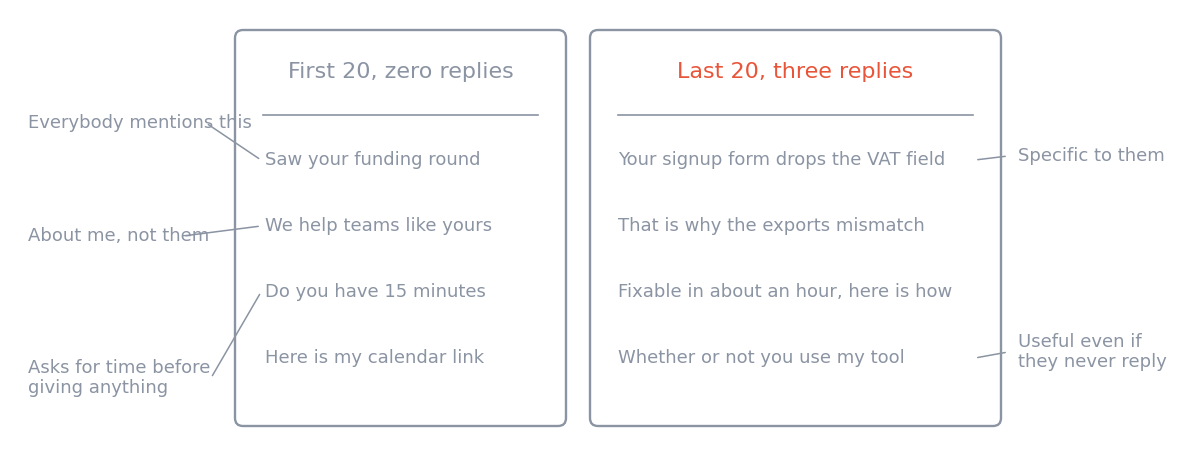
Same person writing. The difference is what I knew before I started typing.
| First 20 | Last 20 | |
|---|---|---|
| Preparation per email | 2 minutes | 20 minutes |
| Led with | Their funding round | A specific fault in their setup |
| Asked for | 15 minutes of their time | Nothing |
| Worth anything if they never reply | No | Yes, they can fix it themselves |
| Replies | 0 | 3 |
The fourth row is the mechanism. The first batch was worthless to the reader unless they said yes. The second was worth something either way.
What the twenty minutes is
I open their product and try to use it as a customer would. I look for the help page that's obviously been rewritten three times, because that's where the confusion lives. I check whether the pricing page answers what a finance person would ask.
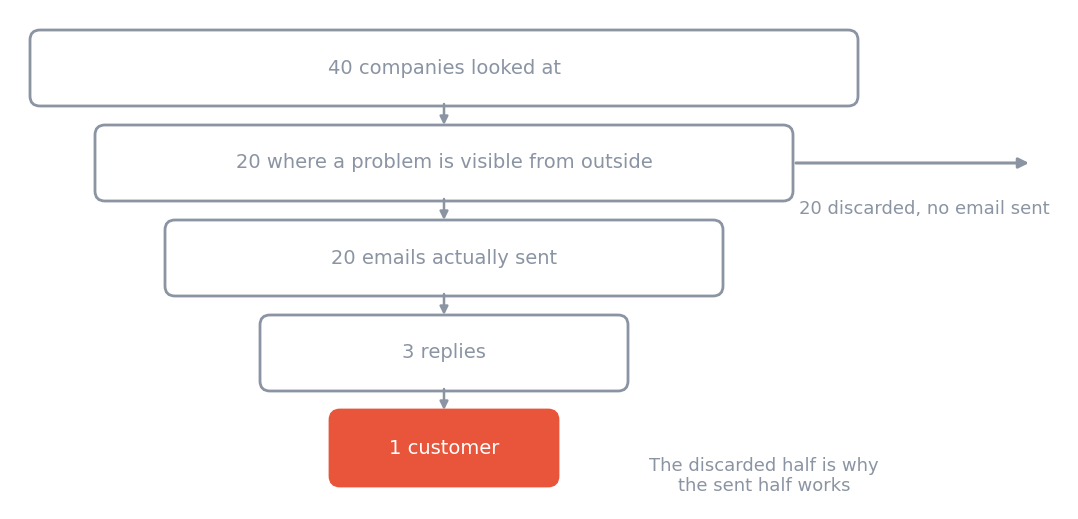
A filter, not a funnel. The step doing the work is the one where nothing gets sent.
Half the time I find nothing. Those companies get no email, and that's the part people skip when they copy this. If I'd pushed through and written to all forty, I'd have produced twenty more emails of the first kind, and the batch reply rate would have made it look like a copy problem.
The test before I write anything
Could I describe this company's problem in one sentence that would make them slightly uncomfortable? Not a guess about their industry. A specific observation about their setup that they already half suspect.
If I can't, there's no email. The whole thing rests on arriving with information they don't have and would want, and no wording substitutes for not having it.
The uncomfortable part needs care. There's a version of this that's just rude, where you tell somebody their work is bad then offer to sell them a fix. What I aim for is a colleague who noticed something walking past. State the fault, don't editorialise, give the fix away, leave.
What closing actually looked like
The one who converted replied within two hours, and not to buy anything. He replied because I'd spotted that their signup form dropped a field their finance team needed later, and he wanted to know how I'd noticed.
Forty minutes on the phone, and I sold him nothing. He came back nine days later.
What closed it wasn't a pitch, because there wasn't one. It was that I'd already demonstrated the exact skill he'd be paying for. Which is worth sitting with. The email isn't an advertisement, it's a free sample of the thing your product does, delivered by a person, and if your product doesn't do anything you can sample in two sentences then this channel isn't going to work for you at any price.
What I do now
Four a month, to companies where I can see the problem without asking.
And I stopped counting a no as a failure. Two of my last five customers said not right now and then came back seven and eleven months later, because the email had been useful and they remembered. Nothing in a quarterly conversion rate captures that, and if I'd judged the second batch on its fourteen day numbers I'd have called it a modest improvement rather than the thing still bringing me customers.
0 replies
Sign in to join the discussion
Log in