Your churn rate is mostly a fact about your price
generalYour churn rate is mostly a fact about your price, not about your product. That's an uncomfortable thing to read when you've spent a quarter trying to fix retention, and the industry data is fairly blunt about it.
The numbers
ChartMogul publish churn segmented by average revenue per account, and the pattern is consistent enough to plan around.
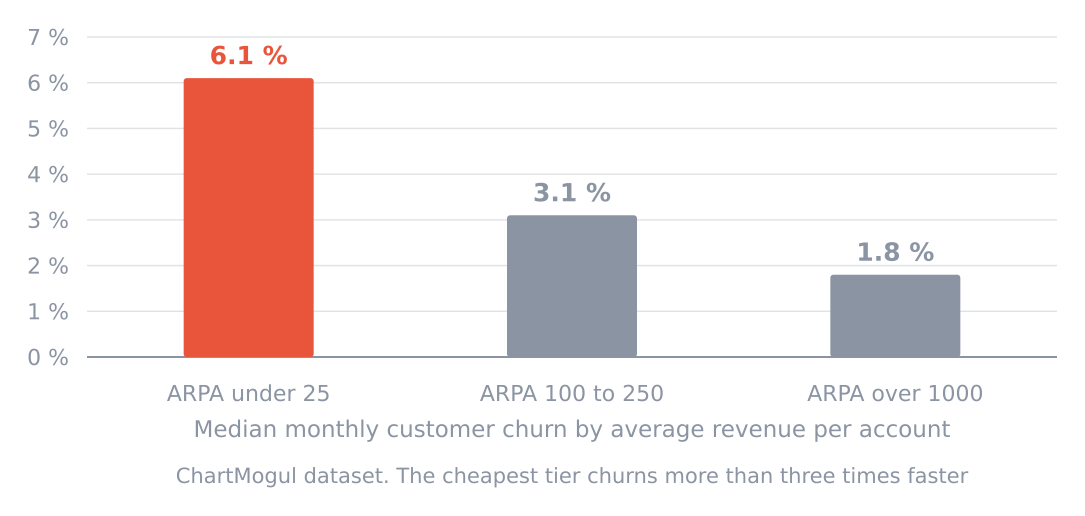
The cheapest segment churns more than three times faster than the most expensive.
| Average revenue per account | Median monthly customer churn |
|---|---|
| Under 25 | 6.1 percent |
| 100 to 250 | 3.1 percent |
| Over 1000 | 1.8 percent |
Six percent a month means you lose 53 percent of your customers in a year. At 1.8 percent it's 20 percent. Same effort, same product quality, and one of those businesses is on a treadmill while the other isn't.
It gets starker with net revenue retention, which counts expansion as well as loss.
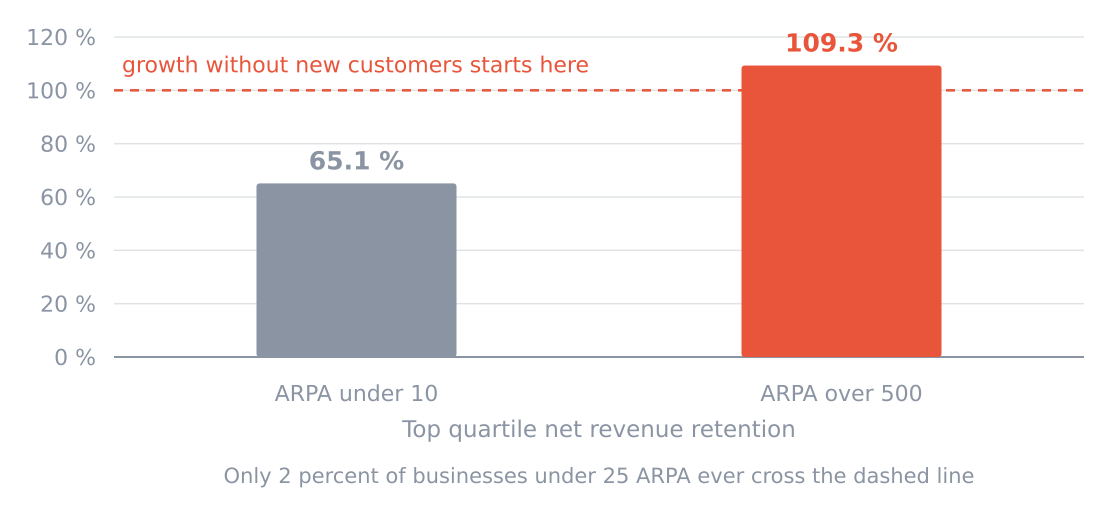
Above 100 percent, a business grows without adding a single customer.
Top quartile net retention for products under 10 ARPA is 65.1 percent. For products over 500 it's 109.3 percent. And only 2 percent of businesses with an ARPA under 25 ever get above 100 percent at all.
Read that last one again. If you charge under 25 a month, the chance you have a business that grows on its existing base is about one in fifty.
Why price drives it, rather than the other way round
The tempting explanation is that expensive products are better. Some are. That isn't the mechanism, and you can see it isn't by looking at what actually causes cancellations at each end.
At a low price the purchase is an individual decision, made in two minutes, often on a personal card, frequently for a problem that turns out to be occasional. Nothing has to be justified to anybody. Cancelling requires exactly as much thought as buying did, which was almost none.
At a high price somebody was persuaded. There's an internal case, other people's names on it, a process that was built around the thing, possibly an integration. Cancelling means revisiting the decision in front of the people who approved it.
That difference has nothing to do with software quality. It's about how much the customer had to commit before they arrived.
So what do you actually do
Three moves, in the order I'd try them.
Change what you charge for before you change how much. Moving from 9 to 29 isn't the same as moving from a personal tool to a team tool. The first is a price change and the second changes who has to sign off, which is the thing that actually drives the churn number. If you can shift the buyer without shifting the price, do that first.
Add annual billing. This is the cheapest available lever and it works partly because it converts twelve cancellation decisions into one.
Then raise the price. And when you do, run the break-even sum first, because the number of customers you can afford to lose is nearly always larger than your fear of it.
What this doesn't mean
It doesn't mean cheap products can't work. It means they need a different engine.
If your ARPA is under 25 and your churn is 6 percent a month, your business is a top of funnel business, and the honest question is whether you can acquire people faster and more cheaply than you lose them, forever. Some can. Consumer subscriptions do it with enormous volume and near zero support cost.
What doesn't work is a low ARPA product with a high touch acquisition channel. That combination is the one I ran for two years. Cold email at 9 a month, hand holding at 9 a month, a founder answering support at 9 a month. The arithmetic never closes and no amount of retention work fixes it, because the problem isn't retention, it's that everything you do to keep a customer costs more than the customer is worth.
The measurement trap
One caution about these benchmarks, because it's the kind of thing that gets quoted badly.
These are medians across a large population of businesses. Your product isn't the median of anything and there are perfectly healthy products under 25 ARPA with 2 percent churn. What the data tells you is where the wind is blowing, not where you personally will end up.
The right use of a benchmark is as a prior. If you're at 6 percent under 25 ARPA, you're normal, and the fix probably isn't another onboarding tweak. If you're at 6 percent above 500 ARPA, something specific is broken and it's worth all the investigation you can give it.
Same number, opposite conclusions, and the only thing separating them is what you charge.
0 replies
Sign in to join the discussion
Log in