You can discount annual billing by 27 percent before it stops paying
generalAnnual billing is the highest return pricing change available to most small SaaS businesses, and almost everybody underprices the discount they attach to it. Here's the arithmetic that tells you how much you can afford to give away.
Start with what the retention data says
Published figures put twelve month retention at roughly 92 percent for annual plans against 68 percent for monthly.
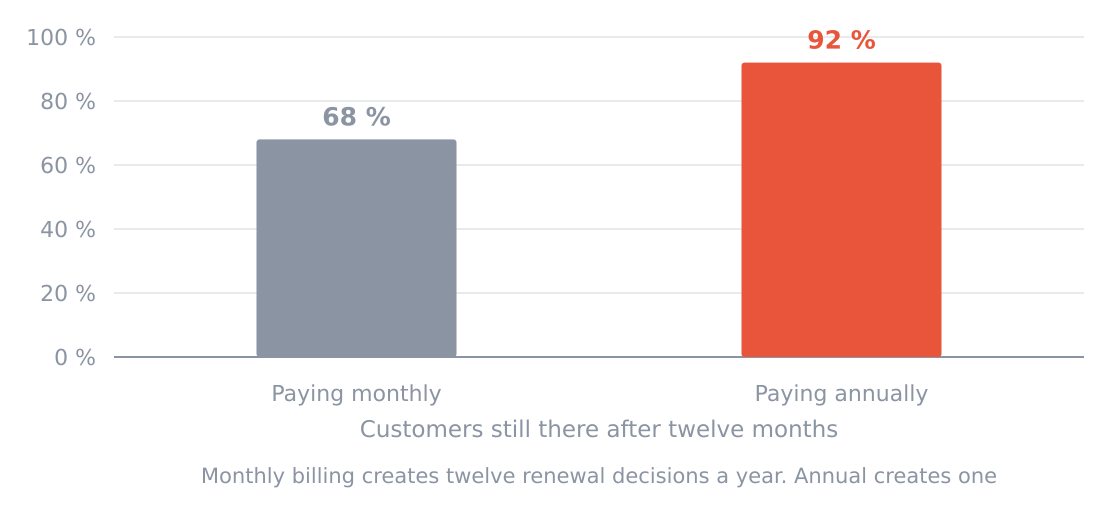
Two ways of charging the same money.
Work backwards and that implies a monthly equivalent churn of 0.69 percent for annual customers and 3.16 percent for monthly ones. Roughly four and a half times the loss rate.
Two things are going on and they're worth separating. Monthly billing creates twelve renewal decisions a year where annual creates one, which is the behavioural half. And monthly billing exposes you to twelve times as many opportunities for a card to fail, which is the mechanical half. Industry estimates put failed payments at 20 to 40 percent of all churn, so that mechanical half isn't a rounding error.
Now the discount question
Everybody knows you offer a discount for annual. Almost nobody works out what the ceiling is.
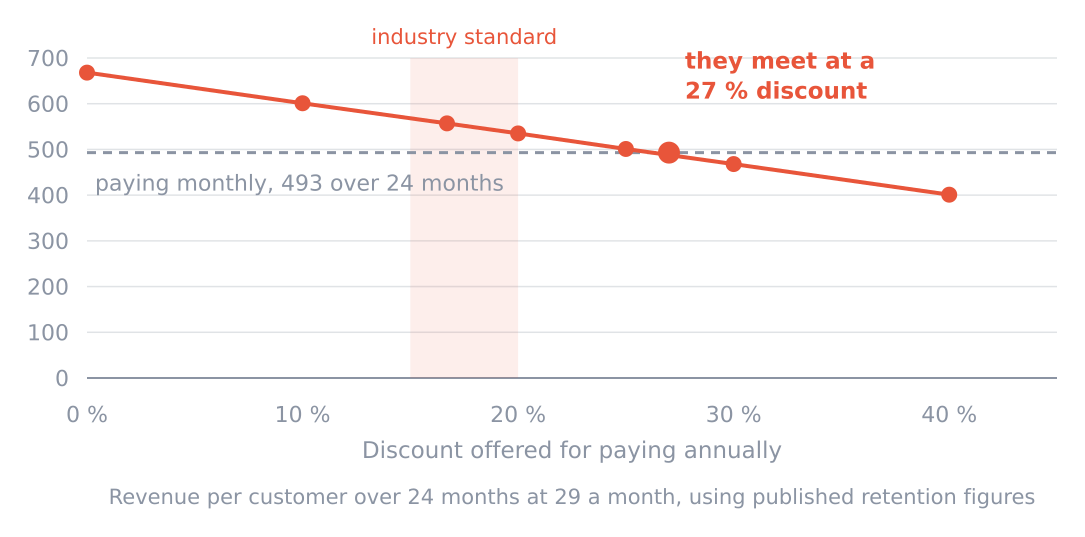
Annual only stops winning past a 27 percent discount.
| Annual discount | Revenue per customer over 24 months |
|---|---|
| 0 percent | 668 |
| 10 percent | 601 |
| 16.7 percent, the Slack figure | 557 |
| 20 percent | 535 |
| 25 percent | 501 |
| Monthly billing, for comparison | 493 |
| 30 percent | 468 |
At 29 a month over a two year horizon, monthly billing yields 493 per customer. Annual billing at a 20 percent discount yields 535, which is 8 percent better, and at the common 16.7 percent it's 13 percent better.
The break-even sits at about 27 percent. That's a lot of room, and the standard industry discount of 15 to 20 percent is nowhere near it.
Which raises an obvious question. If you can afford 27 and everybody offers 17, why not offer 25 and take the extra annual conversions? I don't have a confident answer. My guess is that a discount past about 20 percent starts reading as desperation rather than a deal, and you lose on perception what you gain on arithmetic. But it's worth knowing that the constraint is psychological and not financial, because those get fixed differently.
The cash flow point, which is the real one for a small business
Everything above ignores when the money arrives.
An annual customer at 29 with a 17 percent discount pays you 289 today. A monthly customer pays 29 today and the rest across two years, if they stay. For a business without funding, that difference is the difference between being able to buy a month of your own time and not.
Cash today is also worth more than cash in eighteen months, which the table above doesn't discount at all. If you apply any realistic rate the annual case gets better still.
What I'd do, in order
Offer annual on the pricing page, defaulted to monthly. Defaults are powerful and defaulting to annual makes the headline price look higher, which costs you signups. Show both, put the saving next to the annual option in cash rather than percentage. Save 58 lands harder than save 17 percent.
Ask existing monthly customers once. One email, no urgency, offering to switch them at the annual rate. Roughly a fifth of mine said yes and it cost nothing.
Don't offer annual to somebody in their first month. They don't know yet whether they want your product for a year, and if you convince them and it goes badly you've bought a refund conversation instead of a customer. I now offer it at month three, on the anniversary of them doing something real.
When annual is the wrong answer
If your product is genuinely seasonal, annual pricing forces people to pay for the eight months they don't use it, and some of them will do the sum and decline both plans.
If your churn is driven by the product failing rather than by inertia, annual billing hides it. You'll take the money, they'll drift away in month two, and you'll find out at renewal instead of at month three. That's twelve months of feedback delay and I'd rather have the feedback.
And if you don't have the cash to refund an annual payment when something goes badly wrong, don't take annual payments. That money isn't yours yet in any sense that matters.
0 replies
Sign in to join the discussion
Log in