The median SaaS takes 16 months to earn a customer back
generalThe median SaaS business takes 16 months to earn back what a customer costs to acquire. The top quartile does it in under 6. The bottom quartile takes 47, which is longer than most small companies survive.
That spread is the whole game, and for a small product it's decided almost entirely by price.
The benchmark
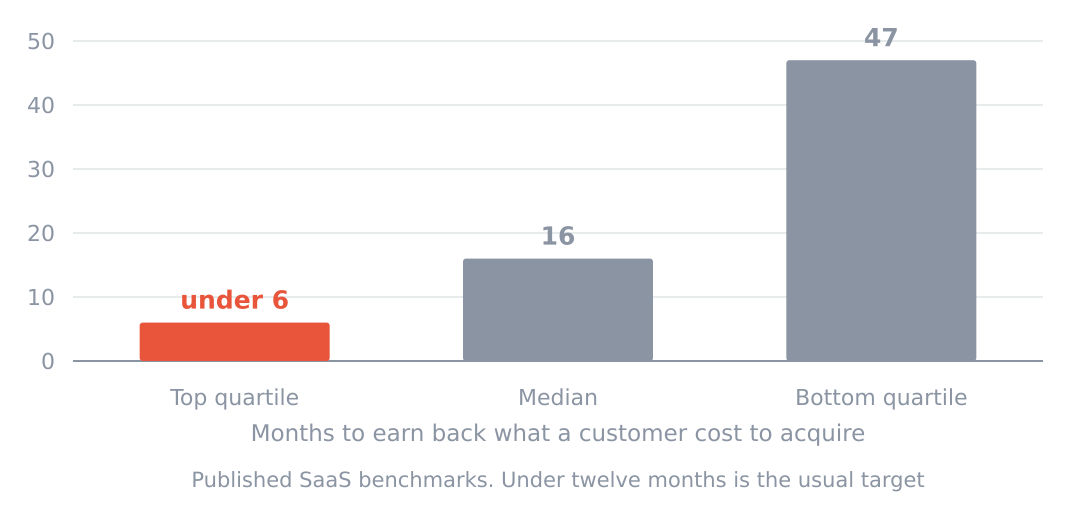
Published SaaS benchmarks. Under twelve months is the usual target.
The formula is unglamorous.
payback months = acquisition cost / (monthly price x gross margin)Two inputs. And for a one person business, the first one is mostly your own time valued honestly, which is the part people leave out and which changes the answer completely.
What it looks like at indie prices
Say a customer costs 533 to acquire, which is 13 hours of research and outreach at 40 an hour. That's a real number from my own cold email work.
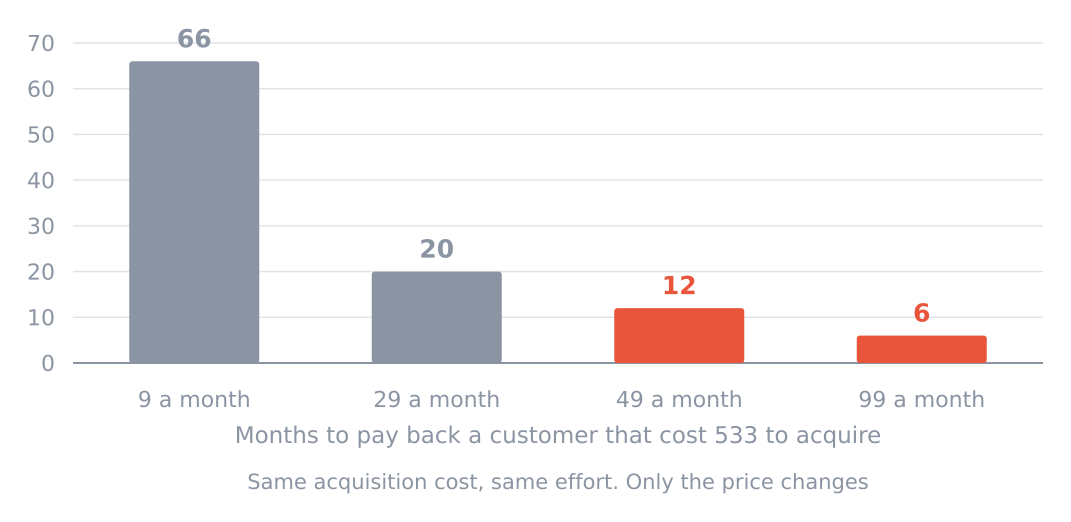
Same acquisition effort. Only the price changes.
| Price | Payback |
|---|---|
| 9 a month | 66 months |
| 29 a month | 20 months |
| 49 a month | 12 months |
| 99 a month | 6 months |
At 9 a month, that acquisition method needs five and a half years to break even. Your customer won't be there. The average life is nowhere near it, so the channel loses money on every single customer and no amount of volume fixes it.
At 99 you're in the top quartile of the entire industry using nothing but a spreadsheet and some patience.
Same effort, same emails, same person doing the work. The only variable that moved was the number on the pricing page.
The three ways out, and only one is easy
Raise the price. Halves your payback for every doubling, and it's the only lever with no execution risk. There's no project. You change a number.
Make acquisition cheaper. This is what everybody tries first because it feels like work. It's real but it's slow, and the cheapest channels are the ones that compound over years rather than the ones you can switch on this quarter.
Improve margin. For most software this is already 85 to 95 percent and there's nothing to win. Skip it unless you're paying somebody per transaction.
Price is the one that moves fastest and it's the one people leave alone longest, in my case for two years.
Counting your own time isn't optional
The single commonest mistake in indie unit economics is treating founder hours as free because no invoice was raised.
If cold email takes you thirteen hours per customer and you count that as zero, your payback looks like one month and the channel looks fantastic. Count it at any honest rate and the same channel is underwater at low prices.
You're the scarcest input in the business. Pricing yourself at zero doesn't make you cheap, it makes your reporting wrong, and wrong reporting is how founders spend two years on a channel that was never going to work.
Pick a number, even a rough one. What would you pay somebody to do this, or what would you charge a client for the hour. Then use it consistently.
The number that pairs with payback
Payback tells you when you get your money back. It doesn't tell you whether the customer is still there when you do.
At 6 percent monthly churn, half your customers are gone by month eleven. A payback of 16 months in that business means the median customer never repays their acquisition cost, and you're funding growth out of the customers who happen to stay.
So the two numbers have to be read together. My rough test is that payback should be comfortably shorter than the time it takes to lose half your customers. If it isn't, growth is making things worse rather than better, and that's the situation where founders describe themselves as growing and running out of money at the same time.
What this means for channel choice
Once you have a payback figure per channel, some arguments stop being arguments.
Content and search cost time up front and approach zero per customer afterwards. Payback improves every month you leave them alone.
Cold outreach and any high touch sale cost the same every time. Payback is flat forever and it's set by your price on day one.
Paid ads have the cleanest arithmetic and the least room, since you're bidding against people who have better payback than you do, and they can outbid you precisely because they charge more.
None of that says anything about which channel is nicer to run. It says that the same channel is a good idea at one price and a bad idea at another, and the number tells you which side you're on.
0 replies
Sign in to join the discussion
Log in