I raised the price from 9 to 29 and lost two customers
generalBefore you raise a price, work out how many customers you're allowed to lose. Almost nobody does this, and it's one line of arithmetic.
Revenue is price times customers. Multiply the price by m and you break even when you keep 1/m of them. So the share you can afford to lose is 1 - 1/m. That's the whole calculation.
Going from 9 to 29 is a multiple of 3.22. Which means you could lose sixty nine percent of your customers, more than two in three, and still take home exactly the same money.
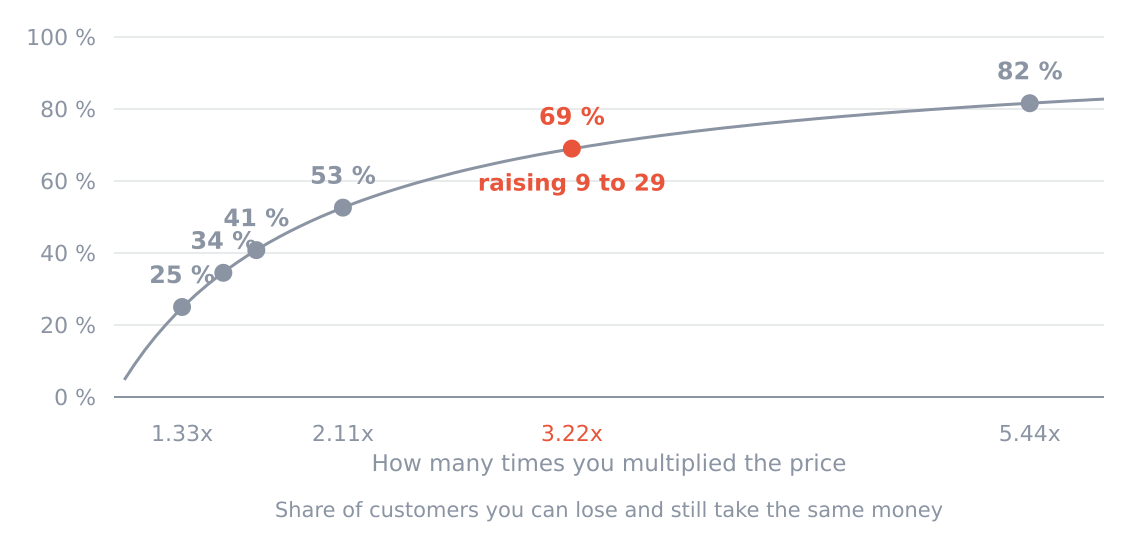
The curve is 1 - 1/m. It's not an estimate and it doesn't depend on your market.
| Old price | New price | Multiple | You can lose |
|---|---|---|---|
| 9 | 12 | 1.33x | 25 percent |
| 19 | 29 | 1.53x | 34 percent |
| 29 | 49 | 1.69x | 41 percent |
| 9 | 19 | 2.11x | 53 percent |
| 9 | 29 | 3.22x | 69 percent |
| 9 | 49 | 5.44x | 82 percent |
I sat on 9 for two years. Had I done this sum at any point in those two years I'd have moved sooner, because once you see that the answer is sixty nine percent, the fear stops being about money. Nobody loses two thirds of their customers over a price change. It doesn't happen.
Why the curve bends, and why that matters
Notice the shape. Small increases are brutal and large ones are forgiving.
Go from 9 to 12 and you can only lose a quarter of your customers. Go from 9 to 29 and you can lose more than two thirds. The bigger jump is by far the safer bet, which is the exact opposite of how it feels when you're deciding.
This is why timid pricing changes are the worst option available. A twenty percent bump gives you a thin margin for error and a result you'll never be able to read, since the loss it would take to hurt you is also the loss you'd expect from ordinary month to month noise. You take the risk and learn nothing.
The number is actually better than that
Everything above assumes your costs stay flat. They don't.
Fewer customers at a higher price means fewer support conversations, fewer edge cases, fewer accounts to migrate when something changes. And it isn't proportional, because your cheapest customers are usually your most expensive ones to serve.
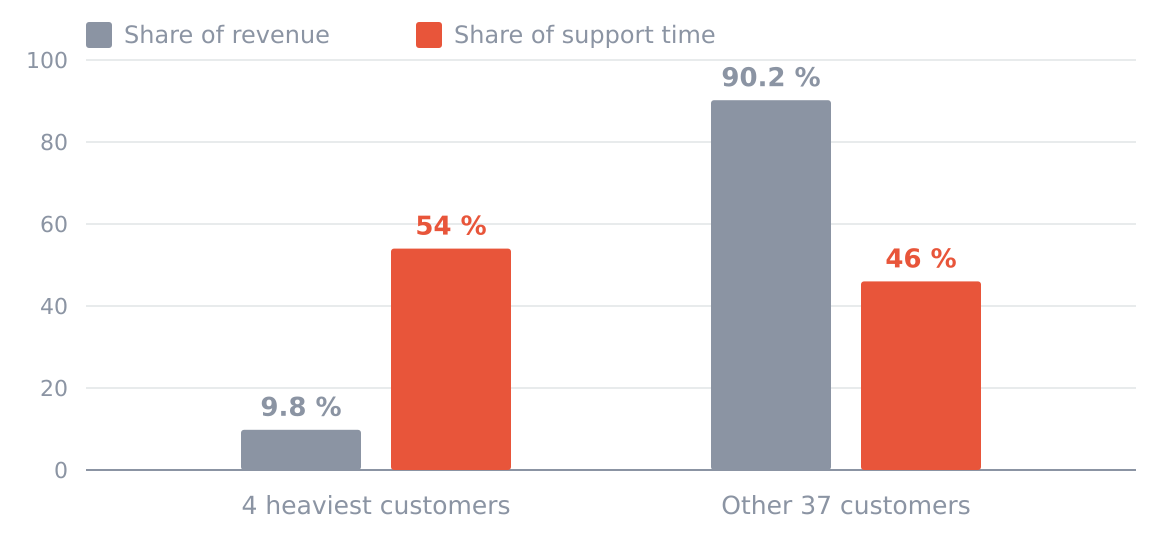
Four accounts out of forty one. Together they paid about a tenth of the revenue and consumed more than half the support.
If losing thirty percent of customers takes forty percent of your support load with it, your real break-even is higher than the curve says. I can't give you a general formula for that because it depends on your product. I can tell you the direction, which is always in your favour.
What actually happened
Two customers left out of forty one. Five percent, against an allowance of sixty nine.
I'd braced for something between fifteen and thirty percent. That estimate came from nowhere. It was a feeling in my stomach dressed up as a forecast, and it was wrong by a factor of at least three.
Then week one arrived and nearly ruined the whole thing.
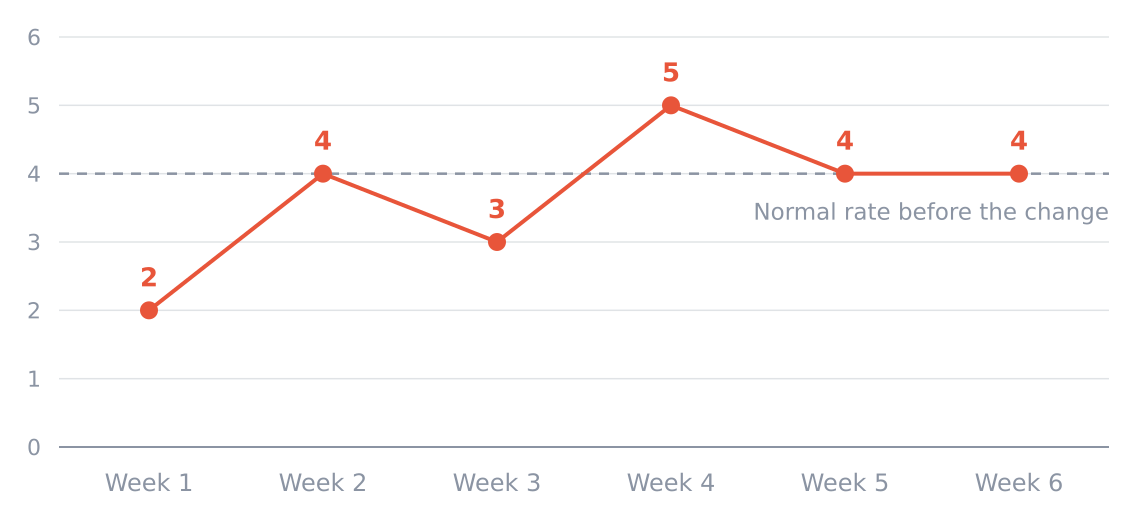
Two signups in week one against a normal four. By week five it was back and each one was worth three times as much.
I spent that weekend building a page to justify the new price. Never shipped it, because week two came back at four. If I'd judged this on week one I'd have reverted, concluded 29 was too much, and gone back to earning a third as much while telling myself I'd tested it properly.
One week of signup data at that volume is not evidence of anything. You already know this if you've read anything about sample sizes. You'll still panic on day nine. Write the decision rule down before you start, because the version of you who has just watched signups halve is not the person you want making the call.
What the price says before anyone tries the product
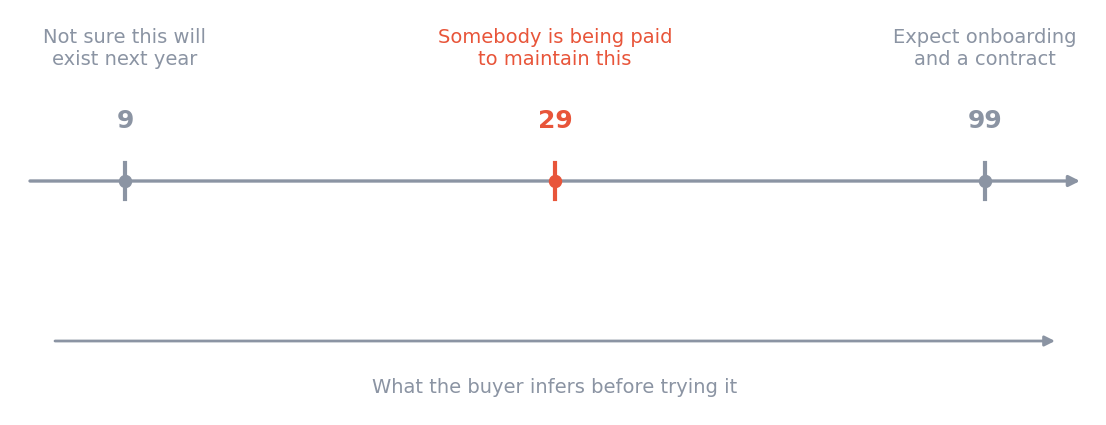
The buyer hasn't opened it yet. The number is doing all the talking.
One customer replied to my email to say he'd assumed we were going out of business at 9 a month, and was relieved.
That's the part the arithmetic misses. A price too low doesn't just leave money on the table, it makes a certain kind of buyer file you under hobby project, and those buyers are frequently the ones with budget. You aren't only choosing revenue. You're choosing which reader believes you'll still be here in two years.
Where this maths stops working
Three cases, and it's worth checking whether you're in one before you get excited.
Your product gets better with more users. If people come for the network, shedding two thirds of them wrecks the thing they were paying for. The arithmetic still balances the books and the product is now worse. Different sum required.
You have a real funnel. If today's cheap customers reliably become tomorrow's expensive ones, some of what you shed is future revenue and the calculation needs their expected value, not their current price. Be strict with yourself here, because everybody thinks they have a funnel. Go and count how many free or cheap accounts actually upgraded last year. If it's under a few percent, you don't have a funnel, you have a story about one.
Your competitor is a serious alternative at the old price. The 1 - 1/m figure tells you what you can survive losing. It says nothing about what you will lose. Where switching is easy and a near identical product sits at your old number, that's the one situation where the loss can genuinely reach the allowance.
Outside those three, this is close to free money and most people leave it there for years. I did.
Existing customers
I let everybody keep 9 forever. One email, no countdown, no plan migration.
Nine people replied. Four said they'd have paid more. Nobody asked for a discount.
I'd do it again, but understand what forever costs. Two years on, those accounts are twenty percent of my customers and eight percent of my revenue, and they're the loudest voice in every feature discussion because they've been here longest. If I were doing it now I'd say two years, or for as long as you stay on this plan. Both are honest, both keep the promise, and both leave a door.
Do this today
Take your price, pick a number two to three times higher, and calculate 1 - 1/m. Write the answer on something.
Then ask yourself honestly whether you expect to lose that many. If the answer is no, and it will be, you've just found out that your pricing decision was never about the customers. It was about you, and it has been for a while.
0 replies
Sign in to join the discussion
Log in