Asking for a card triples trial conversion. Here is where that stops paying
generalAsking for a card at the start of a free trial roughly triples your conversion rate. It also cuts your signups, and almost nobody works out where those two lines cross.
The two numbers
Published benchmarks separate trials into opt-in, where no card is required, and opt-out, where the card goes in at signup and the trial converts automatically.
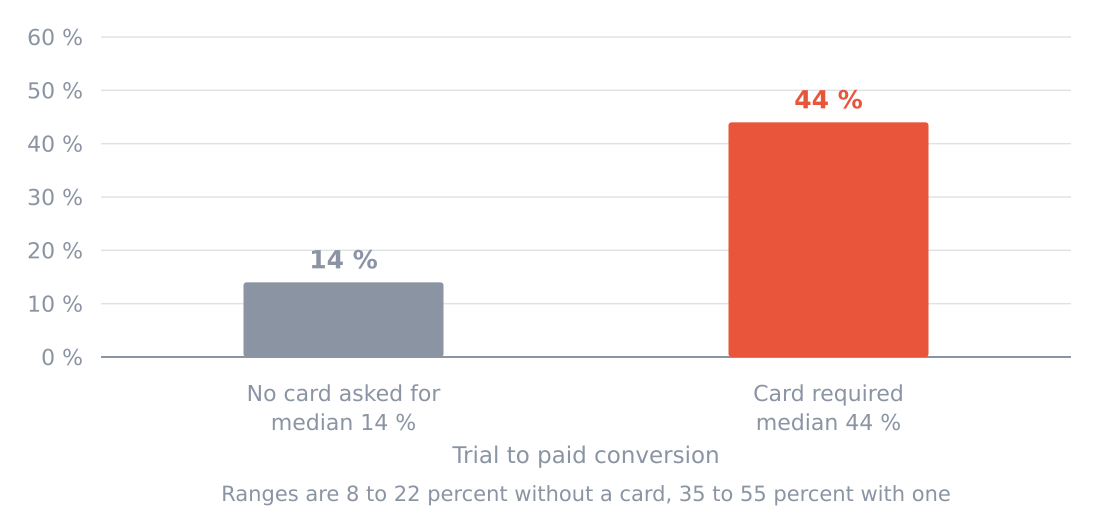
Median 14 percent without a card. Median 44 percent with one.
The ranges are 8 to 22 percent without, and 35 to 55 percent with. That gap is far larger than anything else you can change. Bigger than trial length, bigger than industry, bigger than most of what a conversion checklist tells you to try first.
Where the lines cross
Obviously the card requirement reduces signups. So the question is how many it can cost you before the higher conversion stops paying.
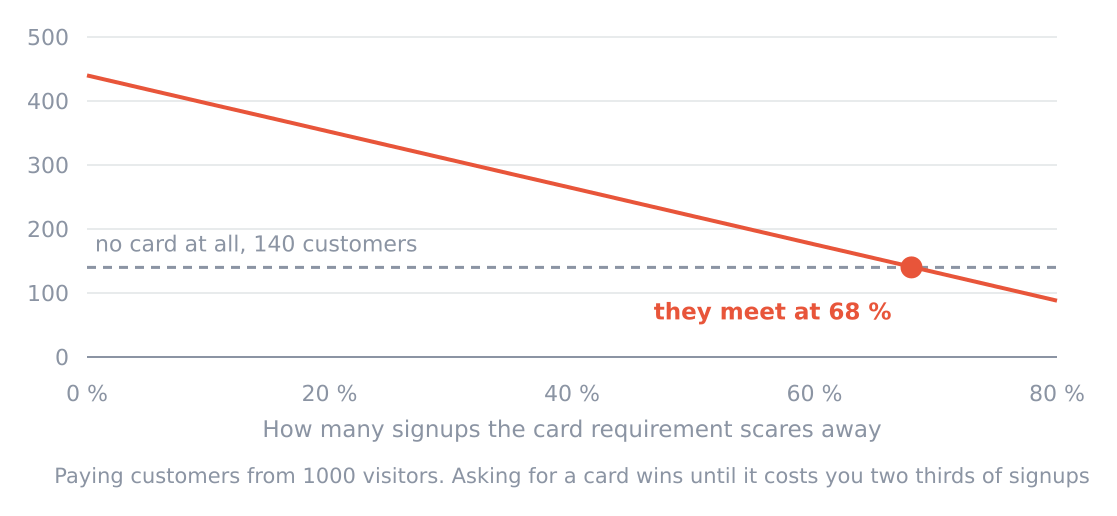
Asking for a card wins until it costs you more than two thirds of your signups.
Take a thousand visitors. Without a card you get, say, a thousand signups and 140 customers. With a card you get fewer signups but 44 percent of them convert.
| Signups lost to the card requirement | Paying customers |
|---|---|
| 0 percent | 440 |
| 30 percent | 308 |
| 50 percent | 220 |
| 68 percent | 141 |
| 75 percent | 110 |
Break-even is at 68 percent. You would have to scare away more than two thirds of the people who would otherwise have signed up before the card requirement costs you money.
Does it scare away two thirds? Reported effects vary and I've seen figures from 30 to 60 percent. All of those are inside the winning range. So on the published numbers, the card requirement wins for most products, and the reason people don't do it's that the signup count is the number they look at daily and the conversion rate is the number they look at monthly.
Why I still don't require a card
Because the arithmetic above optimises for the wrong thing, and this is where I part company with the benchmark.
An opt-out trial converts by default. A meaningful share of those 44 percent are people who forgot to cancel, and you'll meet them again as refund requests, as chargebacks, and as one star reviews. The benchmark counts them as conversions in month one. It doesn't follow them to month four.
I've never seen retention split by trial type in any of these datasets, which is the number that would settle it. Until somebody publishes that, I treat the 44 percent as an upper bound containing an unknown quantity of people who didn't choose you.
There's also a practical point for a small product. Chargebacks are expensive and they count against your processor. A conversion mechanism whose failure mode is a card dispute is a bad trade at 29 a month, and a fine one at 900.
Trial length, which matters less than you think
Fourteen days is what 62 percent of products use. Seven day trials show a 24 percent median conversion against 19 for fourteen days and 14 for thirty.
Shorter converting better isn't because shorter is better. It's that a short trial forces the decision while the problem is still in front of the person, and a thirty day trial gives everybody permission to look at it next week, which is a week that never arrives.
But there's a split in the data worth knowing. Fourteen day trials do better than thirty in opt-in mode. Thirty day trials do better in opt-out mode, because the card is already captured and more time simply means more chance to activate.
So the two decisions interact. If you don't take a card, go short and create urgency. If you do take a card, go long and remove pressure.
What I'd actually do
Start the clock on first real use, not on signup. This was worth about six points of conversion to me and it costs nothing. Somebody who signs up on a Friday and opens the product properly on Tuesday gets their full trial from Tuesday. A person who never starts was never going to buy, so you lose nothing by not counting their week.
Ask for the card at the end, not the start. You get the honest conversion rate rather than the flattered one, and you get to see who genuinely activated.
And don't cut access dead at midnight. Pause the account, keep the data, say so in plain words. Three people have come back to me after more than six months precisely because their work was still there, and none of them would have if I'd deleted it on day fifteen.
0 replies
Sign in to join the discussion
Log in