A tenth of a second was worth 8.4 percent
generalDeloitte and Google ran the study most people cite badly. Thirty seven brands, thirty million user sessions, four weeks, and they isolated mobile page speed as the variable.
A tenth of a second was worth 8.4 percent more retail conversions.
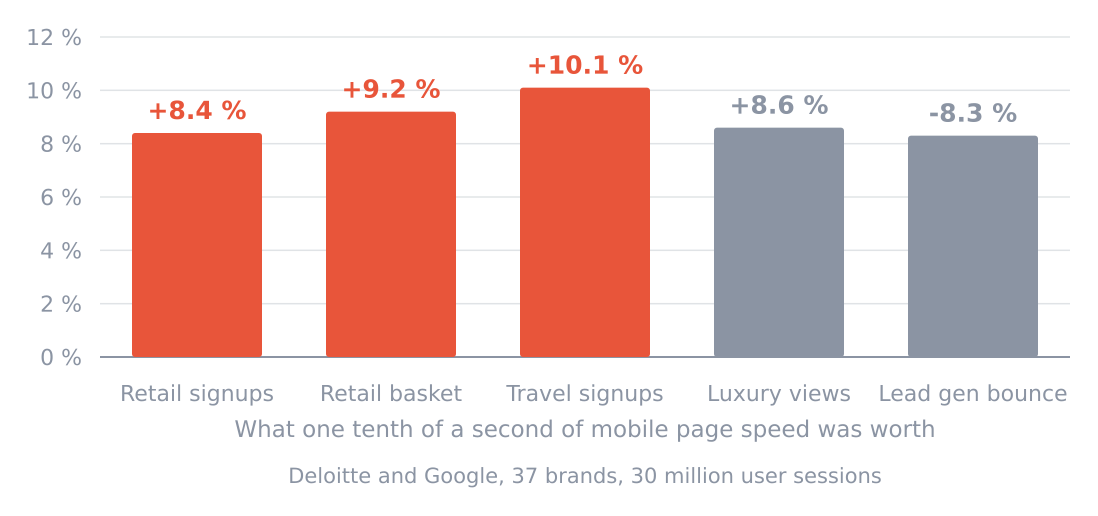
Deloitte and Google, 2020. Isolated speed, not a redesign.
| Measure | Effect of 0.1 seconds |
|---|---|
| Retail conversion | plus 8.4 percent |
| Retail average order value | plus 9.2 percent |
| Travel conversion | plus 10.1 percent |
| Luxury page views per session | plus 8.6 percent |
| Lead generation bounce rate | minus 8.3 percent |
One tenth of a second. A hundred milliseconds. That's less time than it takes to blink and it moved conversion by more than most redesigns do.
Why this is bigger than it sounds
Take a small product. A thousand visitors a month, three percent conversion, thirty signups. Improve mobile speed by 0.1 seconds and you're looking at roughly 32 or 33, which sounds like nothing.
Now hold it for a year and remember it applies to every visitor forever, costs nothing to maintain, and doesn't need a test to prove because somebody already ran the test on thirty million sessions.
Compare that to the alternative uses of the same afternoon. Rewriting your headline needs 4000 visitors to evaluate and might do nothing. Adding a feature takes six weeks. Cutting 100 milliseconds is a known quantity with a published effect size, and it's usually one of about four things.
Where the second actually is
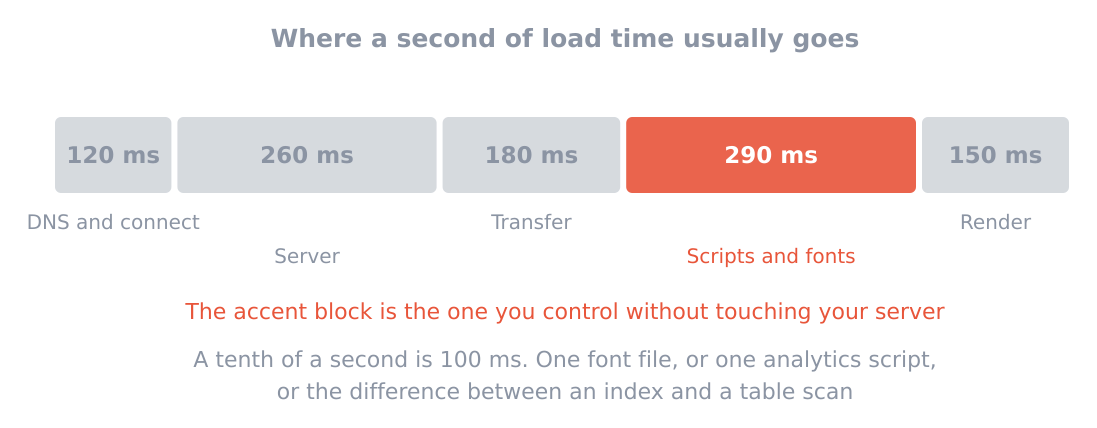
The accent block is the one you control without touching your infrastructure.
Most small sites lose their time in the same places, and it's almost never the server.
Blocking scripts and fonts. Analytics, a chat widget, a font loaded from a third party. Each one is a DNS lookup, a connection, and a file that blocks rendering. Removing one third party font is frequently the whole hundred milliseconds by itself.
Images that aren't sized. Not the file size, the missing width and height, which forces the browser to lay the page out twice.
One query without an index. The classic small product problem, where a table scan is invisible at 500 rows and fatal at 50 thousand.
A framework doing work on the client that could have happened on the server. The most expensive of the four to fix, so check the other three first.
The honest caveats
The study is on retail, travel, luxury and lead generation. It isn't a SaaS study. I use it as directional evidence rather than as a number I'd forecast from, because a person evaluating accounting software behaves differently to somebody buying shoes.
And it's a correlation across sites, not an experiment on one site. Fast sites might differ from slow ones in ways that also drive conversion, which is exactly the confounding problem that ruins most onboarding metrics. The methodology mitigates it by comparing within sites across sessions, but it isn't a randomised test.
What survives both caveats is the direction and the rough magnitude. Speed is worth something, and the something is large relative to how cheap it's to buy.
How to spend twenty minutes on this
Open your own site on a mobile connection, not on your laptop with a fibre line. Then look at what loads.
Count the third party domains. Every one is a connection you're paying for before anything renders. Most small products have between four and nine, and most of them are there because somebody added a tool once and nobody removed it.
Then check whether your fonts block rendering. A web font with no fallback strategy means the text is invisible until the file arrives, and on a bad connection that's most of your load time spent showing nothing.
That's it. Two checks, and between them they cover the majority of the hundred milliseconds the study says is worth 8.4 percent.
The thing I'd argue with
There's a version of this that turns into a hobby, where a founder spends three weeks getting a score from 82 to 97 while nobody buys anything.
The study says a tenth of a second is worth eight percent. It doesn't say the next tenth is worth another eight, and it certainly doesn't say the tenth after that is. You're on a curve with diminishing returns and the cheap part is at the start.
Take the free hundred milliseconds. Then go back to talking to customers.
Sources: Deloitte, Milliseconds Make Millions
0 replies
Sign in to join the discussion
Log in